Average Cost to Hire a Developer in India
Average Developer Cost in India by Experience
| Developer level | Typical experience | Indicative annual salary | Approx. monthly equivalent |
| Junior | 0–2 years | ₹3L–₹6L | ₹25K–₹50K |
| Mid-level | 2–5 years | ₹6L–₹15L | ₹50K–₹1.25L |
| Senior | 5–8+ years | ₹10L–₹20L+ | ₹83K–₹1.67L+ |
| Lead / Architect | 8–12+ years | ₹15L–₹30L+ | ₹1.25L–₹2.5L+ |
The following are planning ranges and do not represent fixed market rates. To understand why the average Indian developer salary might be misleading, let’s look at current salary data.
For instance, according to Glassdoor data from 2026, mid-level software engineers earn around ₹10.95 lakh per year on average, and the estimates for the salary of a senior software developer also differ significantly based on the dataset. The average base salary of leading software developers is approximately ₹18 lakh per annum.
Hourly, Monthly, or Annual: How Are Developers Usually Priced?
You will find a big difference in the number you end up paying depending on the hiring model.
1. Hourly hiring
Often, freelancers and remote workers will request an hourly fee. The model is suitable if you have an intermittent workload, require specialised expertise, or require support in developing the product within a fixed number of hours.
2. Monthly hiring
A dedicated developer, or remote developer, can work on a retainer basis, monthly. This can be a simpler budgeting process in the event the developer is always at work on your product.
3. Annual employment
The salary quoted is typically for full-time workers and is an annual amount. But salary isn’t the same as total employment cost.
Salaries vs. Real Hiring Costs.
Let’s assume that you hire a developer who earns ₹10 lakh per year. These costs do not include any employer-side contribution, benefits, recruitment costs, equipment, software licenses, training, office/coworking costs, paid leave or other overheads of the employment.
This distinction is salient for companies opting to hire developers from India, especially when contrasted with a direct employee or a remote/outsourced developer. Some of an agency’s quoted rates might also include some of the costs that an employer will have to cover separately.
Why Do Developer Rates Vary So Much?
There are several factors that can shift the price a lot:
- Experience: Senior engineers typically earn more than their junior counterparts since they are able to perform architecture, complex debugging, and make technical decisions.
- Rate difference: Expertise in AI/ML, cloud infrastructure, cybersecurity, blockchain, or other niche sectors might set you apart from the more traditional developers.
- The location: Compensation may vary from one high-tech centre to another less densely populated area.
- Project complexity: Different skill sets are needed for a basic website and a scalable SaaS website or enterprise application.
- Hiring Model: Different pricing models for hiring freelancers, employees, dedicated remote developers and offshore development companies.
- Communication and ownership: If the developer has to work in close contact with US stakeholders, has to manage teams, or is in control of the architectural decisions, the communication and ownership costs may be higher.
India vs. US Developer Hiring Costs
The difference in cost is more apparent when compared to US compensation. According to the U.S. Bureau of Labour Statistics, software developers make a median annual salary of $135,980 in May 2025, with 10% of the lowest earners reporting an income of less than $82,460 annually and 10% of the highest earners reporting an income of more than $214,670 annually.
This isn’t to say that an Indian developer is just a low-cost equivalent of a US developer. Comparisons of Skill Level, Responsibilities, specialisation, and Employment Model should be made on an equal basis. But it is another factor in offshore development interest in India and remote engineering teams is the significant disparity in pay.
The cost comparison should then be done with expected expertise, delivery capacity, communication, requirements of the project, etc. of Indian developers, and not just their salary.
Developer Hiring Costs by Type and Experience
When it comes to specialisations, the cost of hiring a developer in India varies significantly from title to title. It’s perfectly normal to have two developers, one a junior web developer and one a senior AI/ML engineer, but their skill sets, roles, time availability, and business value can vary significantly.
The most useful way to consider hiring developers from India for startups and US companies is to take into account their experience and the complexity of the work, at the same time as cost; don’t just pick the cheapest Indian programmer on an hourly basis.
Developer Cost by Role and Experience
| Developer type | Junior | Mid-level | Senior |
| Web developer | ₹3–6 LPA | ₹6–12 LPA | ₹12–20 LPA+ |
| Front-end developer | ₹3–6 LPA | ₹6–14 LPA | ₹14–22 LPA+ |
| Back-end developer | ₹4–7 LPA | ₹7–15 LPA | ₹15–25L+ |
| Full-stack developer | ₹4–7 LPA | ₹8–16 LPA | ₹16–28L+ |
| Mobile app developer | ₹3.5–7 LPA | ₹7–15 LPA | ₹15–25L+ |
| AI/ML developer | ₹5–9 LPA | ₹10–20 LPA | ₹20–35L+ |
| DevOps engineer | ₹4–8 LPA | ₹8–18 LPA | ₹18–30L+ |
LPA = lakh per annum. These are suggestive salary ranges and not fixed ranges. They can be outside of specialised roles.
1. Web Developers
One of the most frequent hires for startups creating websites, portals, ecommerce sites, and web applications is web developers.
A junior web developer usually has the experience to take on specific tasks like making pages, debugging simple issues, and working with existing frameworks.
While senior developers can work with complex applications, optimise for performance, address security considerations, and make technical decisions, mid-level developers can be self-sufficient and handle larger features and integrations.
When the project is fairly simple, hiring more senior developers for each task might not result in any extra value. Sometimes a team consisting of both types of developers is more practical.
2. Front-End Developers
Front-end experts operate on the front end of an app that users access. Common skills are TypeScript, JavaScript, React, Angular, Vue, responsive design, and front-end performance.
A mid-level developer can often be helpful for startups when the product is under a clear direction in design and technology. The more complex the application’s interfaces, performance, accessibility, or the number of components, the more important senior talent will be.
3. Back-End Developers
Back-end developers construct systems that support the front-end (the application or website), such as API, backend databases, authentication mechanisms, business logic, and integrations.
Experienced software developers are required for distributed systems, cloud infrastructure, high-volume applications or complex database architecture, which can make the cost of hiring a software developer in India higher.
If your startup is still a baby with an MVP in its infancy, you might need something more basic, like a mid-level back-end developer. Senior knowledge can assist in minimising architectural and scalability dangers for a platform that’s anticipated to process massive volumes of visitors or delicate transactions.
4. Full-Stack Developers
Full-Stack Developers can work on both the front-end and back-end programs. This makes them very relevant when a startup aspires to hire remote programmers from India without having to establish a huge engineering team in the state right off the bat.
In this position, the junior full-stack developer could require a lot of guidance. The mid-level developer can be the one to own and develop the full features, whereas the senior full-stack developer can be the one to shape the architecture, technology, maintain code quality, and mentor the developer.
It can, therefore, be acceptable for someone with experience as a full-stack developer to be a premium for that person having to be responsible for a wide range of the product.
5. Mobile App Developers
Mobile developers are usually focused on either an Android or an iOS platform or another cross-platform solution like Flutter or React Native.
The appropriate level is highly dependent on the product. For more straightforward screens and functions, it may be best to utilise a junior developer’s ability, but more complex APIs, performance optimisation, payments, security, or integration with device capabilities might require senior skills.
6. AI/ML Developers
AI and machine learning careers tend to pay more due to the need for a more specialised set of programming, mathematical, data management and modelling expertise, and now a growing familiarity with AI tools.
If your startup is trying to use AI in a feature, you may not need to hire an expensive specialist to build a feature that you’re already exploring with AI. However, if the core product relies on the development of a model, recommendation systems, computer vision or NLP, then a seasoned eye can make a significant difference in the production of ML.
7. DevOps Engineers
DevOps engineers are responsible for deployment and cloud infrastructure, automation, monitoring, security, CI/CD pipelines, and system reliability.
A junior DevOps job profile can perform repetitive infrastructure activities while following instructions from the supervisor. Senior engineers are more useful when a business requires scalable infrastructure, observability, disaster recovery, automated deployment or stability in their cloud architecture.
When does paying more really make sense?
Cheap developer is not the same as least expensive!
Let’s say that you are a US startup developing a SaaS solution. It may seem like a good deal to save $10–15 per hour in development. If that inexperienced developer takes twice as long to implement a feature, builds up technical debt, or even needs to be supervised, then the savings can be lost as well.
When you require: When you need a higher-cost senior developer, you might be able to justify it if you have:
Complex system architecture
Specialised technical expertise
Delivering critical features at a faster pace.
Security-sensitive development
Cloud or infrastructure knowledge
AI/ML implementation
Technical leadership
Codebase modernization
Mentoring for a larger engineering team
Junior and mid-level developers may be able to do the job well for easier, well-defined tasks if the documentation is available.
What Should Startups and US Businesses Budget For?
When hiring Indian developers, you should not only compare their rates based on their job title. Identify product requirements, technology requirements, anticipated workload, and level of ownership.
In a startup, one of the possible structures could be having a mid-level full-stack dev who will be handling the day-to-day product development, but will be backed by senior experts when it’s a problem of architecture or very technical. A larger US business, on the other hand, may opt to go for a team of dedicated front-end, back-end, QA, DevOps professionals and technical leadership.
This is where offshore development in India can be more than a cost-saving effort – the goal is to create the right mix of skills needed for the project but at a development cost that is consistent with the projected business benefit.
What Factors Affect Developer Costs in India?
No fixed price for businesses seeking to hire developers in India. The price of a developer depends on the kind of developer, work involved, and the approach taken for the engagement.
But recent hiring trends also illustrate the importance of experience and skills, as foundit found that hiring in India’s IT industry rose 30% in 2025, with a focus on AI, cloud, data engineering, and cybersecurity skills.
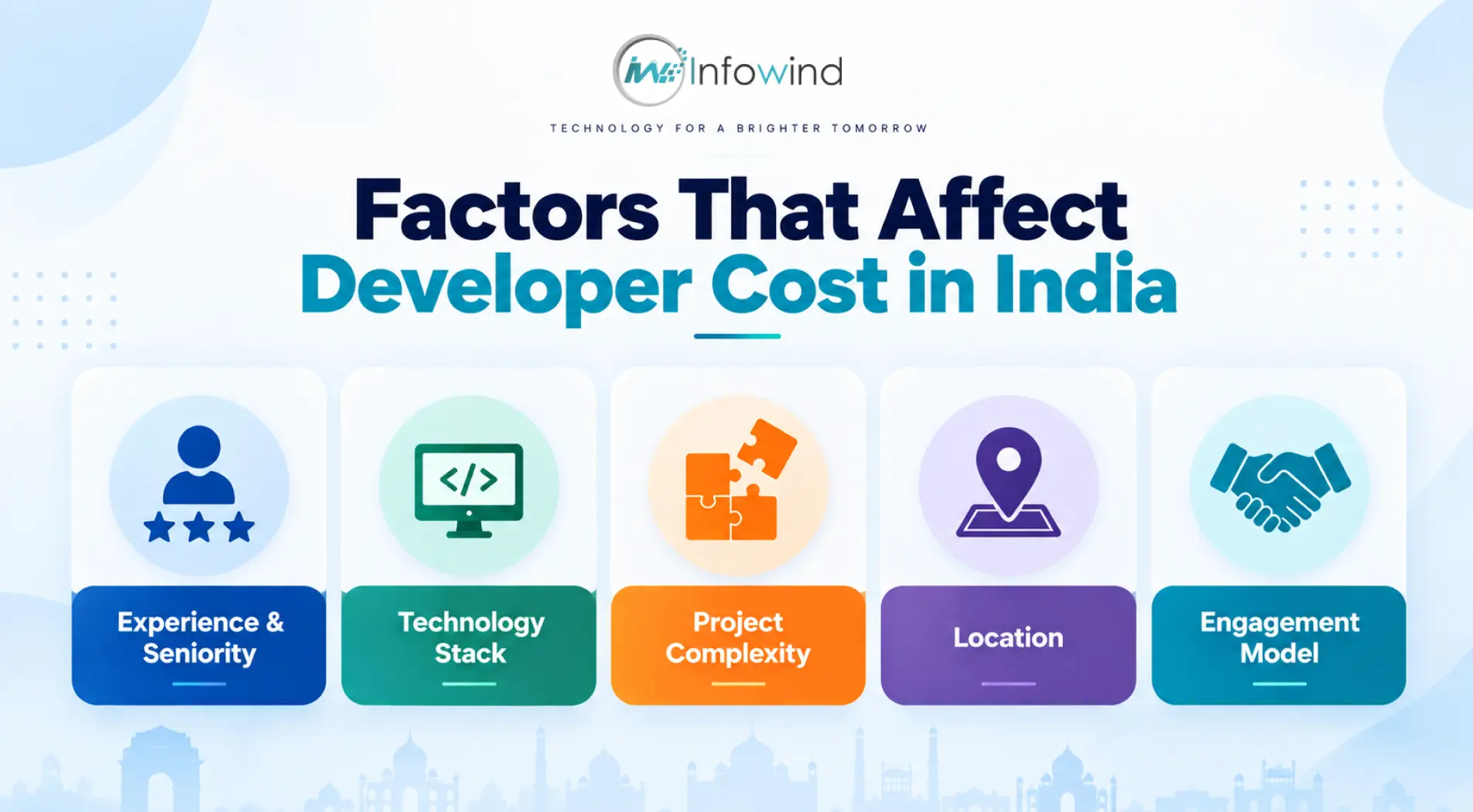
Below are the major factors to be taken into account before putting in a budget for development.
1. Experience and Technical Expertise
Experience is one of the major cost drivers. A junior developer can take care of simple work, whereas a senior engineer can make architectural decisions, solve complex technical issues and mentor junior developers.
An additional premium may be given for specialised skills. For instance, according to Foundit’s salary data, AI professionals can expect significantly wider salary ranges compared to many IT-related positions, especially at higher levels of experience, in 2025.
2. Technology and Programming Stack
The technology stack also has an impact on hiring Indian developers. Broadly, there are technologies that are easier to find talent for, like common ones such as AI/ML, cloud, cyber, blockchain, or enterprise-specific platforms; and there are technologies that are more specialised where the talent pool is smaller, such as a technology focused on AI/ML or blockchain.
Once again, it’s not just about who has the lowest rate; it’s about the skills this project actually needs.
3. Project Complexity
The building requirements of a basic business website are really different from those of a multi-tenant SaaS platform.
Complex projects can include:
Several integrations/APIs
Advanced databases
Cloud infrastructure
Security controls
Real-time functionality
Scalable architecture
This can be achieved through AI or data processing.
The more complex the development, the more advanced the developers and the more engineering jobs.
4. Project Duration
The pricing models for a two-month MVP, a six-month product build and a long-term software development program can vary widely.
If the project is short, it may be feasible to have it done as a project or by the hour. It is possible to get more predictable budgeting from a dedicated developer or team of developers if they are available monthly for continuous development.
5. Location Within India
The amount of Developer compensation differs from city to city in India. Bengaluru, Hyderabad, Pune, Chennai, Mumbai and Delhi-NCR have always been key technology hubs, a nd Tier-2 cities are now emerging as key talent markets.
Foundit found that Tier-2 cities would account for almost 20% of India’s STEM jobs in 2025, and cities like Ahmedabad and Jaipur would be key STEM hiring destinations.
This does not imply that businesses in search of offshore development in India have to restrict their search to the largest metros.
6. Full-Time, Part-Time, or Project-Based Engagement
Your hiring model directly affects the cost.
| Engagement model | Typically suitable for |
| Full-time | Long-term product development |
| Part-time | Ongoing but limited workload |
| Hourly | Flexible or specialised work |
| Project-based | Clearly defined deliverables |
| Dedicated team | Larger or continuously evolving products |
7. Individual Developer vs. Dedicated Team
If you hire a developer in India directly, you actually pay them for their work and any other employment costs involved.
With a dedicated development team, you can have development, QA, DevOps, project management, and technical leadership without hiring each one as an individual. A dedicated development team is more expensive in total but can offer development capabilities, QA, DevOps, project management, and technical leadership without having to hire each one separately.
8. Industry Expertise
If you have knowledge of a particular regulated or niche market, such as fintech, healthcare, e-commerce, or logistics, and can bring this in addition to your coding ability, you might attract a higher price.
That experience can help to shorten the amount of time it will take to grasp what businesses need and avoid costly implementation errors.
9. Communication and Time-Zone Requirements
If your company is considering employing remote developers from India, you might want to determine how communication will take place. The developer must be available as necessary for frequent meetings across the US time zone, must have overlapping hours with other developers or must communicate directly with customers; if this is the case, the developer’s availability should be agreed upon in advance before hiring.
As teams grow distributed, communication skills are also gaining prominence; As per Michael Page’s 2025 Talent Trends India survey, communication skills were one of the top hiring priorities reported by employers.
10. Security, Compliance, and Infrastructure
Protecting financial data, health-related data, enterprise systems, or IP-sensitive data may necessitate even more security practices, access controls, testing, monitoring, compliance processes and infrastructure.
These needs can add to the overall project cost, irrespective of the hourly price of the developer.
Why the Lowest Hourly Rate Can Cost More
Consider two developers:
Developer A: $20/hour, but takes 100 hours to complete a feature = $2,000
Developer B: $35/hour, but completes the same feature completed in 50 hours = $1,750
The higher the hourly rate, the higher the project cost is not necessarily.
That’s why it’s crucial to compare the total cost, delivery time, quality, technical ownership, and rework, and not just the advertised price per hour when you’re hiring a remote software developer. The benchmark to consider is not the lowest number on the quotation but the cost of the outcome that will be achieved.
Ways to Hire Developers in India
The model that works best for you will vary based on your need for control, the length of time you require the developer and whether you have technical leadership already in place. When hiring developers in India, it is not just about the price, but also about the hiring approach that aligns with the risk level, complexity, and timeline of a project.
India is still able to cater to a significant international tech market. NASSCOM’s forecast for FY2025 exports from the technology industries is at $224.4 billion, and the total technology industry workers are approximately 5.8 million. That spread provides various options for US companies and startups to tap into India’s engineering resources.
Ways to Hire Developers in India
The standard methods to hire a developer in India are: hire a freelancer, hire an in-house developer, hire a dedicated developer or hire a developer company. Businesses have various problems solved with each model.
Quick Comparison: Which Hiring Model Fits?
| Hiring model | Cost | Flexibility | Scalability | Control | Management required | Best use case |
| Freelancer | Low–Medium | High | Low–Medium | Medium | High | Short, well-defined projects |
| In-house developer | Medium–High | Medium | Medium | High | Medium | Long-term product ownership |
| Dedicated developer | Medium | High | High | High | Medium | Ongoing remote development |
| Development company | Medium–High | Medium–High | Very High | Medium | Low–Medium | Complex products and complete teams |
1. Freelance Developers
If you require certain skill sets that you can’t find in an employee, freelancers will be available.
For instance, a startup may outsource its software development to India for a three-month period of time to create an MVP, redesign a website, build a specific API integration or resolve some issues in an already developed application.
When freelancers have their say:
- Short-term projects
- Clearly defined deliverables
- Temporary workload increases
- Specialised one-off tasks
- MVPs and prototypes
- Bug fixes/feature development
Advantages
There is flexibility; that’s the main advantage. No need to commit to a permanent position if you want to work part-time or full-time. When you have technical direction in-house, freelancers can be helpful too.
Limitations
There is typically a trade-off in increased management responsibility. Requirements, communication, quality checks, documentation and coordination may have to be performed by you.
Another aspect of risk is the possibility of a continuity issue if the freelancer is unavailable or no longer working on the project.
Ideal for: small companies who have a clear problem to solve, and at least one member who can manage the development in-house, or for startups.
2. In-House Developers
An in-house developer is a person who will be a part of your organisation and will be working as a full-time employee. This is often the most direct request for control of priorities, processes, communication and IP.
Of course, the pay rate is just part of the cost. Other employment-related expenses that employers might need to consider include recruitment, benefits, equipment, software, leave, training, office furniture and facilities, and other expenses.
What are the benefits of in-house hiring?
It can be beneficial when:
- In today’s digital age, software plays a crucial role in your business.
- You anticipate that the project will be ongoing over the course of several years:
- The developer should have a strong understanding of internal systems.
- A desire for long-term ownership of the product.
- This is where the engineering team will play a key role within a company.
Having direct employees in a country can offer a significant amount of control, but at the same time demands more operational and HR structures for a US company looking to maintain a long-term engineering presence in India.
3. Dedicated Developers
There is a third model for a developer, intermediate between traditional employment and project outsourcing. You hire a developer who is assigned to your project, usually full- or long-term, and the provider takes care of employment or operational infrastructure.
This is especially true if businesses are looking to engage remote developers from India but don’t require a full hiring infrastructure.
The number and seniority of developers needed can be specified and can be changed as the product progresses.
Why are startups relying on dedicated developers?
Suppose a SaaS business in the USA that requires:
- One full-stack developer
- One front-end developer
- One QA engineer
The company can hire a dedicated team from a provider, rather than creating a separate Indian entity and hiring its own staff.
This model provides a level of continuity which is not usually achieved in a freelance hiring model, and can be more scalable than a single recruitment approach.
Ideal for: startups, SaaS businesses and US companies that require continuous development capacity but are not looking to set up a full engineering team in India.
4. Development Companies or Agencies
A development company offers various roles, not just one developer. A team can consist of a developer, UI/UX designers, QA engineers, DevOps, project managers, and technical leads, all depending on the provider.
This is especially helpful if you need to hire software developers in India for a product that requires a number of different disciplines.
The good/service you’re buying.
An agency’s cost is much more than developer time. The engagement can be accompanied by:
- Project management
- Quality assurance
- Technical leadership
- UI/UX capabilities
- DevOps and cloud assistance
- Communication and reporting
- Infrastructure and operational support
That may lead to having a higher headline rate than hiring one individual freelancer but may lessen the coordination the client needs to carry out.
When is an Agency the Better Fit?
Imagine a US business is creating a fintech application. The project needs to include back-end engineering, mobile development, security, QA, cloud infrastructure and project management.
Independent hiring of each specialist can cause a lot of coordination efforts.
They can provide those capabilities in a single engagement, which may streamline delivery through a development company.
This model is typically more suitable for:
- Complex applications
- Enterprise software
- Large MVPs
- Multi-platform products
- Long-term development programs
- Projects with several technical disciplines
The approach of team working is also supported by the existing technology ecosystem in India. India’s technology industry is transitioning from the traditional staff augmentation model towards delivering outcomes and value, as per NASSCOM’s 2026 Strategic Review.
What Model to Use?
There is no one-size-fits-all approach to hiring indian developers.
Work completed by a freelancer if there is a definite task that is not extensive. Opt for in-house hiring where engineering is a critical long-term asset that you want to keep in-house. When you have an ongoing remote capacity need that requires more flexibility, it works very well when you have a dedicated developer or a team. When there are several roles, technical leadership, QA and project management needs, then a development company becomes more relevant.
The important thing to remember is not the hourly rate that the developer is advertising, but the overall cost of the desired outcome. A lower-cost individual might need more supervision, and in the end more management time than a higher-priced dedicated team with established processes.
An appropriate model for businesses wishing to employ a remote software developer will therefore be one that offers the necessary expertise, control, scalability, and delivery support while remaining economically viable, with a total cost of delivery.
How to Hire a Developer in India Without Overpaying
Getting a good rate is just one element of effective hiring. When looking for a developer in India in order to avoid overpaying, keep in mind the value provided for the overall project price, not just the hourly rate.
The carefully planned hiring process will help you fairly compare developers and prevent costly errors.
1. Define the Project Scope
First, take note of the things that you require to build. Describe the key aspects, platforms, integrations, anticipated users, timeline, and technical considerations.
The more clearly defined the scope, the simpler it is to estimate development time and make a comparison between developers/companies.
2. Identify Skills and Experiences needed
Do not just hire the most experienced developer that you can find! Use experience to match the complexity of the work.
For instance, a basic business site might not need a senior architect, but a monetary platform with sophisticated combinations and security protocols likely will.
3. Set a Realistic Budget
Use your requirements to establish a budget range before approaching candidates. Consider development, testing, project management, infrastructure, maintenance and scope changes.
This can help you when you’re assessing proposals, rather than just the hourly rate quoted.
4. Choose the appropriate hiring model
Determine what kind of developer you need: freelancer, full-time worker, dedicated developer or a development company.
If you have a short-term project, you might get a freelancer, while if you are developing a product that continues to evolve, you may need a team. Selecting the appropriate structure can avoid the expense of acquiring the skills that you don’t require and/or the realisation that your team lacks the skills you need at the mid-project point.
5. Shortlist Developers or Companies
Do not judge candidates on experience alone, but on experience that is relevant.
As you look to hire developers from India, keep in mind:
- Relevant technology expertise
- Industry experience
- Similar project experience
- Availability
- Communication capabilities
- Client references
- Security practices
- Development and testing processes
6. Evaluate previous work and Portfolios
A portfolio provides proof of what a developer or company has accomplished.
Search for projects that are similar to your project. When creating a mobile app, for instance, look at previous mobile products instead of mostly at examples of unrelated web development.
Inquire about what the developer did specifically on each project. A company can highlight a product that had 10 engineers involved in its development, but the person you’re interviewing was not on the core architecture of the product.
7. Carry out a Technical Assessment
A résumé is not the best way to learn about a candidate.
Assess: Depending on the role, evaluate:
- Problem-solving ability
- Coding practices
- Architecture knowledge
- Debugging approach
- Testing practices
- Security awareness
- Understanding of your technology stack
In advanced roles, do not rely solely on theoretical questions; instead, talk about actual scenarios.
8. Evaluate Communication and Collaboration
Just because you can do something tech-wise doesn’t mean you can do it as part of a remote team.
Employers of developers from India should set expectations regarding working hours, overlap of meetings, documentation, turnaround time, project updates and escalation.
If a developer can effectively communicate technical issues and identify them early, then it is possible to avoid misunderstandings and project delays.
9. Explain the Contract Before Development Starts
Make essential commercial/legal conditions explicit.
The agreement must cover in detail:
- Scope and deliverables
- Payment schedule
- Intellectual property ownership
- Confidentiality
- Ownership and access to source code
- Security responsibilities
- Data handling
- Support and maintenance
- Termination terms
- Change-request procedures
When dealing with multiple jurisdictions, having professional legal advice as to applicable contracts and IP arrangements can be especially beneficial to US companies.
10. Start With Milestones
Do not commit to a big project that is an “all or nothing” proposition.
Divide development into measurable steps, each having tangible deliverables and acceptance criteria. This will enable both sides to spot technical or communication issues before they arise and give them a better-regulated means of managing the budget.
Mistakes That Can Make Hiring More Expensive
Choosing Solely on Price
All developers are not created equal, and a $15/hour developer isn’t necessarily the cheaper option compared to a $30/hour developer. Productivity, quality, supervision and rework variations can result in a significant change in the final cost of the project.
Employing Without Technical Verification
But a good CV and an impressive portfolio doesn’t mean that the person has the skills your project needs. Other evidence includes technical interviews, assessments, references and a discussion of portfolios.
Poorly Defined Requirements
These ambiguous requirements can result in scope conflicts, unanticipated expenses, and revisions. Establish an expected outcome prior to development.
Ignoring Communication
Time-zone overlap, documentation, meeting availability and responsiveness are significant factors with distributed teams. These expectations should be identified before any issues arise, not as part of the hiring process.
Not checking previous work.
Always check if previous projects show the skills you are looking for. Where applicable, request references and confirm the candidate’s proven work.
Failure to clarify ownership
Determine ownership of the resulting software, source code, designs, documentation, etc., before disseminating proprietary code, data, or product information.
The purpose is NOT to look for the “cheap” developer, but rather to look for the appropriate developer at a commercially viable overall price. The key to hiring Indian developers for US businesses is a disciplined hiring process that goes beyond the lure of a great price tag, ensuring they possess the necessary skills and reliability to meet project requirements.
Conclusion
The price to hire a developer in India depends on more than an hourly or annual rate. Several factors can affect your investment, such as experience, technical specialisation, project complexity, engagement model, and security requirements. India has many alternatives to choose from, from freelancers and individual developers to dedicated teams and full-service development companies for startups and US businesses.
It will depend on the scale of your project, the timeframe you have and the expertise you need. Rather than taking the cheapest quote, consider the technical ability, communication, work done before, ownership terms and overall delivery costs. Having clear requirements and well-defined milestones is one way in which businesses can hire remote developers in India while having more control over quality, budget, and the long-term development goals.