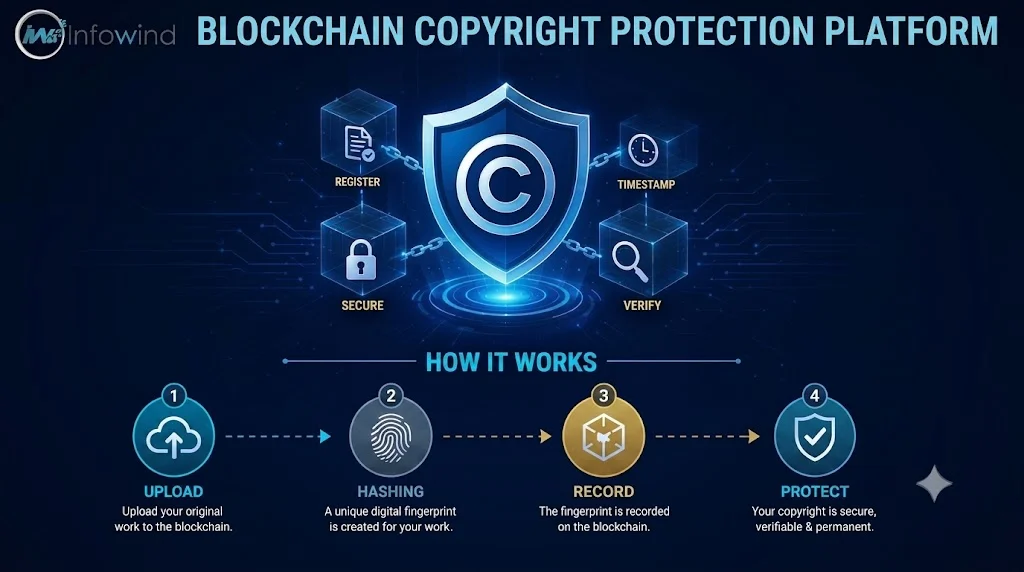
The creation, distribution, and duplication of digital content have never been easier, creating a new challenge for businesses seeking to safeguard their intellectual property. Unauthorised digital consumption in 2025 was on a massive scale, with MUSO’s piracy research revealing 185.6 billion visits to pirated websites for TV, film, publishing, software and music in the year.
While traditional copyright can create legal ownership rights, businesses must still be able to efficiently prove the existence of a digital asset, establish ownership, track rights and manage licensing. This is where a Blockchain Copyright Protection Platform can come into play.
By incorporating a digital asset’s cryptographic hash, blockchain technology can provide tamper-resistant, time-stamped records that help establish evidence of the asset’s existence and integrity without requiring the entire file to be placed on-chain.
This guide delves into the mechanisms of blockchain copyright protection, its applications in the business world, key features, security concerns, and how enterprises can create a robust and scalable solution for managing digital IP.
What Is a Blockchain Copyright Protection Platform and How Does It Work?
A Blockchain Copyright Protection Platform is an application that implements blockchain technology to generate verifiable and time-stamped documentation of digital content like music, videos, pictures, software and documents.
The process is generally as follows:
- Upload: An online file is uploaded by the creator.
- Hashing: The system produces a cryptographic hash (or digital fingerprint) for the file.
- Registration: The hash and associated metadata are saved on a blockchain.
- Timestamping: The blockchain provides a permanent record of the transactions showing when they were registered.
- Verification: The original file can be re-hashed later and used to verify the integrity of the file stored in the blockchain.
The important point is that the entire copyrighted file need not be stored on-chain. However, WIPO defines a blockchain IP system that records a cryptographic hash and is proof of the existence and integrity of a work without revealing the work itself.
This makes blockchain useful in copyright management, DRM, ownership verification, and even Blockchain in intellectual property, but it does not bypass existing copyright laws and registration systems; at the same time, it complements them.
Is Blockchain Better Than Traditional Copyright Protection?
Blockchain is not a substitute for copyright. Instead, Blockchain Copyright Protection can enhance the creation, storage and evidence of digital works’ rights.
Traditional copyright protection is still vital. For instance, in Canada, copyright protection for an original work normally arises upon creation and fixation in tangible form, and can be evidenced by registration with CIPO. In the USA, the U.S. Copyright Office is where eligible works can be registered by creators.
So, where does Blockchain IP Protection fit in?
| Traditional Copyright | Blockchain Copyright Protection |
| Legal rights under copyright law | Tamper-resistant digital records |
| Legal rights under copyright law | Tamper-resistant digital records |
| Registration through authorised systems | Blockchain-based timestamping |
| Manual evidence management | Cryptographically verifiable records |
| Conventional licensing workflows | Potential for smart-contract automation |
| Centralized records | Distributed transaction history |
The benefit is easily verifiable traceability. According to WIPO, blockchain can be used to add a cryptographic hash of a work to its record, allowing for evidence to be provided that the content was the same at a specific time.
In the business world, this translates to blockchain being able to support Copyright Management Software (CMS) and Digital Rights Management Software (DRM).In the business context, this implies that blockchain can be used to add a layer of ownership verification, date stamping, license tracking, and asset integrity to Copyright Management Software (CMS) and Digital Rights Management Software (DRM).
Why Are Businesses Using Blockchain for Intellectual Property Protection?
Protecting IP is no longer just a matter of ownership; it’s a matter of efficiently proving, tracking, and managing rights, too, for businesses that create, license, or distribute digital assets.
There are several of these challenges that a blockchain approach can help with:
- Traceable record: The Blockchain can produce a traceable record for a digital asset.
- Quick verification: Once a registered hash is generated, it can be compared with the file at a later stage to check file integrity.
- Clear rights management: Ownership, licensing, and transaction histories may be more easily audited.
- Automated licensing: Smart contracts can support predefined licensing terms and payment workflows.
- Improved IP traceability: Companies will be able to keep IP trails throughout the life of an IP asset.
WIPO has listed possible applications of blockchain in IP management such as authentication through ownership, payment of royalties, licensing, and digital rights management.
For creators and enterprises, it can be a valuable aspect to complement traditional copyright protection systems. A good system can also be connected to Copyright Management Software and Digital Rights Management Software, which allows the registration, verification, licensing and asset tracking to be done together in one workflow.
This is not a substitute for copyright law, but an additional layer of technology that can help to facilitate more transparent, traceable, and efficient digital IP protection.
Why Are Businesses Using Blockchain for Intellectual Property Protection?
An IP asset is not just a legal asset to creators and businesses; it can also be a major revenue stream. It’s hard to keep track of ownership, access to the asset, as well as the conditions of access, and whether they are paying the right royalties.
That’s where Blockchain for IP Protection can provide a new level of transparency.
What are some of the problems in the business that Blockchain can solve?
A robust Blockchain IP Protection platform can assist businesses in:
- Create tamper-resistant ownership and transaction records.
- Check the authenticity and source of digital assets.
- Monitor for licensing activity and rights to be used.
- Minimise manual rights management procedures
- Keep traceable ownership records.
- Enable automated licensing and royalty workflows.
According to research done by WIPO, blockchain is one of the technologies that could help to manage IP rights, track ownership, verify the source, manage digital rights, and distribute royalties. It says that blockchain can make licensing transactions more transparent and help enhance the accuracy of royalty payments.
This can help a media company, publisher, SaaS company, or content creator leverage and manage their fragmented rights information into a more structured digital workflow.
One thing to note: blockchain isn’t here to replace copyright law; it’s here to coexist with it. In the USA, the Copyright Office is the only official body to register copyrights.
The opportunity is to integrate existing legal protection with Blockchain Software Development to simplify ownership, licensing, and digital rights information.
What Are the Real-World Use Cases of Blockchain Copyright Protection?
Whether it’s music, publishing, software, or AI-generated content, businesses are finding new ways to use Blockchain Copyright Protection to enhance digital asset registration, verification, licensing, and tracking. WIPO has come up with some potential blockchain applications in relation to IP, such as in relation to the process of tracking the provenance of IP, IP licensing, IP rights management, and IP royalty processes. WIPO: Blockchain and IP.
To see where the technology might be used:
| Industry | What Blockchain Can Help With | Key Benefit |
| Music & Media | Ownership, licensing, royalties | Transparent rights management |
| Publishing | Attribution, timestamps, licensing | Verifiable content history |
| Photography | Ownership and provenance | Digital asset verification |
| Software | Source-code records, licensing | IP traceability |
| Digital Art & NFTs | Ownership history, royalties | Creator authentication |
| AI Content | Provenance and metadata | Content traceability |
| Enterprise | Document verification | Tamper-evident records |
How is Blockchain going to safeguard Music, Video, and Podcasts?
Music labels, independent artists, production companies, and streaming services can leverage blockchain IP Protection for establishing verifiable records linked to digital media.
Potential applications include:
- Documentation of ownership and creation
- Licensing information
- Distribution history
- Royalty workflows
- Content provenance
Ideal for: Music labels, streaming platforms, independent creators, production companies and digital media marketplaces.
Would Blockchain be a help to Publishers in protecting Books and Articles?
Publishers can record proof of books, articles, research papers and other digital publications on the blockchain.
A Blockchain Copyright Protection Platform can be utilised to connect a work to a cryptographic fingerprint and date, safeguarding an extra layer of control and approving content.
Ideal for: Academic platforms, publishers, research institutions and digital publishing companies.
How can photographers leverage Blockchain to, in a way, confirm digital ownership?
Blockchain can help to bolster asset transparency for photographers, stock-image providers, and digital artists alike.
A file’s cryptographic hash can be stored as part of its registration, along with other metadata. In case a file is asked for in the future, the asset can be re-hashed and checked against the original blockchain record.
Ideal for: Creative studios, stock-image sites, creativity companies, and digital marketplaces.
Will Blockchain be able to Safeguard Source Code and Software IP?
Software companies can tap into blockchain records of source code versions, software licensing details and other useful software IP.
It can be used alongside existing repositories and Copyright Management Software as an extra record of assets that is tamper-resistant.
These features are available to businesses creating custom platforms, which can be incorporated into safe dashboards and asset-management systems via expert web development solutions.
Ideal for: SaaS companies, software publishers, technology startups and enterprise software vendors.
What is the role of Blockchain in the NFT and Digital Art Industry?
NFTs have already shown the potential of blockchain to record the transparent history of token creation and transfers. In the digital art context, this can be utilised for creator authentication, ownership verification, and royalty workflows.
But there is an important caveat: the ownership of an NFT doesn’t necessarily imply copyright ownership of the artwork itself. Copyright ownership and licensing rights will be based on the applicable agreement and law.
Ideal for: Digital Artists, NFT Markets, Creative Platforms, and Web3 Enterprises.
Will the Blockchain be able to monitor the ownership of AI-generated content?
Generative AI is raising new questions about authorship, provenance, and ownership. According to the U.S. Copyright Office, copyright protection requires a level of human authorship, and prompts do not, in general, constitute the level of human authorship that is required to protect the copyright. Artificial Intelligence and Copyright, U.S. Copyright Office.Copyright and Artificial Intelligence, U.S. Copyright Office.
Blockchain can be used to back new work processes to record:
- Creation events
- Human contributions
- Asset versions
- Metadata
- Provenance information
- Licensing activity
Ideal for: AI content platforms, media companies, creative businesses, and businesses leveraging generative AI.
What are the possibilities for Enterprises to leverage Blockchain in Document Verification?
For enterprises, there are potential applications such as contracts, certificates, intellectual property records, and other crucial digital documents where Blockchain Document Verification can be applied.
Instead of putting sensitive documents directly on a public blockchain, organisations can securely store documents using appropriate infrastructure and record a cryptographic fingerprint, which can be used for verification at a later stage.
Ideal for: Enterprises, LegalTech providers, publishers, professional-service organisations and businesses that require high-value digital records.
The common theme with all these use cases is the need to develop a secure digital record that doesn’t unnecessarily reveal the underlying asset. Blockchain for Smart Contract Development protection can be integrated with a database, API, cloud infrastructure, secure storage, and a user-facing application with the right architecture to build a comprehensive copyright management ecosystem.
What Features Should a Blockchain Copyright Protection Platform Include?
A Blockchain Copyright Protection Platform must be more than just blockchain connectivity. It should integrate the copyright registration, digital asset management, verification, licensing, security and analytics features in a single workflow.
The following capabilities offer a solid foundation for creators, publishers, SaaS companies, media businesses, and enterprises, but will vary based on industry.
Creator Features
Creators should be able to register and control their IP without having to be technical or have blockchain knowledge.
| Feature | Purpose |
| Digital Asset Upload | Register music, images, videos, documents, software, and other files |
| Blockchain Timestamping | Create a verifiable time-based blockchain record |
| Ownership Certificate | Provide a convenient record associated with the registered asset |
| Asset Verification | Compare an asset’s current hash with its registered record |
| License Management | Manage permissions and usage rights |
| Royalty Tracking | Monitor royalty-related transactions and records |
| Wallet Integration | Connect blockchain wallets when required by the business model |
The interface should make blockchain complexity irrelevant and offer content uploading, registration, and verification processes that are intuitive and familiar.
What elements should be part of the Admin Dashboard?
Administrators must have visibility over users, assets, transactions and compliance activities.
Key capabilities include:
- User and role management
- Verify and review assets.
- Blockchain transaction monitoring
- Smart contract monitoring
- Reports and analytics
- Audit trails
- Compliance management
- Conflict and support processes
These features can enable the platform to become a more comprehensive Copyright Management Software than a mere blockchain registration system.
What Enterprise Features are Most Important?
Large organisations generally will need:
- Restricted access to various departments and partners.Access control based on roles for various departments and partners.
- Integrations with existing content and rights-management systems for APIs.
- A multi-user/multi-organization support is provided.
- Blockchain Document Verification
- The marketplace and licensing integrations.Marketplace and licensing integrations.
- Reporting and auditing features at an advanced level.
What Technical Capabilities Power the Platform?
The development of Blockchain Software will usually involve a combination of:
Cryptographic hashing → Blockchain records → Smart contracts → Secure storage → APIs → Database → Monitoring
Sensitive files can be stored in suitable off-chain storage, and smart contracts can facilitate the licensing, transfer or royalty processes as defined a priori.
From the start, security should be embedded in the architecture by implementing encryption, robust authentication and access controls, secure key management, monitoring, and smart-contract testing.
The motive isn’t just putting blockchain in there for the sake of it. Immutable, traceable, verifiable, or programmable rights management adds business value and should be incorporated into a well-engineered platform using blockchain.
How Does a Blockchain Copyright Platform Verify Ownership?
The primary benefit of having blockchain-based copyright protection is the capability to establish a verifiable digital record linked to an asset. The platform will not only base everything on a centralised database, but it will also have a record of the asset using cryptographic hashing and blockchain transactions.
The process normally consists of five stages:
Step 1: Upload and Identify the Digital Asset
The creator uploads a piece of content like a file, such as a photograph, video, music track, document or software asset. It can be linked to relevant metadata, such as creator information, asset type, and registration information.
Step 2: Generate a Cryptographic Hash
The system creates a cryptographic hash, a “fingerprint” that is a fixed-size digital number produced from the asset. The same file should have the same hash value when applied to the same hashing algorithm.
Step 3: Record Hash and Metadata on Blockchain
Instead of public storage of the entire copyrighted file, the platform could store the hash and proper metadata on the blockchain. This can be used to maintain privacy and provide a verifiable reference.
Step 4: Create a Timestamped Blockchain Record
The outcome of the blockchain transaction is a traceable record linked to the event of the registration. According to WIPO, this kind of blockchain-based timestamping could be a means of establishing “proof” of the existence of a digital work at a specific time. (wipo.int)
Step 5: Verify the Asset Later
If verification is to be performed, the platform re-hashes the uploaded file and checks the hash value against the corresponding record in the blockchain.
What Happens If the Original File Is Modified?
Changing the file’s contents will typically yield a hash that is different. The mismatch can trigger a warning on the platform that the asset that was submitted does not match the one that was previously registered with the digital fingerprint.
Blockchain Document Verification and digital asset verification are valuable parts of a larger Blockchain Copyright Protection Platform.
Why Choose Infowind Technologies for Blockchain Development?
Creating a Blockchain Copyright Protection Platform is not just about integrating blockchain; it’s about developing robust application architecture, ensuring secure coding, crafting user-friendly interfaces, and providing post-launch support. As mentioned in the current company profile, Infowind Technologies has been serving clients with end-to-end software development services for 20 years and has 200+ technicians and 2,000+ projects delivered.
From web development to mobile, from full stack to UI/UX, APIs to cloud solutions, our expertise and skills can contribute to the creation of intricate digital systems that businesses need.
Infowind Technologies can assist you in bringing your idea to fruition and transforming it into a production-ready solution that is secure, scalable, and designed to meet the needs of your business.
Planning to Build a Blockchain Copyright Protection Platform?
The key ingredients to building a successful and effective product from the concept are blockchain architecture, application development, security, and user experience. Infowind Technologies can assist companies in designing and developing blockchain solutions that are tailored to their copyright, digital asset, licensing and verification needs.
Looking for a dive into the technical aspects? Read our next guide on How to Build a Blockchain Copyright Protection Platform, where you will learn about architecture, technology stack, development process, smart contracts, security, the time it will take and the costs involved.