
How Virtual Reality (VR) Improves Patient Care in Modern Healthcare

September 8, 2026

Table Of Content

Think of a medical student practising a complicated procedure without endangering a real patient, and a patient in pain using a relaxing virtual setting to help with their discomfort. Now it’s not science fiction anymore. VR in Healthcare is transitioning from a gimmicky, experimental technology to a real-world solution for training, treatment, rehabilitation, and even patient engagement.

Virtual Reality (VR) is a computer-generated environment that users can interact with by wearing a headset and using a dedicated software program. The rise of virtual reality technology is driving a shift in the healthcare industry towards VR-based solutions that can enhance patient care, reduce risks, and improve the learning experience for medical professionals. Virtual Reality Healthcare solutions are gaining traction in the healthcare sector due to their potential to provide safer training opportunities, more immersive treatment experiences, and data-assisted clinical practice.

The market reflects this momentum. According to a study by Grand View Research, the VR healthcare market is expected to grow at a rate of 30.3% CAGR till 2030, reaching $10.9 billion by 2026 from $5.6 billion in 2024.

In this guide, you will see some of the real-life applications, advantages, the healthcare VR app development process, must-have technologies, and factors that affect virtual reality app costs.

What is Virtual Reality in Healthcare?

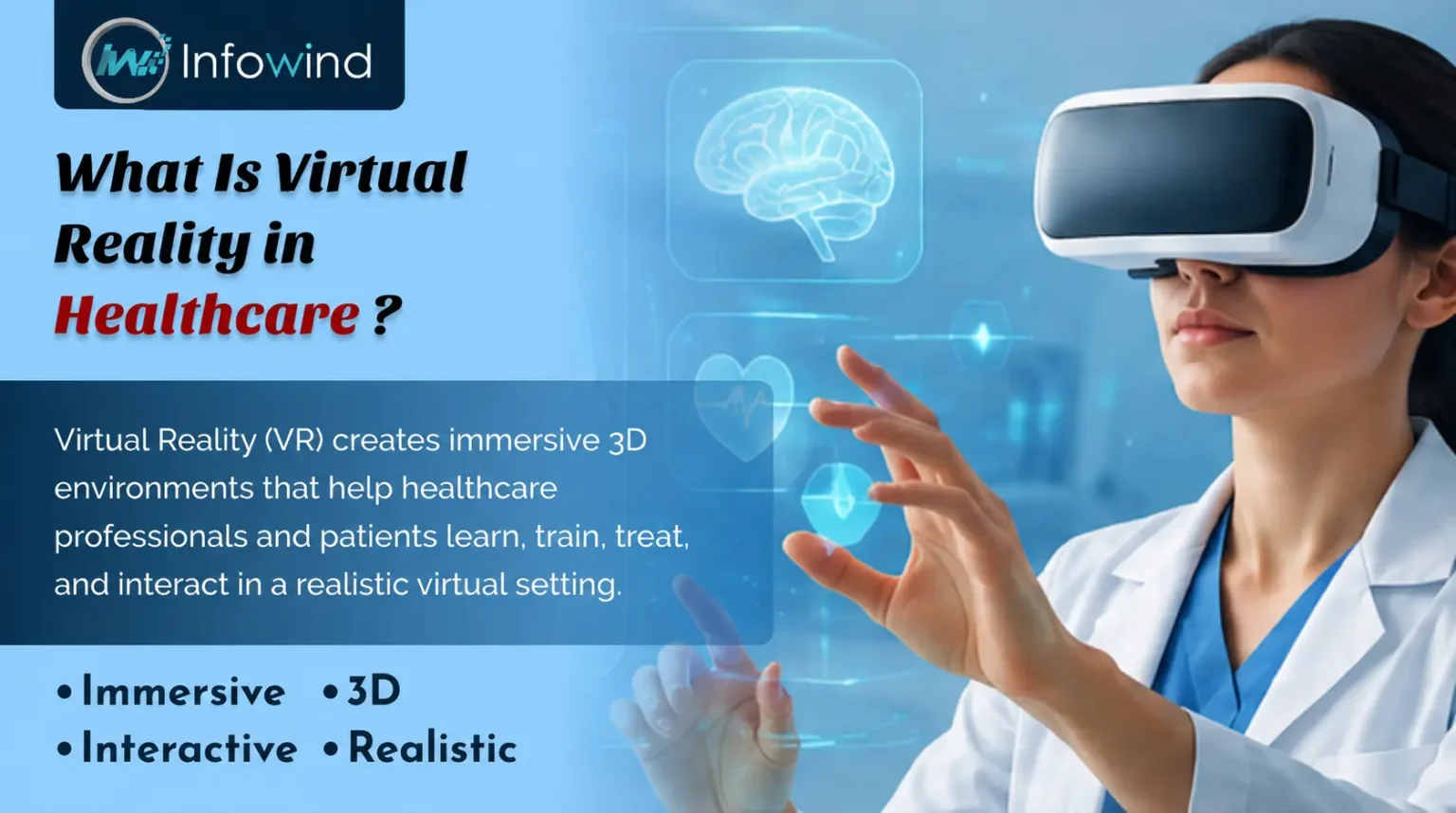
Virtual Reality (VR) in healthcare involves putting patients, doctors, or medical students in synthetic environments that are interactive and realistic. VR offers a sense of presence, which can be beneficial in medical training, rehabilitation, pain management, behavioral therapy, and preparation for procedures. According to the FDA, AR/VR has the potential to be used throughout the diagnostic, treatment, rehabilitation, and other care fields.

How Virtual Reality Works

A healthcare VR system is usually a combination of several technologies:

  • VR headsets: Provide 3D visuals that replace or surround the user’s real-world environment.
  • Motion tracking: One or more sensors are connected to the head, hand, or body to track the body’s movements and make the virtual environment react accordingly in real time.
  • 3D environments: Realistic simulations of anatomy, clinical scenarios, or therapeutic environments.
  • Haptic feedback: Gloves or controllers can offer tactile or force feedback for more interactive experiences.
  • Personalisation through AI integration: AI can tailor scenarios, interpret user interactions, or enhance adaptive experiences.
  • Cloud Connectivity: Allows for centralised data, content delivery, analytics, and collaboration as appropriate.

VR vs. AR vs. MR in Healthcare

TechnologyWhat It DoesHealthcare Example
VRFully immersive digital environment Surgical training or pain therapy
ARAdds digital information to the real worldMedical image overlays during procedures
MRBlends physical and digital environments interactivelyMedical image overlays during procedures

The significant difference is immersion, in that VR takes the place of their surroundings, AR augments their surroundings, and MR brings together physical and virtual objects to interact with one another. VR is already the leader in adoption for training and therapy applications in the healthcare industry, and the results from studies conducted by PwC indicate that VR training can boost the learning rate up to 4 times compared to traditional training methods, and that the VR training method can play a significant role in boosting learning retention in clinical education environments

Why Virtual Reality is Transforming Healthcare

VR is not a question of interest anymore, but one of where on earth it has value to deliver measurably to the healthcare space. Virtual Reality in Healthcare is gaining traction as a tangible and meaningful technology that is enhancing the delivery of care, from immersive medical training to rehabilitation and pain management.
There is great momentum in the market. According to Grand View Research, the VR healthcare market is expected to grow from $5.6 billion to $10.9 billion in 2026. Finally, North America generated 36% of the world’s
revenue for VR solutions in 2024, underscoring the increasing importance of VR for the US healthcare market.
Improved Patient Outcomes

VR can enhance therapy’s interactivity and personalisation. There was evidence that VR-assisted training could have a positive effect on pain outcomes of pain in some chronic musculoskeletal diseases; however, it was limited by the quality of evidence for each disease and type of intervention, in a systematic review of 28 randomised controlled trials that included 1,114 participants by the end of 2025.

Reduced Medical Errors

Simulations that immerse the actor and the learner in a scenario provide a way for them to practice procedures and situations without risking harm to their patients. This helps to provide a secure setting to practice decision-making, communication, and procedural skills.

Better Medical Training

Medical students don’t have to learn solely from textbooks and from observing procedures; they can interact with 3D environments and repeat simulations. This is especially beneficial for surgical education, emergency response, anatomy, and clinical skills training in healthcare VR development.

Faster Rehabilitation

VR can transform mundane exercises into an interactive experience, allowing patients to be more engaged and active. VR/AR interventions were identified as having a positive impact on the engagement of rehabilitation and self-reported outcomes related to pain, strength, and functional mobility in a 2025 systematic review of knee OA studies, but with a call for more robust long-term evidence to support this.

Lower Treatment Costs

R can save money in certain workflows by facilitating remote therapy, self-guided therapy, reusability of simulations, and scaling up medical training. But the savings will be dependent on implementation, clinical validation, hardware, staffing and use case.

Increased Patient Engagement

No doubt VR’s greatest asset is its attention. The immersive experiences make the otherwise repetitive or uncomfortable more engaging. This can foster engagement, but VR isn’t about replacing evidence-based care; it’s about adding to it.

Key takeaway:
Evidence is currently promising, although not all healthcare applications have strong evidence. The most believable virtual reality health care solutions are around clear clinical outcomes, proven workflows, patient safety, and measurable outcomes.

Top Real-World Use Cases of Virtual Reality in Healthcare

Virtual Reality in Healthcare is being employed much more than for VR demos, in an operating room or a rehabilitation clinic. It has the greatest benefit of providing controlled and repeatable environments for patients and healthcare professionals to practice, learn, recover, and interact.
Most importantly, VR is likely to be seen as an adjunct to clinical care, rather than a substitute for doctors or proven treatment. The evidence is also quite different across different use cases.

Medical Training & Surgical Simulation

VR can provide repeatable and risk-free simulations for medical schools and hospitals such as:
  • Surgeon practice: Practise procedures in advance of entering the operating room.
  • Risk-free simulations: Simulations using scenarios that are either uncommon or high-risk without using patients.
  • Anatomy learning: Explore interactive 3D anatomical structures instead of relying solely on static diagrams.

This is especially useful for surgical training, emergency scenarios, and anatomical research, as well as clinical decision-making.

Pain Management

VR can transport patients to relaxing or engaging settings to divert their focus from uncomfortable sensations or procedures, or to help them experience the familiar.

Potential applications include:
  • Burn care: Distraction during the dressing of burns and during dressing changes.
  • Cancer treatment: Support for patients during specific processes of treatment or during treatment.
  • Chronic pain: Our pain-management programs are enhanced by this.
  • Labour pain: A study in 2026 randomized women and found that there was a significant reduction in pain intensity during VR use, but this effect was not maintained for 30 minutes after the VR was finished.

Physical Rehabilitation

VR turns repetitive exercises into interactive activities that can present visual feedback and encourage players.
Common applications include:
  • Stroke recovery
  • Orthopedic therapy
  • Neurological rehabilitation
  • Strengthening balance and mobility exercises
  • Balance and mobility training
  • Upper-limb motor exercises
Evidence is especially relevant to the rehab of stroke. In a 2025 Cochrane review, 190 trials used a total of 7,188 participants and showed that VR could lead to modest benefit for upper-limb function and activities, but there was limited evidence of high or medium quality certainty.

Mental Health Therapy

Immersive environments can help clinicians deliver structured exposure and relaxation-based interventions for:
  • PTSD
  • Anxiety
  • Depression
  • Phobias
  • Stress reduction

For instance, if a patient has a particular phobia, it can be reproduced in a controlled setting, and the intensity is variable. What is important is that VR is to be taught as a clinical instrument in a treatment plan, rather than as a standard treatment for mental illness.

Medical Education

Medical education can be more experiential with VR. Students can:
  • Explore interactive anatomy
  • Practice simulated procedures in a virtual lab environment
  • Repeat clinical scenarios as many times as needed
  • Interact with 3D objects that would not be possible to otherwise visualise with traditional materials
This offers medical institutions the chance to integrate training protocols for various groups and to minimise the reliance on physical simulation resources.

Surgical Planning

VR can be used to visualise patient-specific anatomy and explore a procedure from different angles before complex procedures.
Typical applications include:
  • 3D organ visualisation
  • Procedure simulation
  • Anatomical orientation
  • Team-based surgical planning
  • Anticipating possible steps that could become problematic
The idea is not to use VR as a treatment in its own right, but to offer a new way for visualisation and planning.

Patient Education

It is challenging to grasp medical information via words or 2D images alone. VR technology can make abstract information come to life.
Patients can use VR for some of the following:
  • Treatment explanations
  • Procedure walkthroughs
  • Anatomy visualization
  • Preoperative preparation
  • Education about medications and care plans
Clear visualisation can aid patients in grasping their treatment and engage them better with their healthcare providers.

Elderly Care

VR is also being used in geriatric care for memory therapy, cognitive training, relaxation and engagement.
In a 2026 systematic review of 8 randomised controlled trials (RCTs) of VRCTs for older adults with mild cognitive impairment, VR-based cognitive training was not associated with worsening or stabilisation of cognitive and functional decline in selected cognitive and functional domains. But there were also some variations between intervention protocols and a need for larger, more diversified studies as well.
This is a good thing to consider if VR is to be used in elderly care, but not an alternative to treating dementia or geriatrics.

Pediatric Healthcare

Hospitals, injections, and procedures are frightening to children. VR can help to make these experiences more interactive and serve as a distraction at awkward times.
Potential uses include:
  • Minimising fear and anxiety
  • Interactive therapeutic activities
  • Procedure preparation
  • Vaccination distraction
  • Rehabilitation exercises
An immersive VR pilot study with 30 children (4-10 years) showed that VR is feasible during immunisation and its impact on children’s pain and anxiety.

Telemedicine With VR

VR can also be used to enhance healthcare experiences, such as in rehabilitation or remote collaboration.​
Potential applications include:
  • Remote consultations
  • Virtual clinical environments
  • Remote rehabilitation sessions
  • Specialist collaboration
  • Interactive patient education
Here too, evidence is emerging. There is the possibility of using VR-based telerehabilitation to achieve outcomes comparable to conventional in-person rehabilitation on several measures, as demonstrated in a systematic review and meta-analysis of 9 studies with 260 stroke patients, where access to conventional rehabilitation was limited.

Industries Benefiting from Healthcare VR

Virtual Reality in Healthcare can go beyond the hospital and surgical training. VR is revolutionising the way healthcare organisations use the technology, from better training to patient experiences and rehabilitation, research, and clinical workflows.
IndustryHow VR Creates Value
HospitalsSurgical simulation, staff training, pain management, and patient education
ClinicsRehabilitation, behavioural therapy, treatment preparation, and patient engagement
Medical Universities3D anatomy, virtual labs, clinical simulations, and skills training
Pharmaceutical CompaniesDrug research visualisation, medical education, and patient-support experiences
Rehabilitation CentersInteractive physical therapy, motor training, and progress tracking
Mental Health ClinicsControlled exposure therapy, relaxation, and anxiety-management programs
Dental ClinicsPatient education, procedure visualisation, anxiety reduction, and staff training

Step-by-Step Healthcare VR App Development Process

Developing a successful healthcare VR app is no simple task; it’s about making an immersive 3D environment. Each step from clinical needs to security and deployment must be in accordance with the goal of healthcare.

1. Discovery: Define the Business Goal

First, determine the problem that the VR solution should address. Identify target users, clinical use case, business objectives, expected outcomes and measures of success.

2. Requirement Analysis

Turn the goals into functional and technical requirements. Identify devices and integrations, roles and users, data flows, accessibility, and security.

3. UX/UI Design

Create a user-friendly experience for patients, clinicians and administrators. VR interfaces should be easy to navigate and easy for first-time users to navigate.

4. 3D Environment Creation

Create practical 3D models, settings, animations, and interactions, along with visual creation. In medical applications such as anatomy, surgical simulation and training, accuracy is crucial.

5. Prototype Development

Make a working prototype to test the basic experience before full development. Having a test that identifies usability, hardware and workflow issues early in the process is easier to change.

6. VR Development

Create the base game in Unity, Unreal Engine, C#, C++ and OpenXR. Then, device-specific SDKs can be added as necessary.

7. AI Integration

AI/ML can help with personalisation, conversational support, adaptive exercises, analytics and other intelligent capabilities. Caution is required in the use of AI in clinical workflows and validation is crucial.

8. Backend Development

Create APIs, authentication, databases, dashboards, cloud infrastructures, analytics, and healthcare integration. This is where virtual reality software development comes in, and ties VR to the rest of the digital world.

9. Testing

Evaluate for functionality, usability, performance, compatibility, security, and clinical workflows. Testing is also crucial with the hardware as VR experiences can cause problems like cybersickness, fatigue, or interaction errors.

10. HIPAA/GDPR Compliance

Determine privacy and security requirements as early as possible. In addition to administrative, physical, and technical safeguards for the protection of ePHI, cloud service providers processing ePHI may need appropriate agreements for such handling as required by HIPAA for handling ePHI in US healthcare applications.

11. Deployment

Run the application via the desired VR platform, enterprise deployment, or controlled deployment in healthcare settings. Before commercialisation, review FDA requirements if the software is intended to have a medical application.

12. Ongoing Maintenance

After release, tasks include device compatibility, analytics, content updates, performance optimisation, reports, security updates, bug fixes, and improvements.
In conclusion, a structured development process helps to manage the technical risks, user experiences, security requirements, and ultimately the virtual reality app development cost to create reliable virtual reality-based healthcare solutions. An experienced Healthcare app development company can oversee these phases from the discovery to long-term maintenance.

Healthcare Compliance & Security Considerations

A healthcare VR application can manage highly sensitive data, such as patient identities, therapy sessions, clinical records, and utilisation data. This means security and compliance are an integral part of the development of a Healthcare VR product, rather than an afterthought.

Cost to Develop a Healthcare VR Application

So, how much does virtual reality app development cost in 2026? A single price isn’t possible as a basic VR training app and an enterprise healthcare platform can be vastly different in terms of features, infrastructure, compliance and development.

Estimated Healthcare VR Development Cost

Project TypeEstimated CostTypical Scope
MVP$20,000–$40,000Core VR experience, limited features, single platform
Mid-Level$40,000–$80,000Advanced VR features, backend, analytics, multiple integrations
Enterprise$80,000–$200,000+Complex workflows, AI, multiple platforms, enterprise integrations, advanced security
These represent development ranges and not set quotations. The project’s scope and the developer partner will determine the actual cost.

Why Choose Infowind Technologies for Healthcare VR Development?

Creating a healthcare VR product involves more than just technical knowledge, it’s about understanding healthcare workflow, user experience, security, and scalable technology. This is where Infowind Technologies can come in handy.
Our track record in custom healthcare software development merges the capabilities of VR, AI, cloud, mobile, and backend technologies into actionable, digital solutions for healthcare concepts.
What Sets Us Apart?
  • Custom Development: Solutions built to your clinical and business needs.
  • VR & AI Expertise: Immersive experiences with intelligence and data-driven capabilities.
  • Agile Development: Iterative development, continuous feedback and quick validation.
  • HIPAA-Aware Practices: Security and Privacy are embedded in the development lifecycle.
  • Dedicated Teams: Experienced developers, designers, and experts, working together for your project.
  • End-to-End Support: Strategy and prototyping, development, deployment, and maintenance.

From building a VR rehabilitation platform or medical training application to an AI-driven healthcare VR solution, Infowind Technologies can assist you with your ideas and help you bring them to life.
Looking forward to testing your concept? Let’s talk about your healthcare VR project and develop a solution that will have real-world impact.

FAQs Related to Virtual Reality in Healthcare

Virtual Reality in Healthcare leverages specialised VR hardware and software to enhance medical training, rehabilitation, pain management, patient education, therapy, surgical planning, and other healthcare experiences within an immersive virtual environment.

VR is applied in hospitals for simulation of surgeries, medical education, rehabilitation, distraction from pain, patient preparation, mental health, visualisation of anatomy, staff training, and specific remote-care applications, based on clinical needs and evidence.

Trainings can be more immersive, rehabilitation engagement can be aided, patients can be educated, there can be controlled therapeutic experiences, and repeatable simulations can be made possible by VR. The benefits depend on the application, patient group, implementation and clinical evidence.

The cost of healthcare VR app development varies by scope, ranging from $20,000–$40,000 for an MVP, to $40,000–$80,000 for mid-level applications, and $80,000–$200,000+ for enterprise platforms.

The VR development framework commonly used for healthcare is Unity, Unreal Engine, C#, C++, OpenXR, Meta Quest SDK, cloud platforms, backend frameworks, databases, AI/ML and APIs.

With proper design and supervision, the use of VR can be safe for appropriate patients, but certain individuals may experience dizziness, eye strain, motion sickness, or discomfort. The suitability, availability and length of sessions should be taken into account.

Some mental health interventions that can be enhanced with VR include exposure therapy, anxiety management, and relaxation. The effectiveness is dependent on the condition, intervention design, clinical supervision and supporting evidence for the specific application.

The time required for the development depends on the complexity. A basic MVP can take months, and building enterprise healthcare VR solutions can take much longer depending on the complexity of the 3D development, integrations, testing, security, compliance, and deployment.

Picture of Vipin Maru
Vipin Maru

Vipin Maru is the Founder and CEO of Infowind Technologies, a rapidly growing web and mobile application development company. With deep expertise in technologies such as React.js, Node.js, Laravel, Flutter, React Native, and Ruby on Rails, he has successfully built a strong global client base. Backed by a skilled team of developers and designers, he continues to drive innovation and expand the company’s reach in the competitive tech market.

Suggested Blogs

The creation, distribution, and duplication of digital content have never...

Picture of Vipin Maru
Vipin Maru

August 26, 2026

Modern software development demands frequent releases, high reliability, and continuous...

Picture of Vipin Maru
Vipin Maru

August 17, 2026

FIFA World Cup 2026 will not just be the largest...

Picture of Vipin Maru
Vipin Maru

August 11, 2026

Scroll to Top

Kickstart your Digital Journey with our Developers.

Avail our flexible on-demand IT Staffing solutions for every project.

Hire vetted in-house developers, Risk free