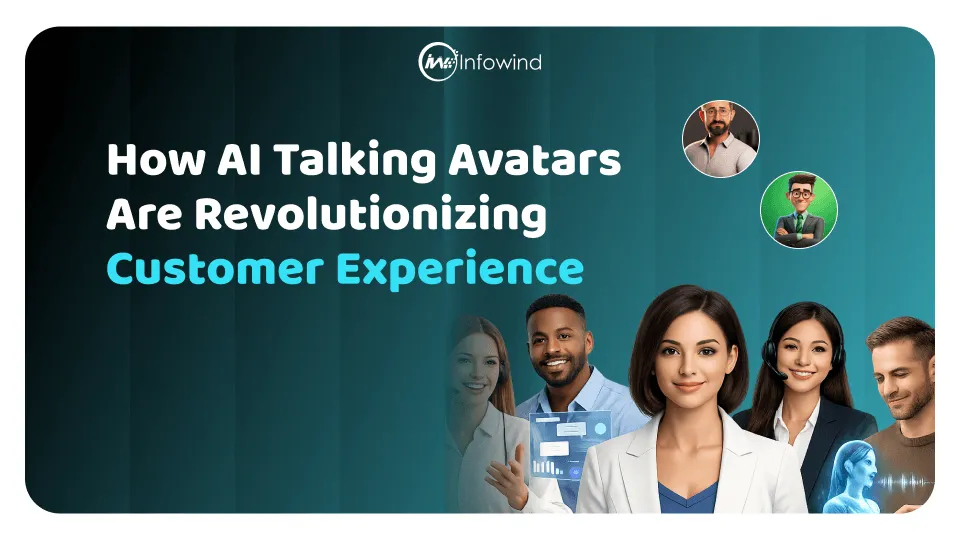
Customer service is evolving rapidly, moving away from text chatbots to more interactive, human-like experiences with AI-powered talking avatars. Although the first chatbots were useful in automating simple queries, most customers today want more natural and quicker conversations that resemble talking to a human being. The industry analysis indicates that AI-based customer service interactions are expanding at a very high pace, with the volume of AI-managed support conversations rising 22 times in one year, as reported by Forbes on the latest industry statistics.
Meanwhile, the expectations of customers are changing. Research indicates that approximately half of the customers have already solved support problems without human intervention with AI tools, which underscores the fact that automation is becoming a standard aspect of online customer experiences.
This change is compelling businesses to implement AI avatars to enhance customer experience, interactive virtual agents that integrate voice, facial expressions, and conversational AI to provide more interactive and personalised customer support. This article discusses the functionality of AI talking avatars, their advantages, their use in practice, and future trends that define the future of talking avatars in customer support.
What Are AI Talking Avatars?
AI talking avatars are computer-simulated human-like computer-controlled apparatus that can discuss, hear, and reply to the user in real time through the application of artificial intelligence. Those types of systems are based on artificial intelligence technology that is applied in real life to produce natural online communication.
In contrast to the traditional chatbots, which use text replies primarily, these avatars incorporate voice, facial expressions, and conversational AI to provide interactions that are more like talking to a real human being. Imagine them as digital customer representatives who may guide the users, respond to the questions, and support them on websites, apps, or kiosks.
The distinction is evident with regard to user experience. A conventional chat robot can present a typed response, whereas an AI-based customer service agent can welcome a client, describe the solutions by talking, and show natural gestures like smiling or nodding. This visual communication usually enhances interaction and understanding, particularly for complex services or onboarding.
Many important technologies support these avatars:
| Core Technology | Role in AI Talking Avatars |
| Natural Language Processing (NLP) | Understands customer questions and intent |
| Text-to-Speech (TTS) | Converts responses into a natural-sounding voice |
| Facial Animation | Syncs lip movement and expressions with speech |
| Emotion AI | Detects or simulates emotional cues for more human interactions |
Research points out that human-like AI interfaces will increasingly take over digital communication as organisations are interested in more interesting and accessible customer experiences (World Economic Forum).
The Evolution of Customer Experience (CX) and AI Integration
The concept of customer experience (CX) has been changing significantly in the last 20 years. Early customer support was mainly done via call centres, whereby human agents would respond to inquiries via phone or email. Although it was effective, this model was usually slow, expensive, and restricted to certain working hours.
With the growth of digital channels, companies launched chatbots and automated messaging platforms to respond to simple questions on websites and applications. These tools were useful in minimising response time and operational expenses, yet they still did not have the human touch required in complex conversations or emotional appeal.
The current customer expectations have changed radically today. Research conducted by the PwC indicates that 73% consumers indicate that customer experience is a key consideration in their buying behaviour, and that most consumers anticipate that brands provide quick, customised, and compassionate service. Customers do not want to wait in lines or use complex menus anymore; they want to be served instantly and with assistance on the digital platforms.
This change is leading to the use of AI talking avatars and AI-based virtual assistants as the next phase of CX innovation. In contrast to traditional chatbots, AI customer service avatars are conversational AI, voice interaction, and human-like images that make conversations more natural and engaging.
To a great extent, AI avatars are the border between automation and human communication. They enable businesses to grow customer service and retain the warmth, clarity, and personalisation that contemporary customers desire, and thus are an important aspect of the current digital revolution in customer experience.
Key Benefits of AI Talking Avatars in Customer Experience
The use of AI talking avatars is changing the way businesses communicate with customers by automating and making them feel like humans. These AI customer service avatars not only respond to questions but also provide more interactive and personalised experiences, assisting brands to provide better customer experiences at scale.
Personalised Interaction and Emotional Attachment
The fact that AI talking avatars can mimic human interaction is one of the largest benefits of this technology. Avatars can read the tone and react in a friendly, empathetic way using such technologies as natural language processing and emotion recognition. This is important since loyalty is affected by emotional attachment. Studies that have been identified by the World Economic Forum indicate that customers who are emotionally involved are much more likely to trust and stay loyal to a brand.
Around the clock and Personalised Service
In comparison to the conventional support systems, AI-based virtual assistants are available 24/7. A virtual avatar can meet the users, describe services, and lead them through solutions even when the business is not open. The IBM Institute of Business Value states that organisations that have applied AI-enabled customer service automation have achieved a maximum of 30% in support costs and faster response time.
Multilingual and Inclusive Communication
AI avatars are also available in global audiences because they can change languages instantly, modify voice styles, and have subtitles. This ability assists businesses in catering to a wide range of customers in a better way and makes digital services more accommodating.
Brand Differentiation and Trust Building
A properly created avatar is a part of a brand. An example is that companies employ branded digital representatives on websites or product demos to make memorable interactions, which make customers feel more attached to the brand.
Automation of Customer Support at a Low Cost
Talking avatar customer support helps to reduce the number of human agents by answering simple questions and helping users navigate through the most common procedures. This enables the teams to concentrate on the complicated problems without compromising customer satisfaction and service quality.

Real-World Examples of AI Talking Avatars in Action
AI talking avatars are no longer experimental, as they are already being applied in industries to enhance customer interaction, education, and service provision. The following are real-world applications that illustrate the use of AI avatars in customer experience in the real world.
Retail & E-Commerce: Customised Shopping Guides
Retail brands are trying AI avatars to show the way to the shopper and describe products in an interactive way. As an illustration, Kuki AI has been employed as a virtual brand ambassador that can interact with customers by talking to them on websites, social media, and digital campaigns. The AI bot has engaged with millions of users and can act as a representative of brands by responding to questions and advertising products in real time.
Healthcare: Wellness Coaches and Digital Nurses
Healthcare organisations are considering the use of AI-based virtual assistants as digital health guides. Applications like Soul Machines are developing realistic digital humans that can provide wellness coaching, patient guidance, and health information in the form of natural dialogue and facial expressions. These avatars assist in increasing the scale of patient engagement and delivering consistent health education.
Banking & Finance: Conversation Advisors
Financial institutions are embracing AI avatars to make complex financial information easy. As an example, banks such as KB Kookmin Bank and Rakuten Securities have introduced AI-based digital assistants that can inform customers about investment options and onboarding and make the process more accessible, complementing human advisors.
Education: Interactive Artificial Intelligence Tutors
AI avatars are applied in education to provide interactive lessons and training material. Synthesia and other companies provide organisations with AI presenters, which describe a topic, training module, or onboarding content in any number of languages, which saves time on production and helps learners more effectively.
Also Read: AI for Education: Benefits, Use Cases & Adoption
Hospitality & Travel: Virtual Receptionists
Digital human assistants are also being used by travel companies and telecom providers to offer multilingual support. As an example, Deutsche Telekom introduced AI avatars that can help customers in over 70 languages, which shows that avatars can provide scalable global customer service.
These illustrations underscore the fact that talking avatar customer support is shifting out of theory and into practice, and is assisting companies in providing more interactive, accessible, and scalable customer experiences.
How AI Talking Avatars Work – The Technology Behind the Magic
AI talking avatars are a combination of multiple high-tech solutions that form natural and human-like conversations. To get an idea about how these intelligent systems are propelled using modern technologies, you can check out artificial intelligence and how it can be used in digital solutions.
These systems combine language interpretation, voice production, and visual animation to fuel AI customer service avatars that can be used in real time to interact with users. The knowledge of these elements can be used to understand why AI customer experience avatars are more interactive than traditional chatbots.
NLP and NLU: Customer Intent
The fundamental element of any AI-based virtual assistant is Natural Language Processing (NLP) and Natural Language Understanding (NLU). These technologies examine what a user is saying, what the intent is, and what the most suitable answer is. The Stanford Human-Centred AI Institute states that NLP has been developed to a great extent, and now machines can better understand the context of conversation and respond to it more accurately and meaningfully.
TTS & Voice Synthesis: Natural Voice
After getting the intent, it is done by a Text-to-Speech (TTS) system, which transforms AI advancement into lifelike sounds. In the current voice synthesis models, it is possible to change tone, pace, and accent to suit brand personality or user preference, making talking avatar customer support more conversational and approachable.
Facial Animation & Lip-Sync
To create a realistic online experience, the facial expressions and the movement of the lips of the avatar should be in line with what is being said. The animation engines employ technologies that make sure that the mouth movements are in sync with the speech and that the expressions are altered intrinsically, just like humans do with the help of minor visual signals.
Emotion AI: Reaction to Empathy
Emotion AI assists avatars in identifying emotional cues in a speech or text so that they can react more empathetically. Studies presented by the MIT Media Lab point to the fact that affective computing can be used to make machines more responsive to human emotional conditions, enhancing online communication.
3D Modelling Engines: Making Realistic Avatars
The engines used to create and render realistic digital humans in the background of the images are powerful 3D engines like Unity, Unreal Engine, and Blender. These tools enable companies to develop branded avatars to supplement AI talking avatars in customer support, training, and interactive experiences.
Implementation Guide – Bringing AI Avatars into Your Business
The strategy of implementing AI talking avatars can greatly improve customer experience, provided that the avatars are adopted strategically. At times, the increase in active involvement and efficiency of operation in some organisations, which deploy the process with a specific aim and considerate integration, may be observed. This is the roadmap of essential steps for the successful introduction of AI avatars of customer experience into your business.
1. Customer Goals and Customer Touchpoints
Beginning with how the customers engage with your brand, the most likely websites, mobile applications, or help portals are. Decide on whether the avatar is going to be helpful in assistance onboarding, frequently asked questions, product support, or technical support.
2. Select the Iran AI Arrangement/Partner of Development
The right technology stack or even the partner should be selected. Companies weighing the ethical consequences of using conversational AI should also be aware of how much it costs to develop an AI chatbot, so that they can choose an AI development partner. Enterprises can engage specific AI development agencies to create AI customer service bots, which subsequently fit in with the current systems and CRM systems.
3. Get it personalised by making the Avatar identity
Create an avatar that is based on the brand personality. This involves the selection of visual appearance, voice tone, and language that will be used to ensure the experience is the same and authentic.
4. Train AI Knowledge Brand-Specified
In order to have meaningful conversations, the AI is supposed to be trained with your company documentation, product information, and support processes. This facilitates the provision of precise and useful responses by an AI-driven virtual assistant.
5. The Strategies to Integrate Across Various Platforms
The avatars should be deployed in as many channels as possible to reach a wide audience (websites, mobile apps, kiosks, and even immersive VR spaces).
6. Test of Accuracy and Involvement
Before its launch, conduct pilot discussions to get clarity, empathy, and precision so that the talking avatar indeed contributes to the customer service.
Need to design smart AI avatars for your business? Challenge solutions presented by Infowind Technologies, the experts in the development of AI chatbots and avatars, to provide an exciting, scalable customer experience.
Challenges and Ethical Considerations
Although the benefits of AI talking avatars are notable in terms of interacting with customers, they need to be implemented responsibly. Ethical issues that organisations need to take into consideration include prejudice, confidentiality, and openness to foster long-term confidence among the users.
Laws and Ethics of Artificial Intelligence
AI models are trained on large datasets, and if these datasets include biases, then the system will accidentally generate unfair or inaccurate answers. In the case of businesses that use AI customer service avatars, the training data should be checked regularly, and the dialogues monitored to avoid unfair and discriminatory communication of all users.
Data Privacy and Security
The customer-related interaction tends to have personal aspects, and therefore, the aspect of privacy is paramount. A firm engaging in the use of AI-powered virtual assistants should observe effective data governance practices and adhere to the international standards of privacy. The Organisation for Economic Co-operation and Development suggests that responsible AI systems are supposed to focus on the lifecycle of the system in terms of being transparent, secure, and protective of the user.
Artificial Intelligence Interactions Transparency
Always, customers must understand when dealing with AI. It is obviously better to mention that one is talking to an avatar or an automatic assistant in order to form credibility and prevent misunderstandings. It is common to find other straightforward messages like you are talking to an AI helper, and only then do the conversations start.
With these ethical considerations, a business is able to roll out AI avatars in customer experience in a responsible manner by introducing both innovative and reliable talking avatar customer support without compromising on building customer trust and brand relationships, both in the short term and over the long run.
Future of AI Talking Avatars in Customer Experience
Further AI speaking avatars development will be even more interactive as the new technologies will also change the digital interactions. Essentially, currently, business organisations are experimenting with new technologies, including voice cloning, empathetic reaction, and simulated 3D worlds, to ensure that communication with AI customer care bots becomes more authentic and intimate.
Voice personalisation is one of the significant tendencies, as the sophisticated voice synthesis is capable of imitating the speech patterns and tone that are used in natural speech. This will enable virtual assistants with AI to change their voice style based on the scenario, like soothing a stressed-out customer or vocally enthusing with a new user to use a product.
The other important development is the merging of augmented reality (AR) and virtual reality (VR). The customer experience AI avatars might be used in such settings as sales guides in virtual stores, learning platforms, or product demonstrators. As per the knowledge on immersive technologies as indicated by the World Economic Forum, immersive technologies, alongside AI, will be relevant in influencing the next wave of digital communications and service experiences.
In perspective, speaking of Avatar, customer support will probably be an aspect of an omnichannel ecosystem, communicating harmoniously throughout websites, mobile applications, smart gadgets, and virtual conditions. These smart digital assistants will not replace human support teams; instead, they will complement them, supporting the business in providing more responsive and enjoyable, and worldwide customer experiences.

Conclusion
With the ever-increasing digital interactions, companies are looking to find methods of enhancing the customer experience through a more intimate and interactive approach. The AI talking avatars fit the difference between automation and human contact as they combine an intelligent technology with visual and emotional communication. These AI customer service avatars are unlike classical chatbots, making conversations more lively, adding a voice and facial expression, and understanding the context, helping the brand respond to the queries much faster yet without loss of empathy and personalization.
Customer experience AI avatars are changing the way organisations relate with their audiences, covering the elements of retail and banking, as well as healthcare and educational fields. They help the businesses to support the scaling process, provide multilingual support, and deliver a similar service to the clients across the digital platforms.
In case any companies need to implement AI-based virtual assistants or talking avatars-based customer support, it is crucial to collaborate with an appropriate technology expert. Infowind Technologies assists companies in creating and deploying bespoke AI avatar projects, matching their brand, offering a competitive and compelling digital experience to customers.