The media and entertainment industry is being redefined by Artificial Intelligence (AI) that will transform how content is produced, distributed, and consumed. AI in entertainment is making everything even more personalized and faster in terms of smarter movie suggestions and automated video editing.
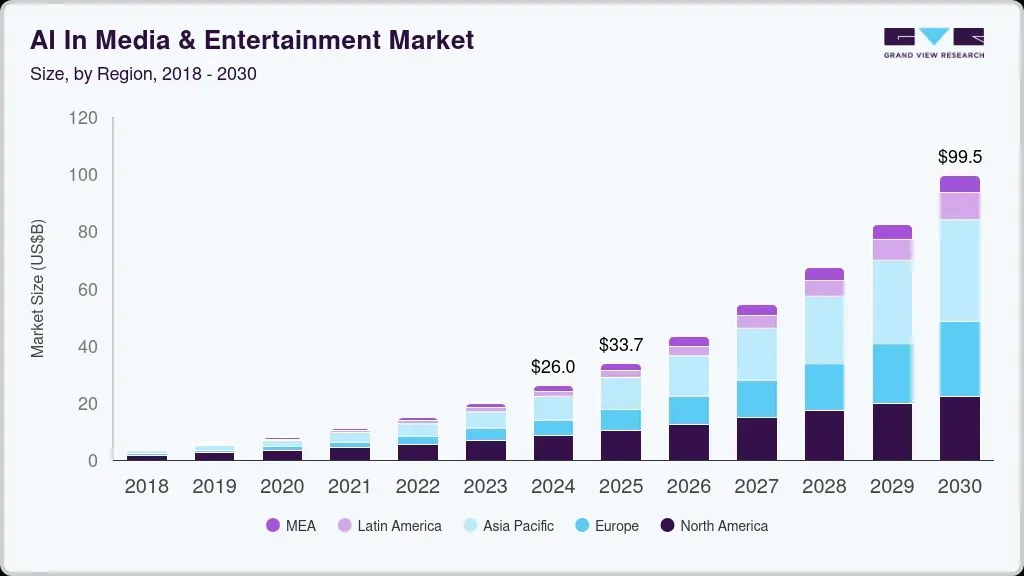
As reported by Grand View Research, the media AI market is estimated to amount to 99 billion globally by 2030, and this shows the speed with which the industry is changing. AI can also assist companies in the behavioural perception of the viewers and predict patterns, and provide content that people genuinely enjoy.
This change will increase during the period 2026-2030, when more studios, streaming platforms, and creators will have adopted AI solutions. Infowind Technologies leads this revolution, as it assists companies to utilise AI-based personalisation, automation, and foresight to produce new levels of entertainment.
The Role of AI in Media & Entertainment
The media and entertainment industry is undergoing a revolution in the form of Artificial Intelligence (AI) that creates, disseminates, and consumes content. AI in film studios to streaming platforms: AI is becoming one of the creative partners that contributes to making content smarter, faster, and more interesting.
The AI finds applications in media creation where it is used to automate editing, create visual effects, and even write scripts or compose music. This allows creators to save time, cut down costs, as well as concentrate more on creativity. Gathering data on the audience, AI can also be used to propose new themes, characters, or plot lines that will be more accepted by the audience.
In terms of distribution, AI allows for delivering the appropriate content to the appropriate audience at the appropriate time. Netflix and Spotify employ AI algorithms to observe the consumer behaviour of users and give them personalised offers that keep their audience binging.
To consumers, AI has a very personalised experience. It drives real-time conversations via chatbots, live recommendations, and interactive storytelling. The viewers do not merely watch, but they are involved.
AI is transforming all entertainment experiences, starting with the idea and finishing with the audience. With technology constantly changing, AI in media and entertainment has a bright outlook to tell smarter stories, do more personalised work, and provide audiences all over with experiences that will be remembered.
Key Features of AI in Media & Entertainment
The media and entertainment sector is entering a new era of creativity and efficiency, which Artificial Intelligence drives. Since customised suggestions might be provided to personalised editing and virtual interaction, AI in the entertainment sector is boosting each content lifecycle step. We shall discuss the most influential applications of AI to media and entertainment that are changing the way we produce and consume content.
1. Personalisation and Recommendation Engines: Content
The likes of Netflix, YouTube, and Spotify employ advanced AI to learn the behaviour of users and recommend content that aligns with their interests. This personalisation keeps the viewers entertained and assists platforms in increasing watch time and loyalty. Media and entertainment AI ensure that all the experiences are differentiated, and the appropriate content is delivered to the appropriate audience at the appropriate time.
2. Artificial Intelligence in Post-Production and Video Editing
Post-production and editing could take hours, whereas using the AI-based tools, the creators could automate the process of colour correction, sound improvement, and selecting the scenes. This enables it to produce quicker, yet not lower quality. AI also assists in identifying continuity errors and increasing the efficiency of workflow production of media with AI it easier and less expensive.
3. Automation of Voice Recognition and Dubbing
Voice recognition based on AI makes dubbing and localisation faster and easier to improve the reach of global audiences. It can imitate voices, follow the lips and translate conversations in real-time, breaking language barriers and increasing its audience.
4. Artificial Intelligence-based Special Effects (VFX)
AI in media and entertainment contributes to visual effects by creating realistic explosions and other effects, as well as realistic animation. It minimises the use of manual labour, and it gives endless creative opportunities to filmmakers and game developers.
5. Generational AI in Music, Scripts, and Graphics
Generative AI applications compose new music, generate images, and even scripts, enabling their creators to experiment with new concepts in real time. With the help of real-time interaction with the audience via chatbots and virtual hosts, AI will make sure that the content creation and consumption remain interactive, intelligent, and inspirational.

Use Cases of AI in Media & Entertainment
The emergence of Artificial Intelligence (AI) in media and entertainment has radically changed how something is narrated, how music is composed, and how an experience is provided. With applications in personalised streaming recommendations, automated commentary in sports, and many others, the manner in which AI is being used in media and entertainment is defining the future of smarter and more immersive experiences. We will discuss the revolution that AI is bringing to every industry in this creative field.
1. Streaming Platforms – Recommendations to the Pipe
Streaming services, such as Netflix, Amazon Prime Video and Disney+ +, are majorly dependent on AI-based recommendation engines to profile user behaviour, viewing habits and preferences. These algorithms will propose movies and shows based on what each viewer loves, which will give them a highly customised entertainment experience. As an illustration, Netflix claims that more than 80 per cent of the content viewed is as a result of its AI-based suggestions. This assists the platforms to keep the users engaged, increase watch time and provide content that seems personalised to each individual.
2. Music Industry – Artificial Intelligence-Composed Music
AI is introducing a new tune to the music industry. Generative AI-based tools such as Amper Music and AIVA (Artificial Intelligence Virtual Artist) are capable of creating original music in all kinds of genres. These tools are being used by musicians, game developers and filmmakers to compose background scores or entire compositions within a matter of minutes. Analysing thousands of melodies and rhythms, AI will be able to create music that suits a certain mood or scene. This saves time, as well as opens up possibilities to creators who are not professionally trained in music.
3. Movies and TV Scriptwriting, Dubbing and Editing
The movie and television sector is fast adopting AI in the creation of media to ease the compound procedures. Artificial intelligence software aids in script composition by processing the tastes of the audience and determining the storylines that will be the most successful. When post-production is taking place, AI will automate the editing, colour correction, and structuring of scenes. In dubbing, AI-based voice recognition systems have the potential to convert dialogues and match lip movements across languages – a global distribution is fast and cheaper. As an example, movies, such as Warner Bros., have utilised predictive AI models to study scripts and determine box-office performance even before shooting.
4. Gaming Smart NPCs and Custom Experiences
In video games, AI will develop more intelligent non-playable characters (NPCs) that will change in response to the actions of the players and will make the gameplay more active and interactive. Such games as The Last of Us Part II and Red Dead Redemption 2 rely on AI to provide NPCs with a human-like response and feelings. In addition to the gameplay, AI can make experiences more personal, adapt the difficulty level, recommend missions, or suggest in-game purchases, based on player information. This combination of AI and entertainment provides simulated and personalised gaming experiences to each user.
5. Advertising & Marketing- Predictive Audience Targeting
Predictive analytics are changing the way advertising is done in the media and entertainment with AI. AI applications can be used to predict which kind of content or advertisement will appeal to certain audiences based on the user data. AI-based marketing platforms are now being used by brands to build personalised ad campaigns, optimise budgets, and enhance engagement rates. This leads to an increase in ROI and more pertinent non-obtrusive advertising.
6. Sports Broadcasting – Computerised Highlights and Commentary
The use of AI in sports media automates activities such as the creation of highlights, tracking performances, and live commentary. AIs such as IBM Watson or WSC Sports are used to analyse live actions, highlight the most important moments, and make highlight videos in real-time. Broadcasters apply such insights to improve viewer interest and provide a real-time and data-driven narrative during live events.
7. Journalism and News Media Automated Reporting and Fact-Checking
AI in media and entertainment guarantees quicker and more dependable media coverage in the news and journalism sector. Such tools as the Lynx Insight of Reuters and the Heliograph of The Washington Post are going to create short summaries and data-based news stories. In the meantime, fact-checking systems based on AI aid in checking the information on the fly, minimising the dissemination of fake data.
Personalised streaming to AI-generated music and automated news are just a few ways AI is influencing the future of creativity and interaction in the media and entertainment industry. With the ever-growing technology, these AI applications in the media and entertainment industry will not only make life easier in production but will also transform how people around the world engage with narratives, music, and experiences.
Benefits of AI in Media & Entertainment
Artificial Intelligence (AI) applications in the media and entertainment have created enormous opportunities for both creators and producers, and audiences. The use of AI in the entertainment sector is changing the way the industry works, whether it is enhancing user experiences, simplifying production preventing fraud. We shall discuss some of the best advantages of this digital revolution.
1. Individualised Audience Response
One of the largest uses of AI in the media and entertainment is personalisation. Websites such as Netflix and Spotify apply AI algorithms to interpret the preferences of their visitors, suggest content, and personalise experiences. Such a degree of AI-powered personalisation not only increases the satisfaction of the audience but also the retention and engagement rates.
2. Economy and Time Saving in the Process
AI-based media production enables studios to automate processes such as video editing, colour correction, script analysis, and others. AI saves creators’ resources and time by minimising the amount of manual labour required. This implies that there is increased speed in the delivery of content and greater creativity despite reduced budgets.
3. Predictive Analytics: Better Decision-Making
Using predictive insights, AI assists producers/marketers in making decisions that are supported by data. Through the examination of the audience trends, market data and engagement metrics, AI can determine the type of content that is going to be the most popular. It results in smarter investments and successful projects in the movies, music, and digital media.
4. Greater Innovation with Generative Tools
Generative artificial intelligence can be used to enable artists, writers, and musicians to explore novel concepts. AI in entertainment not only aids in the creation of innovative works but also enhances quality and originality, whether it comes to creating an original piece of music or writing a script: AI is a creative assistant that improves the creativity of the process.
5. Fraud Detection & Piracy Prevention
AI is really significant in safeguarding digital assets. It can recognise counterfeit content, curb piracy, as well as track unauthorised distribution using sophisticated algorithms. This provides security to content and secures the revenue streams of creators.
6. Better Monetisation Opportunities
AI is used to find new sources of revenue based on the analysis of audience behaviour and the performance of ads. With media and entertainment AI, companies will be able to price, place and target ads optimally – making data a profit.
Simply put, artificial intelligence in entertainment not only makes the industry more creative and efficient but also safer, personalised, and more profitable.
Challenges & Ethical Considerations of AI in Media & Entertainment
Although AI in media and entertainment presents amazing opportunities, it also presents challenges, which require keen consideration. Due to the adoption of artificial intelligence in the entertainment industry, the issues of ethics, ownership, and trust are gaining more relevance than ever.
1. Copyright Problems when using AI-generated Content.
The ownership of AI-generated work like music, graphics, or scripts is one of the largest challenges in terms of copywriting. Because AI-based tools generate content with the help of large datasets, the question of the real ownership of the rights is often unanswered, whether it is the developer, the user, or the algorithm. This grey area brings questions of law regarding media production with AI and intellectual property laws.
2. Deepfakes and Risks of Misinformation
Deepfakes or highly realistic AI-generated video production have posed real threats to the media and entertainment sector. These can misinform or ruin reputations through the manipulation of voices and faces. Detection and control of fake content have now become a priority for the platforms and authorities.
3. Bias in Algorithms
AI systems are trained on the existing data, which is occasionally biased. This may create an unfair content recommendation or even discrimination in employment in the creative sphere. It is important to be fair and transparent in AI to the media and entertainment industry.
4. Data Privacy & Security
In the case of AI, user data is expected to be large, and it should be used to personalise content. Nevertheless, mismanagement of data may result in personal infringement and data breaches. Secrecy of the audience data should be a priority.
5. Finding the Gold mean between AI automation and human creativity
AI can be a useful tool to improve efficiency, but the human imagination cannot be substituted with AI, as it has an emotional component. A balancing act is the only solution to apply AI applications in media and entertainment to augment and not supplant the creative ethos that is the industry.
Future Trends of AI in Entertainment
The future of AI in media and entertainment is coming out to be more immersive, intelligent, and interactive than ever before. The development of artificial intelligence in the entertainment sector between 2026 and 2030 will transform the industry into an assistant and a complete creative companion, transforming the way people consume stories, music, and digital media.
1. Emerging Virtual Influencers and AI-Driven Celebrities
Virtual influencers or other types of AI-created personalities will take over social media and marketing. Being driven by sophisticated algorithms, these digital celebrities will tackle the audience 24/7, providing brand partnerships and custom fan interactions.
2. Metaverse Implementation and Virtual World Entertainment
With the further development of the metaverse, AI in media and entertainment will be an important part of designing realistic avatars, virtual concerts, and interactive experiences. The spectators will not merely watch but experience the entertainment worlds.
3. Artificial Intelligence Storytelling and Interactive Cinema
Movies and shows that are created through AI will become more dynamic, as the audience can affect the storylines in real-time. With this invention, the distinction between the author and the viewer will be obscured.
4. Hyper-Personalised Streaming Experiences
AI will be applied in the services of streaming platforms to provide hyper-personalised entertainment, making everything, including thumbnails or suggestions on the dialogue, personalised.
In 2030, the AI application in media and entertainment will not be limited to automation, and the imagination will be transformed into a whole interactive and tailored journey to each viewer.

Case Studies & Real-World Examples of AI in Media & Entertainment
The integration of AI into media and entertainment is not a futuristic one anymore more it is a reality. Companies ranging in size and streaming power to the leaders in the gaming industry are implementing artificial intelligence in entertainment to enhance creativity, efficiency and audience engagement. The following are the most notable examples of AI in media and entertainment that have an impact in the real world.
1. Netflix -Recommendation System AI
Netflix has been among the most successful examples of AI in media and entertainment. The recommendation engine proposed by it studies billions of pieces of data (viewing history, watch time, preferences) in order to provide personalised content. It is an AI-driven personalisation that assists Netflix in retaining subscribers and makes sure that almost 80 per cent of the viewed content is based on an automated recommendation.
2. Warner Bros. AI Film Distribution Strategy
Warner Bros. has also implemented AI analytics to forecast the success of a movie. The system will assist the studios in determining the films to produce as well as the mode of marketing the films, analysing the audience demographics, previous box office records, and advertising performance. This insightful prediction enables saving of time, minimising risk and aids in making smarter decisions when creating a movie.
3. The use of AI in Music Production: AIVA and Amper Music
Generative AI tools such as AIVA and Amper Music are applied to produce soundtracks for commercials, games, and films. Such tools assist artists in creating high-quality compositions in a few minutes, reduce the cost of production, and increase creative opportunities.
4. Ubisoft & EA – AI in Gaming
Ubisoft and Electronic Arts (EA) are two giant companies in the gaming industry that develop more intelligent NPC creation and adaptive gameplay through the application of AI-driven algorithms. This makes for realistic and personal experiences that make players heavily immersed.
These media and entertainment applications of AI, like streaming or gaming, show that artificial intelligence is changing creativity, efficiency, and audience engagement across the globe.
How Businesses Can Adopt AI in Media & Entertainment
The use of AI in media and entertainment is becoming a necessity for every business that wishes to remain competitive in the digital era. Artificial intelligence in entertainment will help improve the creation of smarter content and interactivity, performance, and profitability by enabling the creation of smarter content, data-driven engagement, and interaction with the audience. This is how businesses can take their first step towards AI.
1. Adopt AI in Content Production and Distribution
First of all, determine the spheres where AI can be the most valuable, e.g., video editing, scriptwriting, dubbing, or content recommendations. Using AI in media and entertainment can help the technology perform routine tasks and enhance creativity. Within distribution, AI can be used to optimise the delivery process by advising on the appropriate content to be broadcast to the appropriate audience based on predictive analytics.
2. Select the AIs Tools and Platforms
It is imperative to choose the appropriate AI tools and platforms. Companies need to seek solutions that can fit their workflow, including generative AI in designing creative work, predictive modelling with analytics services, and media management with automation.
3. Collaborate with Artificial Intelligence Developers
The process of adoption can be made easier by working with a mature technology partner such as Infowind Technologies. Infowind is a reliable AI and app development firm that assists media enterprises in creating tailored AI applications to create content, automate processes, and engage the audience with personalised content.
Using AI cases in media and entertainment strategically will allow businesses to realise new possibilities to be innovative, connect with audiences, and grow in the long term.
Also Read: AI for Education: Benefits, Use Cases & Adoption
Conclusion
The emergence of AI in the media and entertainment is an epoch when there is close collaboration between technology and creativity. Instead of crowding out human imagination, artificial intelligence in entertainment enhances it – assists creators, producers, and businesses to create more intelligent and interactive experiences. Personalised streaming, automated production, predictive analytics, and many more AI applications in media and entertainment are changing the industry on all levels.
To be on top of the curve, companies need to be strategic with AI and be willing to adopt it in their media processes to be successful in the future. It may be automating the content creation process, maximising the audience targeting, or it may be the advancement of narrative, but AI provides limitless possibilities for innovations.
In case you are willing to introduce the power of AI into your media or entertainment project, Infowind Technologies can assist. Get in touch and develop your media of the future with AI-assisted functionality and remain future-proof.