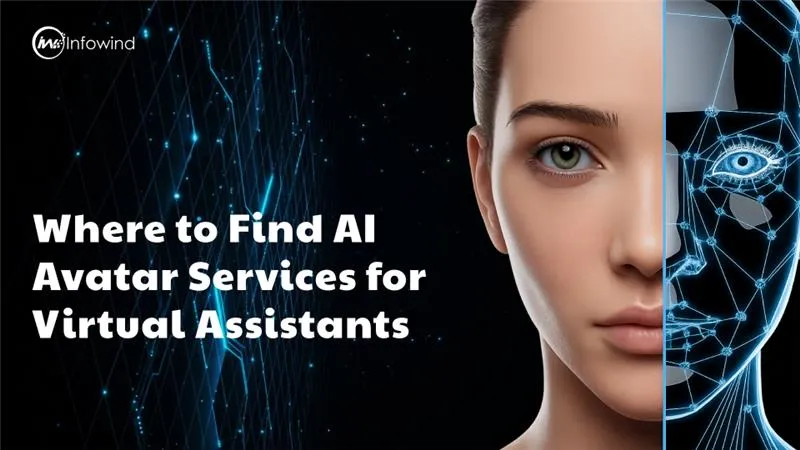
The AI avatars are computer-based human-like figures that run on artificial intelligence and can talk, make gestures, and even react in real-time, much more than any voice-only assistant, such as Siri or Alexa. In contrast to audio-based systems, avatars offer a visual presence, facial expressions, and conversational AI, resulting in a more natural and engaging experience. Synthesia, HeyGen, and DeepBrain AI are at the forefront of this change, enabling the scaling and deployment of more lifelike virtual assistants to businesses.
Such evolution is not merely a tendency, but a rapidly developing market. The global AI avatar market is estimated at approximately $5.9 billion in 2023 and is projected to grow at over 30% CAGR. By 2025, 30% of all internet users are estimated to be engaged with AI-generated content.
AI avatars can enhance user experience (by up to 3 times) as well as increase customer satisfaction by approximately a quarter. They are transforming brand-to-brand interactions through the inclusion of personality, accessibility, and human interaction.
Benefits of Using AI Avatars in Virtual Assistants
The modern virtual assistant is being transformed into AI avatars, which transform the interaction with customers into a more human communication experience (CX), among other things, and AI communication, which is scalable. This is why the adoption of this technology among businesses that correspond to any industry is increasing rapidly. Companies that have already implemented AI via chat are more engaged. Here are the best conversational AI chatbots to have real conversations and good chats.
1. More Human-Like Interaction & Emotional Connection
The avatars that are powered by AI and include facial expressions and gestures provide a more emotional impact in contrast to the usage of traditional chatbots. This enhances user confidence and interaction – particularly in areas such as health, education, and online shopping where personalisation is an issue.
2. Multilingual Scalable Communication
High-level AI avatars can be used to have real-time multilingual chat with voice and expressions synchronised. This enables the companies to provide customer service to customers internationally without the need to employ several language professionals, and hence it is suitable for global brands.
3. Significant Time & Cost Savings
Firms that use virtual AI assistants or automation involving avatars do not require the services of big support teams. Onboarding, FAQ, and training can be done automatically 24/7, which leads to a faster response, a reduced cost of operation, and standard service delivery. To get a better idea of development and investment, you can refer to the cost of building an AI chatbot.
4. Greater Recollection of the Brand and Customisation
AI personas serve as an online brand persona that enhances memory and uniformity. The companies can tailor it in terms of tone, appearance, and personality and have a unique brand identity, which helps them stand out in a competitive digital world.
5. Real-Life Application and Practice
Using advanced tools and custom solutions, businesses are actively integrating AI avatars in their business processes:
- ChatGPT + Synthesia Integration: Firms integrate ChatGPT conversational intelligence with the AI video avatars of Synthesia in order to establish interactive video assistants. An e-learning system may be used as an example, as a lesson may be delivered by a personalized avatar that provides explanations, real-time answers to questions, and changes the answers according to the users, which improves the results of learning and remembering.
- Infowind Technologies Customer Support Automation: Infowind Technologies has developed AI avatar chatbots that are custom-built to operate on websites and mobile applications on which customers ask queries. Such avatars will be able to meet the users, interpret queries, and offer immediate solutions with a human-like interface, which will save time and enhance user satisfaction.
- Sales & Marketing Personalisation: AI avatars are used by businesses to design individual video messages to lead to business, product demos, and onboarding. This method has a great level of engagement as opposed to text messaging or the use of text messages.
| Use Case | Practical Impact |
| Customer Support | 24/7 human-like assistance with faster resolution |
| E-learning | Interactive, personalised training experiences |
| Marketing | Higher engagement through personalised video content |
AI avatars are not merely a trend in the modern digital transformation period driven by AI, and they are a potent tool for making engagement more engaging, automating operations, and establishing a stronger global brand relationship.
Top AI Avatar Service Providers
The selection of an appropriate AI avatar platform is important in the development of scalable virtual assistants, AI video automation, and personalised customer experience. The comparison of the most popular platforms based on real advantages, application, and pricing clarity is a research-based, people-first comparison below.
Leading AI Avatar Platforms Compared
| Platform | Key Features | Ideal Use Case | Pricing (Approx.) |
| Synthesia | 230+ lifelike avatars, 140+ languages, enterprise-grade security | Corporate training, internal communication, and explainer videos | $30/month+ |
| HeyGen | Real-time avatars, voice cloning, 175+ languages, API access | Marketing videos, onboarding, personalised outreach | $24–$48/month+ |
| DeepBrain AI | Hyper-realistic avatars, real-time interaction, strong TTS | Customer service, finance, and healthcare assistants | Custom |
| Hour One | Fast video generation, 100+ languages, simple UI | Product demos, high-volume content production | $25/month+ |
| Colossyan | Scenario-based learning, interactive videos, and quiz integration | Employee training, L&D, compliance videos | $27/month+ |
| Infowind Technologies (Custom) | Fully customised AI avatar chatbot with voice + motion sync | Custom virtual assistants, business automation | Project-based |
What are the Strong Points of these Platforms?
Synthesia – Enterprise-Ready & Scalable
The global businesses prefer to use Synthesia because of its quality avatars and standards of compliance. It is compatible with 140+ languages and professional templates, which is why it is perfect when it comes to organised training and corporate communication.
Ideal to use: Organisations that require sophisticated, safe, and multilingual training videos.
HeyGen – Best Marketing and Personalisation
HeyGen is the first to have real-time avatars and voice cloning as well as support in 175+ languages, which allows brands to build highly customised video campaigns at scale.
Real Use Case: Sales teams create personalised outreach videos automatically when connected to the API.
DeepBrain AI Hyper-Realistic Customer Interaction
DeepBrain AI is oriented toward near-human avatars that are capable of holding real-time conversations, and it is suitable in such industries as banking, healthcare, and education, where trust is paramount.
Example: Virtual banking assistants that direct users on the service provision in a human-like manner.
Hour One Speed and Volume Efficiency
Hour One is designed to support the teams that require quick and massive video production. It makes the workflow easier; that is, it is only necessary to enter a script and create videos immediately.
Use cases: Weekly product updates, internal training, and scalable content pipelines.
Colossyan – Training-Focused Innovation
Colossyan is also an interactive learning tool that is characterised by the presence of such features as a branching scenario and quizzes that enhance the engagement and retention of the training programs.
Stat Insight: Avatars can be interactive and enhance 40-60% interaction with the training in comparison with static materials.
Infowind Technologies – Custom AI Avatar Solutions
In comparison to SaaS tools, Infowind Technologies offers the development of a fully customised AI avatar chatbot in accordance with the business requirements.
Real Use Case:
- The AI avatars were incorporated into the websites as a 24/7 customer care support system.
- Lead generation and qualification for voice-based assistants.
- Solutions related to the industry (ex, healthcare assistants, EdTech tutors).
Final Takeaway
The platforms are used for different purposes, such as enterprise training (Synthesia), marketing automation (HeyGen), and custom AI assistants (Infowind). The most suitable option will be based on the purpose:
- Content on the scale? → Hour One
- Engage globally? → HeyGen
- Train employees? → Colossyan
- Create personal assistants? → Infowind
In the current AI-enhanced digital landscape, the choice of the appropriate avatar platform may have a direct influence on engagement, efficiency, and ROI.
How to Choose the Right AI Avatar Service
However, the choice of the correct AI avatar platform is not only an indirect matter of choice, but it also has a direct influence on your customer experience and the future scale of your business. There are several tools at hand, and therefore, the businesses must be structured in a research-based approach.
1. Start with a Clear Use Case
The first step is to set a major objective. The various platforms are adapted to various results:
- Customer Support: Customer Support Displacement, Real-Time AI Avatars on websites or apps.
- Training and E-learning: Interactive videotapes.
- Creation of the Contents: Marketing videos, product explanations.
- As a Metaverse and Virtual Experiences: Real-time immersive avatars.
A vivid use case would make sure that you invest in an option that would suit your business goals and ROI needs.
2. Realism, AI Capabilities, and Performance
There is no equality among all AI avatars. Focus on:
- Graphic realism and facial expression (more exciting to watch)
- Articulatory and voice quality, vocal and lip-synch accuracy.
- Response time (important in live interactions) and latency.
- AI intelligence (natural conversation, understanding of the context)
As an example, very realistic avatars can greatly enhance the trust and the time of interaction between the users, particularly in customer-facing jobs.
3. Check Integration & Scalability
Contemporary companies need a smooth working process. Make sure the platform is based on:
- CRM, chatbot integrations, and API to internal systems.
- Integration with such tools as ChatGPT or business AI.
- Support for millions of users.
This is paramount to companies that intend to automate on a large scale or omnichannel experiences.
4. Analyse Pricing, Licensing & Branding Flexibility
See past the fundamental pricing:
- Do you have any untold expenses of video creation or API consumption?
- Do you own the commercial rights of usage?
- Is it possible to make the full customisation of the appearance, tone, and personality of the avatar?
Good branding flexibility is beneficial in ensuring the incorporation of a certain level of stability in digital identity.
5. Select the Ideal Implementation Partner
Tools do not suffice in a sophisticated application. Development, integration, and optimization of business often need to be customized.
Expert Tip:
To achieve maximum control, scalability, and branding, business entities tend to cooperate with the providers of AI solutions, such as Infowind Technologies, capable of connecting avatars to the conversational AI projects or the already available CRM/chatbot environments.
| Factor | What to Look For | Why It Matters |
| Use Case Fit | Platform specialization | Ensures better results |
| Realism | Natural expressions & voice | Improves engagement |
| Integration | API & system compatibility | Enables automation |
| Pricing | Transparent & scalable | Avoids long-term costs |
| Customization | Branding & control | Builds brand identity |
Final Insight
The right AI avatar service must not only address your immediate needs but also address your expansion, automation strategy, and global expansion. The selected solution has an opportunity to be a long-term digital asset, which will become the source of engagement, productivity, and brand differentiation in the increasingly AI-driven world.
How AI Avatar Integration Works in Virtual Assistants
The knowledge of the AI avatars’ work in the virtual assistants also aids the business in sound decision-making and in adopting the technology well. The essence of AI avatars is a complex, multi-tiered answer, involving the use of natural language processing (NLP), speech synthesis, and real-time animation, to provide the experience of human interaction.
Step-by-Step Workflow of AI Avatar Integration
It is usually carried out under a pipeline structure:
Input Text/User Query → NLP Engine → Word-to-Speech (TTS) Engine → Lip-Sync Processing → Avatar Animation → Output (video/speech response)
Detailed Breakdown of Each Stage
1. User Input
The process will start when a user types or speaks a query. This input may be in the form of websites, mobile applications, kiosks, or an enterprise.
2. NLP Engine (Understanding Intent)
An input is sent through an NLP engine, which can be an OpenAI language model that uses intent, context, and user behaviour. This gesture includes making sure that the answer is not only correct, but it is also conversational and contextual.
3. Response Generation
When the intent is realised, the system will produce a response that is related to it. Successful AI models can be used to personalise responses on the basis of user history, preferences, or business logic.
4. Text-to-Speech (TTS) Conversion
Text generated is turned into a natural-sounding speech by engines such as ElevenLabs or Amazon Polly. In current TTS applications, traffic includes realistic voice modulation, variations in the tones, and multilingual support.
5. Lip-Sync & Facial Mapping
The sound coming out is in sync with the lips of the avatar and the facial expression. It is a very important step in designing a real and engaging experience because a little bit of inconsistency can drop the confidence of a user.
6. Avatar Animation & Rendering
The avatar is made alive with the use of software, such as Unreal Engine or Unity. These engines handle:
- Facial expressions
- Body gestures
- Eyewitness movements and micro-expressions.
This helps to transform the rather dull responses into interactivity that is appealing to the eyes and more humanised.
7. Final Output Delivery
The response is sent to the user as follows:
- An avatar video is a talking video.
- Conversational interface provided in real time.
This output may be integrated into the websites, mobile apps, or customer service.
Simplified Flow Overview
| Stage | Technology Used | Outcome |
| Input | Web/App Interface | User query captured |
| NLP Processing | OpenAI / AI Models | Intent & response generation |
| Speech Conversion | ElevenLabs / TTS APIs | Natural voice output |
| Animation | Unreal Engine / Unity | Avatar movement & expression |
| Output | Web/App/Video | Human-like interaction |
Integration with Modern APIs & Systems
The AI avatar systems are highly versatile and may be connected to the already existing digital ecosystems by use of APIs:
- OpenAI APIs: Drive contextual reply as well as communicate.
- ElevenLabs APIs: Power hyper-realistic voice synthesis.
- Unreal Engine/Unity: Render avatars and offer real-time interaction of high quality.
- CRM Systems and Chatbot Systems: enable the use of avatars to receive customer data as well as automate work processes.
This is a modular architecture that means that businesses are capable of scaling it, customizing, and actively enhancing the capabilities of their virtual assistant.
Expert Insight
Regarding the implementation, the effectiveness of the AI avatars’ integration will be decided by the effectiveness of their component synchronisation. Despite the improved tools, in many situations, the only attack used is custom development, latency optimization, and system integration skills to reach a flawless interaction.
That is the reason why numerous enterprises would like to cooperate with specific AI solution providers and guarantee their performance, accuracy, and the consistent brand experience.
Final Takeaway
The integration of AI avatars is not a one-tool entity, but the working environment of AI technologies to work in unity. When treated appropriately, it provides a potent mixture of robots, customisation, and the touch of humanity, which makes virtual assistants more efficient and technologically advanced. If you want to understand the technical foundation behind such systems, you can learn how to build a personal AI assistant with open source tools.
Real-World Use Cases of AI Avatars in Virtual Assistants
The AI avatars cease to be experimental, and they are in fact taking over industries by providing human-like, scalable, and intelligent interactions. Customers can engage with avatars in business through aspects like customer engagement, training, and healthcare, and more businesses are using avatars to enhance efficiency and user experience.
Conversational AI (including avatars) is likely to be doing 20% of the customer service interactions by 2025, indicating that the rapid adoption of AI is already happening in the enterprise.
1. E-commerce: Smart 3D Shopping Director
AI avatars in the e-commerce model can be seen as virtual salesperson assistants, who can help users choose a product based on appearance.
- Greet users and recommend products based on behaviour
- Give one-on-one recommendations and provide immediate responses.
- Help with checkout and upselling.
Indicatively, contemporary e-commerce websites have been utilising avatars as an alternative to rigid frequently asked questions for interactive consultation, resulting in 25-35% more conversions and 80% less expenditure by Support.
This is the change of how things used to be, without search but guided shopping, which is redefining digital retail experiences.
2. Education: AI Tutors in Personalised Learning
Virtual tutors using AI bots are popular on e-learning and academic platforms.
- Present classes in the human-like form of avatars.
- Offer real-time doubt solutions and feedback.
- Change teaching philosophy depending on the performance of students.
Studies reveal that Avatars enhance engagement, retention, and access, particularly in very complicated subjects where visual explanation is of importance.
One such area is teaching robots, which allow a student to communicate in real-time and through 3D characters, creating the impression of learning in augmented reality.
Also Read: AI for Education: Benefits, Use Cases & Adoption
3. Healthcare: Virtual Nurses & Patient Assistants
AI avatars in healthcare can be used as virtual nurses or assistants, enhancing the process of interaction with patients and experience.
- Describe medical procedures using easy, understandable language.
- Aid the patients in the pre- and post-treatment planning.
- Offer 24/7 call services for very simple queries.
The involvement of these avatars is likely to increase engagement and trust between the patient and the healthcare organisation as it introduces a more human presence to the digital healthcare setting, particularly in telemedicine and hospital support settings.
Also Read: Best Online Medical Apps for Simplifying Personal Healthcare
4. Corporate Training: Scalable Learning & Onboarding
AI avatars are used to offer organisations the opportunity to provide similar training to teams and locations.
- Discuss policies and compliance of the company.
- The simulations can be real-world training for employees.
- Offer multi-lingual boarding experiences.
Research has noted that the use of avatars can enhance the retention and attention of knowledge, especially in large or dispersed groups.
5. Custom Business Solutions: Infowind Technologies Use Case
In addition to mainstream solutions, numerous companies must have a specific implementation of the AI avatars that suit their processes.
Infowind Technologies focuses on creating custom AI chatbots that interconnect with:
- This is a CRM system that will enable you to interact with customers on a personalised basis.
- Smart, responsive conversation AI engines.
- Mobile apps and websites for real-time interactivity.
Example Scenario:
A company that is service-based incorporates a personalised avatar within the webpage when offering its services. The avatar:
- Meets visitors and knows will.
- Conversation is a qualitative leadership approach.
- Connect the users to the services or the needed support.
This will make a human-like interactivity out of a basic site, turning it into a more conversion-oriented interface with automation combined with it.
Final Insight
AI avatars can be adopted in the very near future as a part of the digital transformation strategies in industries. It may be enhancing the conversation rates in e-commerce applications, increasing the educational outcomes, or benefiting the work with patients, as they can perform the functionality of AI intelligence with a human-like interface; they are among the most influential technologies in the contemporary virtual assistant environments.
Cost of Using AI Avatar Services
Knowledge of the cost of AI avatar services should be considered to develop a sustainable and scalable implementation plan. The price of the computers can have great variability based on the degree of realism, features, and integration. The most widespread pricing models employed in the industry have been succinctly and clearly illustrated and explained by research.
1. SaaS-Based Platforms (Subscription Model)
A majority of the businesses begin with SaaS applications such as Synthesia or HeyGen because they are easy to use and can quickly be deployed.
Normal Price: $20-$100 per user/month.
What’s Included:
- Ready-made avatars and templates.
- Less generation of credits in video creation.
- Simple power customization and multiple languages.
Best For:
Creating fast and cost-effective content that requires no opulent technical configuration.
2. API-Based Integration
The API based pricing is more lenient on the businesses that are apprehensive about creating AI-based applications or virtual assistants.
Typical Cost: $0.02–$0.10 per generation (video/audio/avatar interaction)
What’s Included:
- Pay-as-you-go usage
- Integration with systems like OpenAI, ElevenLabs, or custom backends
- More command of automation and scalability.
Best For:
Firms that come up with tailored workflows, chatbots, or real-time AI avatars.
3. Custom AI Avatar Development (Enterprise Model)
Businesses will tend to need highly differentiated solutions for their branding, systems, and applications.
Typical Cost: $5,000–$25,000+ (project-based)
Cost Depends On:
- Avatar realism (2D vs 3D, real time rendering)
- NF (Ineloquency, personalisation)
- CRM, app, or enterprise system integration.
- Constant maintenance and renewals.
Best For:
Companies that need complete control, distinct branding, and long-term scalability.
Cost Comparison Overview
| Model | Pricing Range | Flexibility | Ideal For |
| SaaS Tools | $20–$100/month | Low–Medium | Quick video/content creation |
| API-Based | $0.02–$0.10/use | High | Scalable AI applications |
| Custom Development | $5,000–$25,000+ | Very High | Enterprise & advanced use cases |
Transparency, Limitations & Ethical Issues
Although AI avatars are extremely useful, one should have reasonable expectations and use them ethically:
- None of the AI avatars is fully human-equivalent; simple feelings and profound contextual knowledge are not well developed yet.
- Customer trust and experience can be affected through over- automation that does not involve humans.
- When users are communicating with AI, businesses should make sure there is a good display.
- Privacy of data, consent, and responsible use of AI should be ensured.
Final Insight
The prices of AI avatar services are to be considered as investments in automation, interaction, and digital evolution. The correct pricing model will be conditional upon what you want to achieve: speedy content creation, integrative AI, or the creation of an entirely tailored virtual assistant environment.

Conclusion
The future of virtual assistants is quickly being redefined by AI avatars that offer the attributes of human interaction/conversation, AI smartness, and scalable automation. They build more engaging, personalized, and visually interactive experiences, unlike conventional chatbots or voice assistants, which makes them exceptionally effective in any industry, e-commerce, education, healthcare, and enterprise training. The AI avatars are now a major component of digital strategies in the long term as businesses keep focusing on customer experience, globalization, and efficiency.
Nonetheless, what is true is the hallmark of customisation and integration. Each business is special, and its workflow, followers, and objectives are special–it is in this way that customised solutions can be special.
Infowind Technologies provides tailored AI avatar chatbot solutions to particular business requirements, whether it is customer support automation or full-fledged virtual assistants, and companies interested in venturing beyond standard tools should explore this opportunity.
When you are willing to launch AI avatars that will represent you and your goals in a genuinely authentic and effective way, reach out to us today to discuss a custom solution that will be created to fit your business.