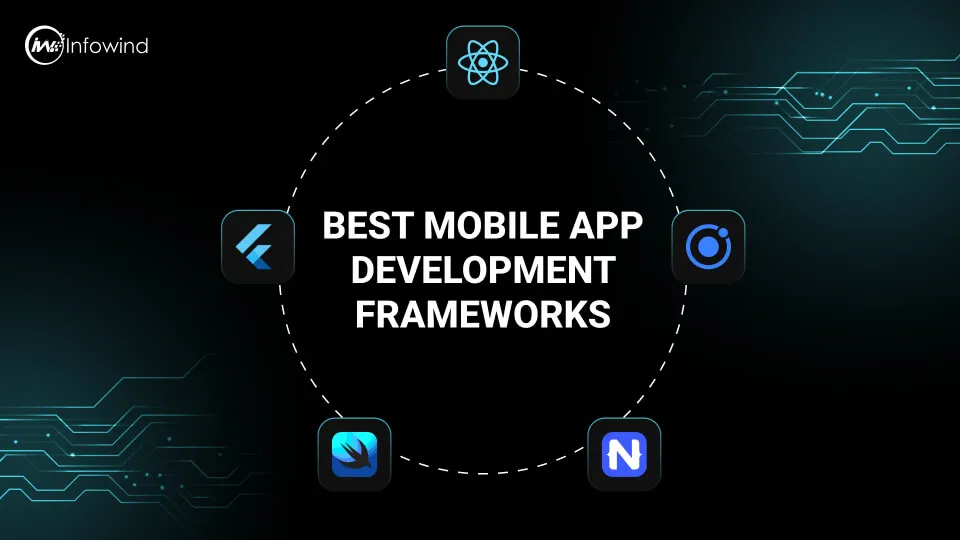
The frameworks of mobile app development are gaining more relevance annually as business organisations focus on mobile experiences. The use of mobile apps has reached more than 80% of digital time today, indicating the need for a proper framework. In 2026, it is more important to select the most optimal mobile application development framework since it has a direct impact on the speed of the apps, user experience, security, and future growth. Among all these well-known mobile app development frameworks, it might be difficult to select the right one.
This tutorial is ideal for any beginner, an entrepreneur, a student, or any other person intending to develop an app. By the close, you will get a clear understanding of the most suitable mobile app development frameworks, their advantages, and the framework that fits your needs, which would make the development process quite simpler and more effective.
What Makes a Great Mobile App Development Framework in 2026?
The best mobile app development framework in 2026 is not only a question of trends but also of creating apps that are fast, flexible, and future-ready. An excellent framework at this point should have a high level of cross-platform support so that a single codebase can be used to write an Android and an iOS application. It must also be high-performing, have an active and large community, and be a rich ecosystem of plugins, libraries, and tools.
The other significant reason is AI integration. As generative AI is going to be a fundamental aspect of the new-generation applications, developers require models that can facilitate AI-powered functionalities such as chatbots, personalisation, and automation.
It is also necessary to be compatible with new technologies. By 2026, the leading mobile app development frameworks should seamlessly integrate with AR/VR, GenAI, and 5G to provide immersive and low-latency experiences. Apps are not effective anymore; they should be smart, interactive, and real.
The real world presents some difficulties to developers as well: meeting deadlines, preventing performance problems, locating solid third-party extensions, and keeping pace with incessant upgrades. An excellent structure will decrease these pain points by providing stability, easy debugging, and easy documenting.
Once all these boxes are checked by a framework, it will prove to be a powerful tool in the development of modern, scalable, and future-ready mobile apps.
Also Read: Why mobile applications are beneficial for your business?

Top Mobile App Frameworks in 2026
Selecting the optimal mobile app development frameworks may seem daunting, given that there will be numerous formidable frameworks in the market in 2026. To simplify the matter, the following is an introductory and concise overview of the most popular mobile application development models and what each has to offer.
1. Flutter (by Google)
Flutter still remains the top player in mobile app development frameworks since it provides a fast performance and beautiful UIs.
Ideal Use Cases: great apps, startups, MVPs, and apps that require pixel-perfect designs.
Key 2026 Enhancements:
- Faster rendering engine
- Smarter AI-assisted widgets
- Additional support for foldable and wearable gadgets.
2. React Native (by Meta)
The great use of React Native is still a leader due to its robust community and versatile JavaScript platform.
Ideal Use Cases: Social applications, E-commerce applications, and cross-platform applications that require a lot of user interaction.
Key 2026 Enhancements:
- Faster performance, TurboModules.
- Built-in AI and ML utilities
- Increased tightness with 5G networks.
3. SwiftUI (for iOS Apps)
SwiftUI is the current UI-based framework of Apple and the one that developers who create Apple-exclusive applications use.
Ideal Use Cases: Both iOS and iPadOS applications and native, highly performing macOS applications.
Key 2026 Enhancements:
- Advanced animation APIs
- Improved support of Vision Pro and AR applications.
- Quickened previews and debugging software.
4. Kotlin Multiplatform (KMP)
KMP is quickly becoming a potent platform for a cross-code-sharing tool, with retained native UI layers.
Ideal Use Cases: Apps that require native performance and share the business logic.
Key 2026 Enhancements:
- Waterproof multiplatform libraries.
- Improved iOS interoperability.
- Improved real-time application performance.
5. Xamarin /.NET MAUI (by Microsoft)
.NET MAUI has evolved into a powerful cross-platform application development framework built on C#.
Ideal Use Cases: Enterprise applications, dashboards, secure and scalable business applications.
Key 2026 Enhancements:
- Improved integration of cloud with Azure.
- Desktop + mobile development has been made easier.
- AI-driven debugging tools
6. Ionic
Ionic suits well when it comes to developing applications within a limited amount of time with the help of web technologies such as HTML, CSS, and JavaScript.
Ideal Use Cases: WebView-based applications, hybrid applications, and administration applications.
Key 2026 Enhancements:
- Lighter build sizes
- Faster WebView performance
- Better UI elements of 5G-enabled apps.
7. NativeScript
NativeScript enables the writing of actual native applications in JavaScript or in TypeScript.
Ideal Use Cases: Apps that require nativity with no Java/Kotlin/Swift knowledge.
Key 2026 Enhancements:
- Supported Better native modules.
- More performances of animation.
- Updated AR/VR compatibility
8. Contour (Android UI Toolkit)
Jetpack Compose is an Android application framework that is used to make it modern.
Ideal Use Cases: Web 2.0 Android applications that are intuitive to use and fast to develop.
Key 2026 Enhancements:
- Supercharged performance
- Multiplatform compatibility.
- AI-assisted forms of creation of UI.
9. Unity (For AR/VR Apps & Games)
It is the unity that is the most powerful engine in the development of immersive AR/VR mobile applications and games.
Ideal Use Cases: 3D mobile games, AR/VR applications, metaverse applications.
Key 2026 Enhancements:
- More integration with Apple Vision Pro.
- Smoother mobile rendering
- AI-powered asset creation
10. Thunkable
Thunkable is a no-code tool that is perfect for creating an app without code.
Ideal Use Cases: Simple applications, Prototypes, educational applications.
Key 2026 Enhancements:
- Increased interconnections with artificial intelligence.
- New drag-and-drop components
- Better Android and iOS performance.
These mobile app development frameworks ensure that 2026 is a promising year for developers. You have the choice of the powerful native applications, cross-platform, or even the basic no-code products, and you will find a framework that best suits any level of skills and project needs.
Frameworks Comparison Table
| Framework | Platform Support | Performance | Ideal For | 2026 Highlights | AI/AR/5G Compatibility |
| Flutter | Android, iOS, Web, Desktop | ⭐⭐⭐⭐⭐ | Beautiful UI apps, MVPs, startups | Faster engine, AI widgets, foldable support | Strong AI, strong 5G, good AR |
| React Native | Android, iOS | ⭐⭐⭐⭐ | Social apps, eCommerce, cross-platform | TurboModules, ML utilities, 5G optimisation | Strong AI, moderate AR |
| SwiftUI | iOS ecosystem | ⭐⭐⭐⭐⭐ | iOS, macOS, Vision Pro apps | Advanced animation, AR upgrades, faster previews | Excellent AR/VR, strong AI |
| Kotlin Multiplatform (KMP) | Android, iOS, Web, Desktop | ⭐⭐⭐⭐ | Logic sharing + native UI | Stable KMP libraries, improved iOS support | Good AI, moderate AR |
| .NET MAUI | Android, iOS, Windows, macOS | ⭐⭐⭐⭐ | Enterprise & secure business apps | Azure integration, AI debugging | Strong AI, limited AR |
| Ionic | Android, iOS, Web | ⭐⭐⭐ | Hybrid apps, admin dashboards | Lighter builds, faster WebView | Good AI, limited AR |
| NativeScript | Android, iOS | ⭐⭐⭐⭐ | Native apps with JS/TS | Better native modules, AR/VR features | Good AR, moderate AI |
| Jetpack Compose | Android | ⭐⭐⭐⭐⭐ | Modern Android UI | Faster runtime, Compose Multiplatform | Strong AI, growing AR |
| Unity | Android, iOS | ⭐⭐⭐⭐⭐ | AR/VR apps, mobile games | Vision Pro support, AI asset tools | Excellent AR/VR, strong 5G |
| Thunkable | Android, iOS | ⭐⭐ | No-code apps & prototypes | New AI integrations, better components | Basic AI, no AR |

Expert Recommendations Based on Use Cases
The selection of an optimal mobile app development framework is based on what you are building, the size of your team, and the speed at which you would like to make a launch. The following are some of the ideas and suggestions that experts recommend to select the correct choice.
Flutter and React Native would be a good choice due to their rapid development and cross-platform capability, as well as the availability of community resources, in the case of startups and MVPs. These are renowned mobile application development frameworks that assist in the rapid launch of new businesses, with quality being maintained at a high level. Flutter is fabulous on beautiful UI, whereas React native is ideal when your group is already familiar with JavaScript.
Also Read: What Makes Flutter Ideal For MVP development?
SwiftUI is the most intelligent element in case you are developing an iOS-only application. It provides a high level of performance, animation, and good compatibility with the Apple ecosystem, such as Vision Pro and AR.
Xamarin/.NET MAUI is the best solution in the case of enterprise apps as it provides long-term stability and robust security and can be easily integrated with Microsoft Azure. It is designed with installation suits on a large scale and relies heavily.
Unity cannot be beaten in the case of AR/VR apps or in the case of gaming. It helps to enjoy beautiful 3D images, 360-degree effects, and the newest hardware devices.
In the case of fast prototyping and low-code requirements, heavy-code-free software such as FlutterFlow and AppGyver can be used by teams to transform ideas into running prototypes.
In choosing a mobile app development framework, take into consideration such long-term aspects as maintenance, scalability, and availability of talent. Flutter and React Native have high scores because they have extensive developer bases. SwiftUI and .NET MAUI are not that difficult to maintain since they are supported by Apple and Microsoft. Unity also provides high scalability of games and interactive applications.
With the appropriate framework of choice, you save yourself on development time, technical issues, and you have made an app that will be pertinent in the future.
Trends in Mobile App Development Frameworks
The mobile app development frameworks world is changing more rapidly than ever, and 2026 is building the future of smarter, more adaptable, and AI-assisted tools. The inclusion of GenAI into frameworks is one of the largest changes. The developers can now build UI layouts, user flows, and even app logic using AI-assisted tools. This hastens the process of development and is more creative and efficient than the previous one.
The popularity of low-code and no-code platforms is another trend that is increasing. These are making the doors open to non-technical founders, designers, and students to create apps without intensive knowledge of programming. There are tools such as FlutterFlow and AppGyver that are gaining strength as fast mobile development tools.
In 2026, frameworks are also becoming better in their DevOps and CI/CD. A large number of the best mobile app development frameworks now have built-in automated testing, continuous deployment, and cloud syncing, eliminating errors and accelerating the release process.
There is also a high push towards AR, VR, and XR-ready frameworks. Unity, SwiftUI, Flutter, and Kotlin Multiplatform are introducing enhanced support for immersive experiences, which make them best suited to next-generation applications and interactive products.
Last but not least, cloud-native and edge-optimised application structures are taking over the main stage. As 5G and edge computing continue to expand at a very fast pace, frameworks are becoming smarter to provide low-latency performance and real-time capabilities.
These strong trends are defining the future of well-known mobile app development models, as they assist developers in creating faster, smarter, and more innovative apps than in the past.
Conclusion
The most appropriate mobile app development structure in 2026 will depend on the objectives of your project, the competencies of your team, and the compatibility of the structure with how it will be scaled with the expansion of your application. Depending on what you are creating, an MVP, an enterprise solution, or an immersive AR/VR experience, a tool can be a good choice that can save time, cost less, and perform better.
It is best to bookmark this guide, or you can leave it with your team or friends in case you have found this useful.
Infowind Technology has the solution for skilled mobile app development services.
Contact us now so as to realise your app idea into a strong reality!