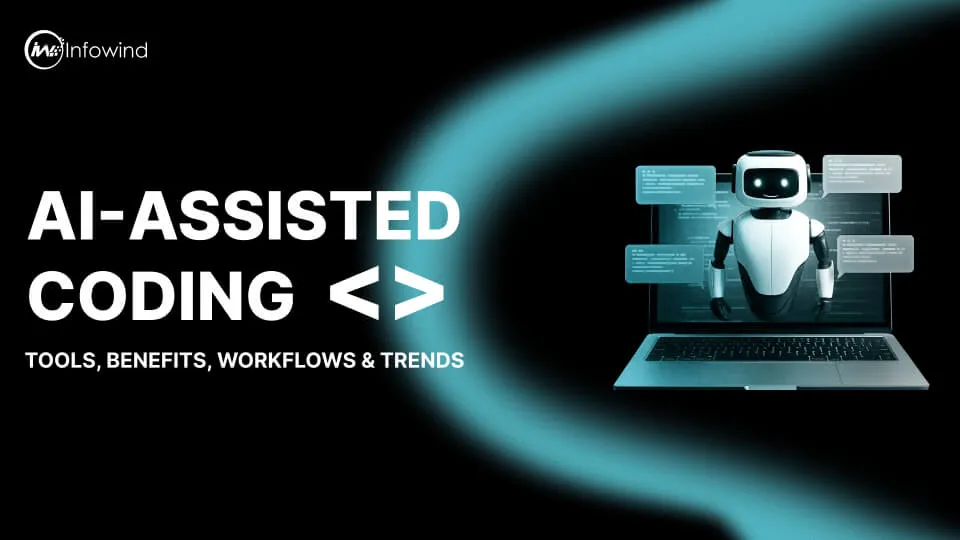
AI is changing the way we develop software, and nowadays, AI-assisted development and AI-assisted programming have become crucial elements of the contemporary coding process. In a very basic definition, AI-assisted coding refers to smart application tools that are able to propose, create, or enhance code as you write. These programming tools that are supported by AI simplify the coding process, increase its speed, and become much more effective.
According to more recent reports in the industry, approximately 76% of developers currently, or intend to code their systems using AI, and many developers report that using this technology allows them to focus less time on their activities (writing, debugging, and documenting) by 30-75%. As this adoption keeps increasing, other companies such as Infowind Technologies are also adopting AI to improve the productivity of the developers and to provide them with better software that takes shorter durations to develop.
Understanding AI-Assisted Coding
AI-assisted coding can be described as the application of artificial intelligence that assists developers with the creation, examination, and enhancement of code in real time. Rather than typing it all in, the developers receive smart code completions, compiler errors, code snippets, and full code blocks that are produced automatically. The main concept of AI-assisted development is to make AI a partner and not a tool.
In comparison to traditional coding, when the developers primarily use manual labour and experience to code, AI-assisted programming makes use of machine learning models trained on billions of lines of code. It can anticipate the coming line, correct bugs in real time, and propose superior logic. It is also not similar to conventional automation, which typically follows definite rules. AI-assisted coding assistants are based on patterns learned, which evolve and become more intelligent and flexible.
This is significant in the current software development. There is less repetition of work and a fast pace with fewer errors as the teams can move faster. The emergence of complex applications, cloud systems, and high-development rate has made AI-assisted coding very topical. It benefits amateurs and professionals and allows them to save their time and concentrate on innovative problem-solving.
Since the field of AI coding is in constant development, it is obvious that it will have a significant impact on the future of software development.
Also Read: Typing Speed and Coding: How Much Does WPM Matter?
Categories of AI-Assisted Coding Tools
The development of AI has paved the way to an entire universe of powerful tools to enable the developer to work quickly and smartly. These AI-assisted programming languages aid in the creation, review, testing, and optimization of code. The following are the key categories that predetermine the current AI-assisted coding environment.
1. Code Completion Tools
The best example of AI-assisted programming is tools such as GitHub, Copilot, and TabNine. They guess what is coming next in your code, in your functions, even complete blocks, what you want them to do. This increases ease, speed, and ease of use in codifying.
2. Debugging Assistants
The process of debugging typically consumes a significant part of a developer’s time. The code-writing AI has the property that debugging assistants can automatically identify errors, draw attention to suspicious lines, and propose simple solutions to problems at the same time, saving many hours of manual troubleshooting.
3. Security Analysts
One of the most important issues in software development is security. AI-enabled security scanners test (read) code against its susceptibility, concerning patterns or contrary techniques. They assist developers in eliminating threats in advance to enhance the software’s safety.
4. Automated Testing Tools
AI-driven testing applications include the creation of test cases, the execution of automated unit tests, and integration testing. These tools guarantee the code and lessen the manual testing of the code.
5. Code Review Assistants
Code review may be a time-consuming activity. Code review tools, which are AI-assisted, are used to test logic, formatting, performance problems, and violations of best practices. They assist teams in having quick peer reviews without compromising quality.
6. Code Generation Models
These are the keys to modern AI-assisted coding. They can create functions, endpoint API, reusable snippets, and boilerplate code. The developers just conceptualise what they require, and the AI produces ready-to-use code.
7. Tool Refiners and Optimisers
With AI, it is easier to perform tunes. These are used to analyse code inefficiencies, redundant logic, or intensive operations and propose more lean and faster alternatives. This increases the performance of the apps and the maintainability of the code.
All these categories working together, AI-assisted development is transforming the way software is developed – it is faster, safer, and much more efficient to code than to develop software, even when it comes to large teams.
Also Read: Artificial Intelligence (AI) In Everyday Life
How AI-Assisted Coding Works
Advanced technologies make AI-assisted development a place that makes the code-writing process quicker, smarter, and more intuitive. These processes assist AI-assisted programming tools to learn and comprehend code, detect bugs, and provide useful suggestions at the same time. The process behind AI-assisted coding is as follows.
1. Natural Language Processing (NLP) + Computer-Assisted Machine Learning (ML)
This is what AI-assisted coding relies on, at the core: NLP and ML models that have been trained on huge amounts of code, documentation, and development dynamics. NLP assists AI in comprehending human language; hence, when developers input comments or instructions, the tool knows what is required. ML will acquire billions of code samples to produce correct context-sensitive recommendations.
2. Pattern Identification and Future Recommendations
AI can find the coding patterns as developers do, but much quicker. AI in predicting the next line or code block of code forecasts repeat structures, common patterns of functionality, and best practices through its ability to identify those patterns. This forecasting skill conserves time and errors, particularly when the logic is complicated.
3. Contextual Human Understanding with Data
Such a contrast to mere automation, AI-assisted programming is contextualized. It examines the entire file, project structure, dependencies, and previous developer actions. This enables it to provide more intelligent suggestions, such as correcting mismatched data formats, fulfilling API requests, or creating relevant test cases.
4. IDES and Workflow Integration
The current state of AI air support is associated with programs built into mainstream IDEs such as VS Code, JetBrains, and Web-based editors. This implies that developers do not need to leave tools to get real-time code suggestions, debugging support, and optimization hints. This ensures a fluent workflow.
5. Ongoing Development Based on Feedback from Developers
Constant learning is one of the most effective mechanisms. The AI tools are enhanced with each suggestion being accepted or rejected by the developers. As time goes by, they get accustomed to the style of coding, frameworks, and project patterns; thus, AI-assisted code becomes more individualised and effective.
All of these intelligent systems collaborate to make AI-assisted development change the whole software development process — making it quicker, cleaner, and, most importantly, more productive to both the development team and novices.

Role of Generative AI in Coding Assistance
One of the largest forces that contributes to the modern AI-assisted development is Generative AI. It allows tools to learn natural language, provides the ability to write code manually, and assists developers in the lifecycle of the software. According to AI-assisted programming, the programmers are now able to turn ideas into working code in the quickest time possible. This is where generative AI becomes an important factor that can revolutionise the coding experience.
1. Code Generation Large Language Models (LLMs)
The fundamental component of generative AI is Large Language Models (LLMs), advanced models that are trained on a large volume of code and technical documentation. These models can produce functions, debug, create APIs, documentation, and even complete workflows. This renders the AI-assisted coding very potent to both amateurs and professional developers.
The LLMs study patterns in millions of code repositories and learn the workings of various programming languages. This enables them to develop optimal, precise, and readable code with less manpower.
2. Machine Translation of Natural Language to Code
Among the most remarkable capabilities of the current AI in the field of coding are the possibilities to convert plain English instructions into working code. The developers can just enter a request such as:
Add an email, password verification, and login feature.
And the AI makes the entire code immediately.
The complexity is eliminated by this natural language-code translation, and the entry barrier for new programmers is reduced, which makes AI-assisted programming tools very accessible and easy to use.
3. Popular Generative AI Tools
Among the innovative tools that are developing the future of AI-based programming, there are:
- OpenAI Codex: This is known to power GitHub Copilot, which can generate quality code.
- Code Llama: The open-source LLM of coding.
- Other AI-aided coding models were added to IDEs and cloud systems.
The tools are industry-friendly as they support a large variety of languages and frameworks.
Generative AI is transforming the programming culture of developers. Natural language translation, powerful LLMs, and advanced coding models are all making AI-assisted development many times faster, smarter, and efficient than ever before.
Importance of Context in AI-Assisted Coding
One of the aspects that has been the most significant determinant of successful AI-assisted development is context. As AI technologies comprehend the entire enterprise (the project structure, the style of coding, frameworks, and logic flow), they will provide much more precise recommendations. This external awareness will enable AI-assisted programming tools to behave more like intelligent partner code completion tools, and less like core autocomplete ones.
1. Why Contextual Awareness Enhances Accuracy
Context in AI-assisted coding is used to make the AI realise what the developer is attempting to accomplish. The AI does not guess random codes; it is exploring the nearby code, structure of files, variables, and dependencies, as well as past responses of the user. This enhanced knowledge will make AI in coding create smarter recommendations, reduce errors, and provide more relevant code blocks.
To give you an example, utilising a project by React, a virtual assistant will proactively propose parts of that project by components, hooks, or patterns developed using React, rather than snippets.
2. Poor Context Understanding Risks
The operation of the AI tools would not be reliable when they do not have the proper context. This can lead to:
- Inappropriate or wrong code suggestions.
- Bugs brought about by incompatible logic/data.
- Duplicity or redundancy of functions.
- Code security threats due to inappropriate code patterns.
Although AI-assisted programming is potent, bad context may confuse and compel the developers to waste some time in rewriting or debugging artificially generated code.
3. Best Practices for Developers to Maximise the Usage of Tools
Developers ought to observe a few practices to maximise the use of AI-assisted programming tools:
- Serious comments should be made to provide the AI with appropriate guidance.
- It is necessary to keep a clean and consistent code to ensure that the AI recognises patterns easily.
- Minimal work increments – split large tasks and get suggestions.
- Foreign policy should be reviewed with caution by the AI output.
- Give feedback by accepting or rejecting suggestions, and allow the tool to get to know your style.
Knowing how to operate and utilize context, developers will be able to reach all the potential of AI-assisted code, accelerate the workflow, clean it, and make it more precise, avoiding the risks that are not necessary.
Benefits of AI-Assisted Coding
The software world is changing with the use of AI-assisted development, as it allows making the process faster, smarter, and much more efficient. The latest AI-powered programming tools allow app developers of any level of skill to become more productive and write cleaner code, and create high-quality apps with less effort. We shall look into the key advantages of AI-assisted coding and its transformation of the development process.
1. More Productivity and Less Development
A significant benefit of AI-assisted coding is that it enhances productivity by a very large margin. The AI tools can produce code, finish functions, correct bugs, and propose superior logic in just a few seconds. This will enable developers to avoid repetitive work and concentrate on the current problems. Using AI in coding, work that previously took weeks can now be finished in days – this greatly accelerates delivery times.
2. Fewer Bugs and Higher Quality of Code
Building applications that are not vulnerable requires high-quality code. Millions of code examples are analysed by AI tools, and this assists them in automatically detecting bugs, bad practices, and performance problems. The resulting smart ideas will result in cleaner and stronger code. This means that the AI-assisted programming lowers the number of human errors and guarantees enhanced long-term maintainability.
3. Better teamwork (AI as a “Pair Programmer”)
AI is similar to a friend who is a pair programmer, and it is always willing to help. It assists programmers in adhering to the coding conventions, testing logic, and increasing comprehension. In teamwork, the AI-assisted programming tools help to maintain best practices by all, and thus, the collaboration becomes easier. This coding partner is online 24/7, and it will give guidance where necessary.
4. Improved Learning Among the Junior Developers
In the initial stages, AI-assisted coding seems like an inbuilt prophet. The juniors will have an opportunity to learn more rapidly by following AI recommendations, finding out the best methods, and trying auto-generated samples. They feel confident when they write code under the guidance and do not feel overwhelmed. This makes the learning process faster and more likely to make them professional developers in shorter periods.
5. Cost Savings for Companies
With AI-assisted development, less time is spent on manual work, the delivery process is faster, and the possibility of costly bugs is minimised. Organisations would save in terms of development hours, maintenance, and rework. As the release cycles are faster and efficiency is enhanced, organisations are able to bring the projects to the market earlier, gaining a competitive advantage at a lower cost of operation.
All those advantages being there, it is obvious that AI-assisted development is no longer a trend, but the future of creating software. Higher productivity, improved learning, and cost reduction are only a few of the benefits that AI-assisted coding will bring to teams to create more intelligent, efficient, and dependable technology.
Challenges & Limitations of AI-Assisted Coding
Although AI-assisted development is associated with huge gains, there are problems that programmers and business organizations should learn from. Even the brightest AI-assisted computer programming tools cannot be flawless. They are based on patterns, training information, and context, which implies restrictions are bound to be in place. The following are the major pitfalls of AI-assisted coding that should not be forgotten by any team.
1. AI-Based Mistakes and False Positives
Even though AI serves as a solution that allows discovering the issue in a short period, it can also cause additional bugs or give emphasis to the problems that do not really exist. Such false positives may cause delays in the working process and misunderstandings among developers, particularly among novices. Artificial intelligence proposals can seem correct but still have logical fallacies or pointless types of data. This is why it is necessary to review it by humans.
2. Over-Reliance on Tools
The other significant threat of AI-assisted programming is that the dependency of developers on the AI tool will be excessive. As the dependency increases, the skills in problem-solving that are performed manually might be undone over time. The developers may overlook the basic knowledge and use AI-generated solutions, which are detrimental in complex or critical projects. AI must be able to support but not to supplant human thinking.
3. Intellectual Property/Licensing
The majority of the code that is used to train AI models contains copyrighted or licensed code and is often based on large volumes of code. This brings about a question of intellectual property (IP). The AI-generated code can be unintentionally similar to licensed code, which can cause legal problems. Firms that apply AI-assisted programming software should remain conscious of such risks and apply safe coding.
4. Information Protection and Data Security
Certain AI tools need to be connected to the cloud, and that is why the developers can accidentally leak sensitive data or proprietary code. This may introduce loopholes or compliance problems, particularly in industries such as finance, healthcare, or government. Using AI-assisted coding tools, it is important to secure the environments and adhere to strict rules of data privacy.
5. Weaknesses in the Master’s Domain-specific Problems
Whereas AI is a terrific trend spotter, it has difficulties with in-depth understanding of the domain. As an example, the logic in industries such as fintech, medical software, or even scientific programs can not be completely grasped by AI tools. Due to this, the code generated can be generic or may not be crucial about domain accuracy. Such a situation cannot replace human expertise.
Nevertheless, AI-assisted development remains a potent tool if teams can apply it appropriately. Knowing its weaknesses enables developers to take advantage of AI-assisted coding without taking unwarranted risks.
Popular AI-Assisted Coding Tools
The current AI-assisted development is fueled by various sophisticated tools that enable developers to write and review code quickly and optimize it through enhanced methods. Such AI-assisted programming systems provide code completion through debugging and documentation assistance. Some of the most popular tools and their applications and official sources are listed below.
1. GitHub Copilot
GitHub Copilot is based on OpenAI models to write code suggestions in real-time. It assists in code completion, generation of functions, and documentation. The tool is ideal when developers need fast and intelligent code assistance.
2. TabNine
TabNine is an AI-based code prediction tool based on rapid code completion. It supports various languages and is easily compatible with the majority of IDEs. Best suited to the developers who like to code lightweight AI-oriented solutions and are privacy-conscious.
3. Amazon CodeWhisperer
CodeWhisperer, an AWS-specific code recommendation, is an AI-based tool. It is very good with cloud, serverless, and backend development.
4. Codeium
Codeium is an open-source AI-based code generation tool that provides code generation, search, and autocomplete. It works with dozens of languages and is reported to have high performance.
5. Replit Ghostwriter
Ghostwriter assists developers in creating and deploying apps on the Replit platform itself. It offers suggestions for code, debugging, and automatic generation of projects.
6. ChatGPT for Coding Support
ChatGPT assists developers with their coding issues, function generation, debugging errors, and explanations of sophisticated concepts in simple words, which is why it is perfect for learners and experts.
These devices simplify the AI-assisted programming, as they assist the programmers to work smarter, quicker, and more precisely.
Also Read: Must-Have ChatGPT Plugins to Transform Your Workflow
Future of AI-Assisted Coding
AI-aided development is a very bright future, and significant improvements are to be achieved in the period between 2026 and 2030. With AI-assisted programming tools getting more and more capable, developers will have an entirely new experience of creating software, which is faster, more natural, and efficient. The following is an examination of the major trends that will influence the next ten years of AI-assisted coding.
1. Greater Code Generation From Universities
By 2030, AI coding will develop into very intelligent systems that can produce complete applications, as opposed to snippets. These tools will be more aware of architecture, business logic, and user requirements, thereby making the development quicker and more automated. Access to code generation will be more precise, tailored, and ready to use.
2. Integration of more IDEs and DevOps
The next generation of AI-assisted programmers will have a smooth path in the whole development process, including coding and testing, deployment, and monitoring. The AI agents will be embedded in IDEs and will be able to execute such tasks as automated debugging/optimisation of CI/CD, and prediction of errors, and, therefore, will have a significant impact on the reduction of human involvement.
3. Artificial Intelligence in Low-Code/No-Code Systems
Smarter AI engines will revolutionise low-code and no-code applications. The user will be able to enter simple commands, such as Build a booking system and AI will create useful apps in real-time. This will not only make software development available to non-technical users but also enable businesses to innovate at a quicker pace.
Also Read: Machine learning and Artificial Intelligence’s Effects on Software Development
4. Better Elucidation and Openness
One subject that will get significant attention is explainable AI. Developers will insist that AI tools have a clear explanation of the reason why a suggestion was created, what it is, and how it influences performance. This openness will create trust and make coding aided by AI easier and safer to implement.
5. AI Coding Assistants Are Ethical
The tools in the future will adhere to high ethical principles – safe data management, less biased code, and compliance with licensing regulations. Enterprises will pay a lot of attention to safe and regulatory AI-aided program development solutions to safeguard intellectual property.
6. Influence on Developer Jobs and Designations
AI will not put developers out of business; it will make them more effective. The roles will be switched to strategic thinking, architecture designing, problem-solving, and AI supervision. Novices will develop quickly than ever before, and seasoned developers will become more productive and creative.
Software development will be redefined in the next decade, and AI-assisted coding will be at the centre of such changes, making teams more empowered, faster, and the future of technology.
Also Read: Developers vs. AI: Who Will Lead the Future of Work by 2030?
How Infowind Technologies Can Help With AI-Assisted Coding
Infowind Technologies is determined to assist businesses in adopting the future of software development based on intelligent, efficient, and contemporary AI-assisted development solutions. Infowind is a team of passionate and skilled experts who will enable the organisation to become more productive, write less code, and create higher quality products with the help of advanced tools and tailored AI integrations.
1. Custom AI Tool Integration
Infowind assists companies in incorporating the most popular AI-assisted programming tools, such as GitHub Copilot, CodeWhisperer, Codeium, and others, into their existing processes. This guarantees easy adoption and accelerated development cycles.
2. Artificial Intelligence Code Review and Optimisation
Through AI-aided codifying, Infowind can improve the quality of code through automated reviews, performance recommendations, and bug detection. This minimizes the error during development and enhances the stability of the software products.
3. Quickened Product Development utilising AI Workflows
Infowind develops AI-based workflows that can automate repetitive processes, simplify the locations of code, and increase the speed of product delivery. AI coding saves time-to-market since it is used in code generation up to testing.
4. Training, Upskilling of the Developer
In order to ensure the maximum advantage of AI-assisted programming, Infowind offers practical training courses to the teams. With the help of AI support, developers get to know how to work with AI tools and become productive, and adhere to the best practices of code development.
5. Personalised AI Development Solutions
Infowind Technologies is also a developer of personalized AI solutions to companies that would like to develop their own AI models or add AI functionality to applications. These are solutions that are customized to the specific project requirements and industry requirements.
With the help of potent AI-based codes and tactics, Infowind Technologies enables companies to remain innovative, develop at a quicker pace, and create smarter computer software without trepidation.

Conclusion
The future of software development is being transformed with the use of AI. Using potent AI-supported programming aids, developers will have an opportunity to write speedier code, minimise bugs, and devote additional time to creativity and solving issues. AI-assisted coding is a game-changer across code generation and debugging, up to optimisation by both large and small teams.
Nevertheless, AI is a tool to help and not to substitute developers. Great software is left to human expertise, logic, and choice. Intelligent use of AI as a coding tool can become a valuable ally that develops instead of stealing the game.
The developers and businesses should look into AI tools now to see how to adapt smarter processes and prepare for the future of development that is AI-driven. The adoption of these technologies today will provide strong, faster, and innovative software in the future.