The chatbots have developed throughout the last ten years. Simple chatbots were basic text-based systems that responded to simple queries with responses that were pre-written scripts. As of today, AI chatbots can now be easily used to provide a higher level of human-like chat capability and visual interaction with 3D avatars due to the development of artificial intelligence, natural language processing, and real-time graphics.
The new generation chatbots are being extensively employed as virtual receptionists, online tutors, and healthcare assistants, to enable organizations to offer real-time and customised assistance. Hospitals, as an example, can use AI-powered virtual assistants to help patients navigate the appointment booking process, and education platforms use avatar tutors that interpretively explain the lesson.
The fast spread of conversational AI shows how it will affect user experience. Research indicates that 67% of consumers have used a chatbot to get assistance, and almost 95% of customer support will be AI-mediated in 2025.
Through a blend of conversational intelligence with animated avatars and voice interaction, a business is able to develop interactive and human-like digital assistants. This guide will discuss the technologies, development stage, benefits, and cost of creating an AI chatbot using a 3D talking avatar.
What is a 3D Talking Avatar Chatbot?
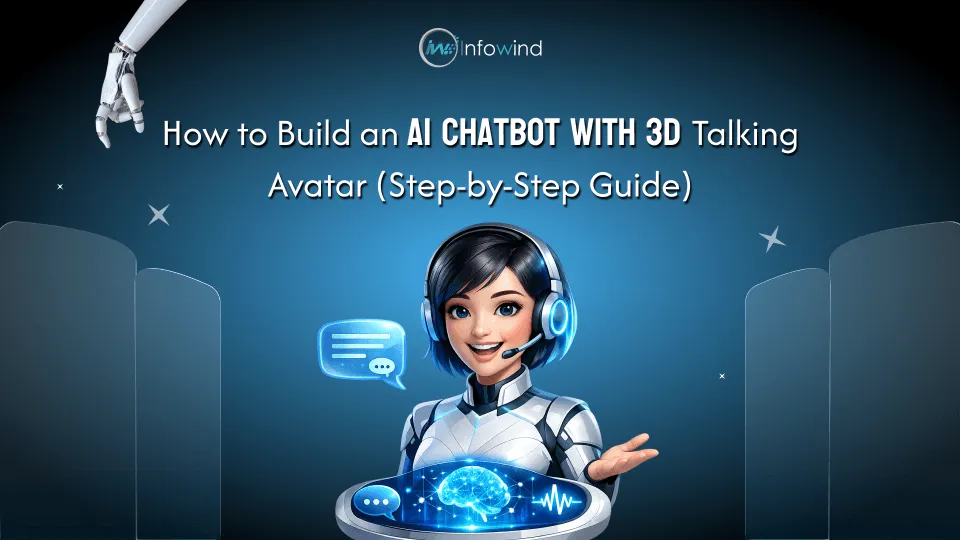
The 3D talking avatar chatbot is a higher-order chat system that integrates the power of artificial intelligence with a 3D digital character that can talk and lip-sync, and even show human-like expressions. In contrast to the conventional text-based bots, the technology enables people to deal with a visual AI assistant that speaks, moves its face, and talks to a user in a natural way. Simply put, a chatbot that uses AI with a 3D avatar will make a typical chatbot more engaging and more human-like as a digital agent.
In a way, a 3D AI chatbot is a combination of many modern technologies that combine to produce a real-life experience:
| Technology | Role in the Chatbot |
| Natural Language Processing (NLP) | Understands and interprets user queries |
| Text-to-Speech (TTS) | Converts AI responses into natural voice |
| Lip-Sync Technology | Synchronises speech with the avatar’s mouth movement |
| Emotion Recognition | Detects user sentiment and adjusts responses |
| 3D Rendering & Animation Engines | Generate and animate the avatar in real time |
The technologies make the avatars’ chatbot talk more naturally to the users, which makes online communication seem more similar to talking with a human. Industry research indicates that conversational AI technologies are becoming very popular, and businesses are pursuing more interactive forms of customer experience. The conversational AI market is estimated to hit a record of $49.9 billion worldwide in 2030, which shows the increasing need for intelligent virtual assistants.
An example of the technology in action that is practical would be customer onboarding systems. New users do not need to read the instructions but can chat with a virtual assistant in 3D who then welcomes, explains product features, and answers questions in real-time. This strategy enhances interaction, makes complicated tasks easier, and establishes a more attractive user experience.
Why Businesses Are Adopting AI Chatbots with 3D Avatars
We are witnessing a fast adoption of AI chatbots with 3D avatars by businesses in any industry to develop more interactive and human-like online interactions. Older text chatbots are capable of providing answers, but are generally not as visual and attached as the modern user is. An avatar chatbot with a personality is provided by a 3D talking avatar, which introduces a sense of personality, voice interaction, and expressiveness to a digital interaction, therefore making it more natural and interactive.
A report by Gartner suggests that as many as 80% of all communication between customers and organisations will be carried out by conversational AI by the year 2029, demonstrating how fast organisations are moving towards using AI-based communication solutions.
Some of the most salient factors contributing to companies’ investment in 3D AI chatbots and talking avatar assistants are presented below.
Human-Like Interaction and Sympathy
The next greatest strength of a talking avatar chatbot is that it is based on simulated interaction with a human being. A 3D animated chatbot can speak to users in a more personal manner, making communication easier through facial expressions and a voice tone, as well as speech that is lip-synced.
As an illustration, a 3D virtual assistant chatbot, in the healthcare platform, may welcome patients, describe appointment processes, and react to the voice tones compassionately. This is a good degree of interaction that makes the users feel more accepted and understood, which enhances user satisfaction.
Better Brand Personality and Trust
A 3D avatar chatbot enables companies to have a stable digital personality that reflects their brand. Users do not talk to a generic chat window; instead, they talk to a recognisable digital assistant that symbolically represents the company.
There are numerous brands worldwide that apply an AI chatbot with a talking avatar and use it as a virtual receptionist or brand ambassador on the internet and in applications. The familiarity and trust are created through this visual identity, as the users are convinced that they are dealing with a professional and credible organisation.
According to research by PwC, 73% of consumers indicate that customer experience plays an important role in their buying decisions, which evidences the need to pursue digital interactions.
Accessibility Through Voice and Visual Aid
The other significant factor that has led to the use of AI chatbots with lip-sync avatars is accessibility. Such systems are easier to interact with since they offer visual and voice-based communication in contrast to text-only interfaces, which are easier to interact with by a wider audience.
For example:
- Voice interaction is beneficial to those users who find it difficult to type.
- Avatars that are animated give visual cues that enhance comprehension.
- Spoken responses help users who have problems with reading.
This is why the 3D AI chatbots are especially helpful in such industries as education, public services, and healthcare, where access and clarity are vital.
Expressive and Multilingual Communication
The current AI avatar chatbot developing platforms have a variety of languages and expressive speech generation. A talker chatbot is a 3D character that could talk with people who speak other languages and change the tone of voice, facial expressions, and gestures to correspond with the interlocution.
The feature enables international companies to implement 3D virtual assistant chatbots that can operate with customers in various locations without the need to have multilingual call centres.
As an example, a global e-commerce organisation may implement a 3D cartoon chatbot that welcomes users to speak their native language, describes the features of the products, and offers them assistance in real-time. This enhances customer interaction, besides cutting operational expenses considerably.

Core Technologies Behind 3D Talking AI Chatbots
The construction of a 3D chatbot in the form of a talking avatar will entail both the application of artificial intelligence and speech technologies and the real-time graphic system. All of the technologies have a certain role in allowing the 3D avatar AI chatbot to interpret users, create answers, and deliver them in a realistic animated form. The following are the fundamental technologies driving the 3D AI chatbots nowadays.
Natural Language Processing (NLP) – Understanding User Queries
Natural Language Processing (NLP) is the tool that enables an AI chatbot with a speaking avatar to comprehend what users are talking or typing. NLP does not use predefined scripts, but it examines language structures, surroundings, and objectives as a means to understand the query correctly.
For example, if a user asks:
Would you please assist me in making an appointment for tomorrow?
The NLP engine recognises the purpose (is it an appointment being scheduled) as well as the important information like the date and time. In the current NLP models, it is also possible to identify changes in wording, slang or unfinished sentences which make the conversation more natural.
The industry research predicts that the NLP market will be more than $91 billion by 2030, as it has become an important part of the conversational AI systems.
Speech-to-Text (STT) & Text-to-Speech (TTS) – Voice Interaction
Many AI chatbots, with lip-sync avatars, have voice interaction as a characteristic feature of their interaction. Two complementary technologies allow this to be facilitated:
| Technology | Function |
| Speech-to-Text (STT) | Converts spoken user input into text that the AI can process |
| Text-to-Speech (TTS) | Converts the chatbot’s text response into natural-sounding speech |
These systems provide users with the option of communicating directly with a virtual assistant chatbot that is in 3D instead of typing in messages. The current speech synthesis systems are capable of generating a very natural voice with tone, speed, and stress variations to enhance interest and comprehension.
As an example, a 3D animated chatbot, which serves as a customer support service, can welcome visitors orally, respond to queries regarding products, and know how to work on a problem.
3D Modeling & Animation Engines
The 3D avatar chatbot is a 3D talking avatar, which is designed using 3D modelling and animation engines. This software creates and develops the virtual personality of the AI assistant.
The platforms that are often used are:
| Platform | Purpose |
| Blender | Creating and designing 3D avatar models |
| Unity | Real-time rendering and interactive avatar experiences |
| Unreal Engine | High-quality graphics and realistic animation |
| Ready Player Me | Generating customizable avatar characters |
These engines enable developers to develop avatars with the appearance and behaviour of a real human being and their interaction with the environment. They can be used together with AI conversation systems, which help a 3D AI chatbot look more like a digital human instead of a fixed interface.
Lip-Sync & Emotion Mapping
A talking avatar chatbot should correspond the speech to facial expression to achieve the feeling of real communication. This is where emotion mapping and lip-sync technology are required.
Lip-syncing involves audio and video, and analyzes audio output and moves the avatar’s mouth motions in real time so that it looks as though they are saying what they are saying. Meanwhile, emotion mapping can be used to make the avatar smile, nod, or look concerned under specific circumstances of the conversation.
As an example, when a user enters a chat with a 3D virtual assistant, the avatar can smile and speak in an excited voice. In case the user complains about something, the avatar may reply witha less anxious voice and understanding facial expression.
Such minor visual effects greatly enhance the experience of the user, and the interaction becomes more natural.
AI Frameworks & APIs
The conversational intelligence is linked to the avatar interface behind the scenes using AI frameworks and APIs. All these tools deal with dialogue processing, integration of AI models, and back-end communication.
Widely recognised models of developing AI avatars and chatbots are:
| Framework / API | Role |
| OpenAI APIs | Advanced language models for conversation |
| TensorFlow | Machine learning model development |
| Google Dialogflow | Conversational AI and intent detection |
| Microsoft Bot Framework | Building and managing chatbot infrastructure |
These frameworks assist developers in making scalable systems with the capability of serving thousands of conversations at the same time without losing the correct response.
Firms dealing with AI chatbots with 3D avatar systems, like Infowind Technologies, are based on validated frameworks and AI-proven platforms, so that the solution would be reliable, secure, and performance-based. Through the combination of trusted AI models, voice technologies, and 3D animation tools, organisations have been able to create strong 3D talking avatar chatbots that provide reliable and intelligent user interactions.
Also Read: Must-Know Programming Languages for AI Development
Step-by-Step Process to Build an AI Chatbot with a 3D Talking Avatar
The creation of an AI chatbot with a 3D avatar is a combination of conversational AI, speech technologies, and real-time 3D animation systems. When a good development process is organised, it will mean that the chatbot will provide rightful answers without compromising a natural and interactive user experience. The following is a detailed step-by-step procedure for creating a 3D talking avatar chatbot, and tips for developing a chatbot and tools.
Step 1: Work out the Purpose and User Goals
The initial process of developing an AI avatar chatbot is determining the main function of the chatbot and the nature of users who will utilise it. This assists in defining the dialogue dynamics, avatar character, and technical specifications.
Common use cases include:
- Product or service answer customer support, agents.
- Website/office virtual receptionists.
- Students are guided by education assistants who also take them through lessons.
- These are avatars that can be used to schedule appointments or give directions to the patient through healthcare.
It is well defined that user goals will help the 3D virtual assistant chatbot provide meaningful interactions to the user and not just generic answers. Another reason why businesses are advised to map common user queries and scenarios is during the pre-development stage.
Step 2: Choose an NLP Engine
The Natural Language Processing (NLP) engine does the work of comprehending the questions of the user by interpreting them and creating appropriate answers. To develop an efficient 3D AI chatbot, it is necessary to select a stable NLP system.
The most common NLP websites are:
| NLP Platform | Key Benefit |
| Google Dialogflow | Easy integration with conversational interfaces |
| GPT-based models (LLMs) | Advanced contextual conversation abilities |
| Rasa | Open-source framework for customizable AI chatbots |
In case of complex interactions, most organisations integrate the large language models (LLMs) with the rule-based conversation flows to enhance accuracy and minimise errors.
Step 3: Design or Integrate a 3D Avatar
The second step is the development of the visual image of the chatbot. A talking avatar chatbot often relies on a digital character who can talk, move, and make facial expressions.
Developers can either:
- Make a 3D model of yourself into an avatar with a 3D modeller VI application like Blender.
- Use avatar websites such as Ready Player Me or similar.
- Include ready-made avatars offered in development engines in 3D.
These avatars are then developed by real-time engines like Unity or Unreal Engine, which enable the avatars to dynamically interact with the users.
Step 4: Implement Text-to-Speech, Speech-to-Text, and Emotional Expressions
In order to support voice input interaction, the chatbot needs to have Speech-to-Text (STT) and Text-to-Speech (TTS) services.
| Technology | Purpose |
| Speech-to-Text (STT) | Converts user voice into text for the AI system |
| Text-to-Speech (TTS) | Converts AI responses into natural voice output |
Emotion mapping is also employed in modern AI chatbots with lip- sync avatars. This will enable the avatar to change facial expression and tone according to the environment of a conversation and make the interaction more human-like.
An example is when a chatbot is a 3D animated character and you, as a new customer, are greeted with their smile, and when you complain, the emotion may turn to a calmer and understanding one.
Step 5: Connect Chatbot Logic with Avatar Animation
At this point, the developers combine the AI conversation engine and the animation system of the avatar. This makes the avatar speak, move, and respond in real time according to the chatbot responses.
This interface is typically established either using SDKs (Software Development Kits) or via APIs, and this synchronises:
- AI-generated responses
- Voice output
- Lip-sync animation
- Facial expressions
It is usual to do it with frameworks like Microsoft Bot Framework, OpenAI APIs, or even a custom backend service.
Step 6: Test for Realism, Accuracy, and Performance
Testing is an important measure in making a 3D virtual assistant chatbot reliable. Before rolling out, developers are to consider many factors:
- Conversation Accuracy – Making sure the AI can comprehend questions.
- Avatar Realism – Ensuring that the lips and facial expression are in sync with the speech.
- Response Latency – Making sure the responses are prompt.
- Cross-Mobile Compatibility – Testing on web, mobile, and others.
It is also useful when the user testing sessions are used to find out the confusing responses or the unnatural behaviour of avatars.
Step 7: Deploy the Chatbot on Target Platforms
After the test is passed, the AI chatbot with the talking avatar can be implemented in various digital settings.
Typically used channels of deployment are:
- Onboarding and customer support sites.
- Personalised help mobile apps.
- Interactive kiosks in malls/airports.
- Tutor learning platforms on AI.
Cloud platform and scalable infrastructure are also frequently utilised by the developers so that the 3D AI chatbot can service a large number of user interactions without performance-related problems.
Practical Development Tips
Developers of the 3D avatar-based AI chatbot ought to keep in mind the following best practices to create a reliable one:
- Begin with an understandable design of the conversation and user maps.
- Practical AI learning modules and artificial intelligence.
- Performance and realistic animation optimisation of avatars.
- Constant monitoring and reaction to chatbot responses through true feedback from users.
Infowind Technologies, a company specialising in chatbot creation based on AI, tends to use proven AI systems, extensible APIs, and sophisticated animation systems to provide businesses in any sector with a powerful 3D talking avatar chatbot.
Example Use Cases of 3D Avatar AI Chatbots
The use of AI chatbots, which come as 3D avatars, is growing at a very high rate in the industries. In comparison to the old-fashioned chatbots that can only suggest the use of text to respond, a 3D talking avatar chatbot offers a visual and verbal interface that is more human-like to the users.
Users do not have to use a basic chat box but communicate with a digital character who may talk, show emotions, and reply in real time. This anthropomorphic interaction enhances interaction, trust, and experience.
Accenture found that 91% of consumers will be more willing to interact with brands that provide individualized digital experiences.
Some of the real-life applications of 3D AI chatbots in digital interactions are shown below.
Education – Interactive AI Tutors for Virtual Classrooms
The 3D virtual assistant chatbots are being deployed on online learning platforms to make digital learning more interactive.
Students no longer have to watch tapes of lectures or read some dead material, but can communicate with a talking avatar chatbot who will explain a lesson and answer questions in real time.
For example:
- A 3D AI tutor can describe mathematical concepts sequentially.
- Avatar teachers may be used in language learning apps to engage them in conversation.
- The students are able to ask questions at any time and get an immediate answer.
This makes the learning process more interesting and closer to the learner, particularly when the learner is a young child who can best receive visual communication.
Healthcare – Patient Guidance and Appointment Booking
AI chatbots in the form of talking avatars are also being embraced by healthcare organisations to enhance communication with their patients.
A chatbot in the form of a 3D talking avatar can help patients with the following:
- Booking appointments
- Fluent in taking orders for treatment
- Finding my way around hospital services
- Providing answers to health-based common questions
As an illustration, a hospital website can have an example of a 3D virtual healthcare assistant, which will greet the patients and take them through the process of booking an appointment.
The personal voice and faces contribute to making the experience of patients more relaxed and convincing.
Retail – AI Sales Associates in Virtual Showrooms
The 3D animated chatbots are being considered by retail firms as online stores’ electronic sales assistants and immersive shopping experiences.
A chatbot 3D avatar can be used in a virtual showroom:
- Welcome, shoppers who have arrived in the store
- Suggest the items according to preferences
- Explain product features
- Help in making buying decisions
In this way, a user is able to experience the process of talking to a real sales representative and retain the scalability of the digital platform.
With the increasing volume of metaverse-style retail experiences available, AI chatbots combined with 3D avatars will be important in interactive shopping experiences.
Gaming & Entertainment – Real-Time Conversational NPCs
One of the most thrilling fields of application of 3D AI chatbots is the gaming industry.
Historically, games have NPC characters following a pre-written dialogue. Nevertheless, an AI-based 3D talking avatar chatbot is able to create real-time conversations with players.
This enables the game characters to:
- Reactive to the actions of the players
- Answer questions naturally
- Change their personality when they are playing
Consequently, the games become more interactive and engaging, and make the players believe that they are communicating with real characters rather than built-in bots.
Also Read: AI in Entertainment: Key Features, Benefits & Real-World Use Cases
Customer Support – Human-Like Digital Brand Representatives
The most common AI avatars chatbot application is customer support.
The adoption of AI chatbots instead of traditional chat widgets is becoming popular among numerous companies with talking avatars as digital brand representatives.
These avatars can:
- Greet visitors on websites
- Takes users through onboarding procedures.
- Sell products or services
- Help with troubleshooting
As an illustration, a 3D virtual chatbot available as a SaaS can guide users through the product features by explaining them verbally and with gestures.
This simplifies complicated news and is enjoyable and human-like in nature.
Why These Use Cases Matter
In any business, AI chatbots that have 3D avatars are transforming business-user interaction.
They combine:
- Conversational AI
- Visual communication
- Coice interaction
- Emotional expressions
This makes it a more natural, engaging, and memorable digital experience than traditional chatbots.
With the ongoing development of conversational AI, 3D talking avatar chatbots will be the interface in the case of digital customer interaction.
Also Read: AI Applications and Use Cases Across Major Industries
Development Cost and Timeline
To create an AI chatbot that includes a 3D avatar, several technologies are to be used, including conversational AI, speech processing, and real-time 3D animation. This technical complexity can lead to variations in cost and schedule of development based on the degree of customisation, realism of the avatars, and integration with platforms in particular.
When organisational leaders want to create an AI chatbot that includes a 3D speaking avatar, a number of important factors need to be considered that affect the overall investment.
1. Complexity of the AI Model
The level of intelligence of a 3D AI chatbot is greatly determined by the AI model to be used in conversation.
Simple chatbots are based on a set of responses, whereas more sophisticated systems are based on large language models (LLMs) and Natural Language Processing (NLP) to provide dynamic responses and comprehend multifaceted queries.
Cost influencing factors are:
- Personal training on conversations.
- Enterprise database integration or CRM.
- Complex intent perception and environmental responses.
More advanced AI is usually time-intensive and costly to develop and execute.
2. Avatar Quality: Basic vs. Realistic 3D Avatars
Avatar visual design is also one that has an important influence on development cost.
| Avatar Type | Description | Relative Cost |
| Basic 2D Avatar | Simple animated character with limited expressions | Lower |
| Stylized 3D Avatar | Interactive character with moderate animation | Medium |
| Realistic 3D Avatar | Highly detailed model with facial expressions and gestures | Higher |
An interactive chatbot with a talking avatar in 3D, like a virtual showroom or a customer service assistant, typically takes a great deal of modelling, facial rigging, and animation systems, which create more work in the production process.
3. Voice Synthesis and Speech Recognition Integration
Many AI chatbots have lip-sync avatars, and voice interaction is among their main characteristics. To have speech capabilities, it will be necessary to incorporate the following technologies:
- Speech-to-Text (STT) to identify the voice input of the user.
- Text-to-Speech (TTS) for creating natural voice AI responses.
- Lip-sync so speech can be synchronised with the actions of the mouth of the avatar.
Voice engines of high quality and multilingual features have the potential to increase the total development cost, yet they are greatly helpful in increasing accessibility and interaction with the user.
4. Platform Support (Web, Mobile, VR)
The applications onto which the chatbot will be implemented also affect the development schedule.
| Platform | Development Consideration |
| Website Integration | Requires browser-based 3D rendering and performance optimisation |
| Mobile Apps | Requires compatibility with Android and iOS environments |
| VR/Metaverse Platforms | Requires immersive 3D interaction and higher graphical performance |
The 3D virtual assistant chatbot that has been created to work with several platforms usually needs further testing and optimization of the performance across various devices.
5. Estimated Cost Range
According to average development demands, an AI chatbot with a 3D avatar can be of varying costs in relation to the level of customisation and the features.
| Development Type | Estimated Cost |
| Basic prototype | $10,000 – $20,000 |
| Advanced conversational chatbot with avatar | $20,000 – $35,000 |
| Fully customised enterprise-grade solution | $35,000 – $50,000+ |
Designing and development usually takes between 6 and 16 weeks, depending on the complexity of the features and the requirement to create an avatar, as well as integrating it with the existing systems.
Build a Custom 3D Avatar Chatbot for Your Business
To develop smart and graphically stimulating digital assistants, Infowind Technologies provides a personalised AI chatbot development with 3D avatars to match your company’s requirements. Their model of development integrates established AI frameworks, conversational intelligence, and state-of-the-art avatars to provide scalable and interactive 3D talking avatars chatbot solutions to the present business world.
Companies can engage customers better, automate customer interactions, and provide a more human-like digital interaction by investing in an AI chatbot with a talking avatar.
Future Trends in 3D Avatar AI Chatbots
The third generation of AI chatbots with 3D avatars will aim at making online communication more human, more 3D, and more personalised. With the improvement of artificial intelligence and graphics technology, 3D talking avatar chatbots will be smarter, more expressive, and will be highly in all digital platforms.
Voice Cloning, Emotion Sensor
In the future, 3D AI chatbots will be able to clone and detect emotions, just like humans, by using sophisticated voice cloning. These systems can perceive the sentiment of the user and respond with the right tone, facial expression, and even gestures, and have a more sympathetic conversation.
Personalised AI Avatars
Software is shifting to customised avatars. Users can also talk with a personal avatar chatbot that is generic, is customised to their wishes, style of communication, or their needs as learners.
AR, VR, and Metaverse Integration
Virtual assistant chatbots will be essential to the work of the immersive environment, including AR, VR, and the metaverse. These avatars have the ability to guide the user in virtual stores, training simulations, or in digital events.
Live Interpretation & Premonstratensian Processions
The AI chatbots of the future will have lip-sync avatars that will help to translate the language in real-time, as well as natural gestures and facial expressions, and will allow for smooth communication across the globe.

Conclusion
The artificial intelligence, coupled with the 3D avatars, is transforming the relationship between businesses and their users in the virtual world. An AI chatbot with a 3D avatar provides a more immersive experience and a more human-like touch since conversational intelligence, voice interaction, and expressive digital characters are combined. These 3D talking avatar chatbots are already changing the nature of industries like customer service, education, healthcare, and retailing by enhancing interactivity, engagement, and accessibility to communication.
Conversational AI will keep on advancing, and eventually, the companies that will implement the 3D AI chatbot systems will be in a better position to offer personalised and unforgettable user experiences. In case you want to create an AI chatbot with a 3D avatar that suits your corporate requirements, Infowind Technologies can help you with qualified development services supported by testable AI structures and advanced technologies of avatars.
To understand the potential application of this technology in your business, get in touch with us today and begin creating your next-generation conversational AI solution.