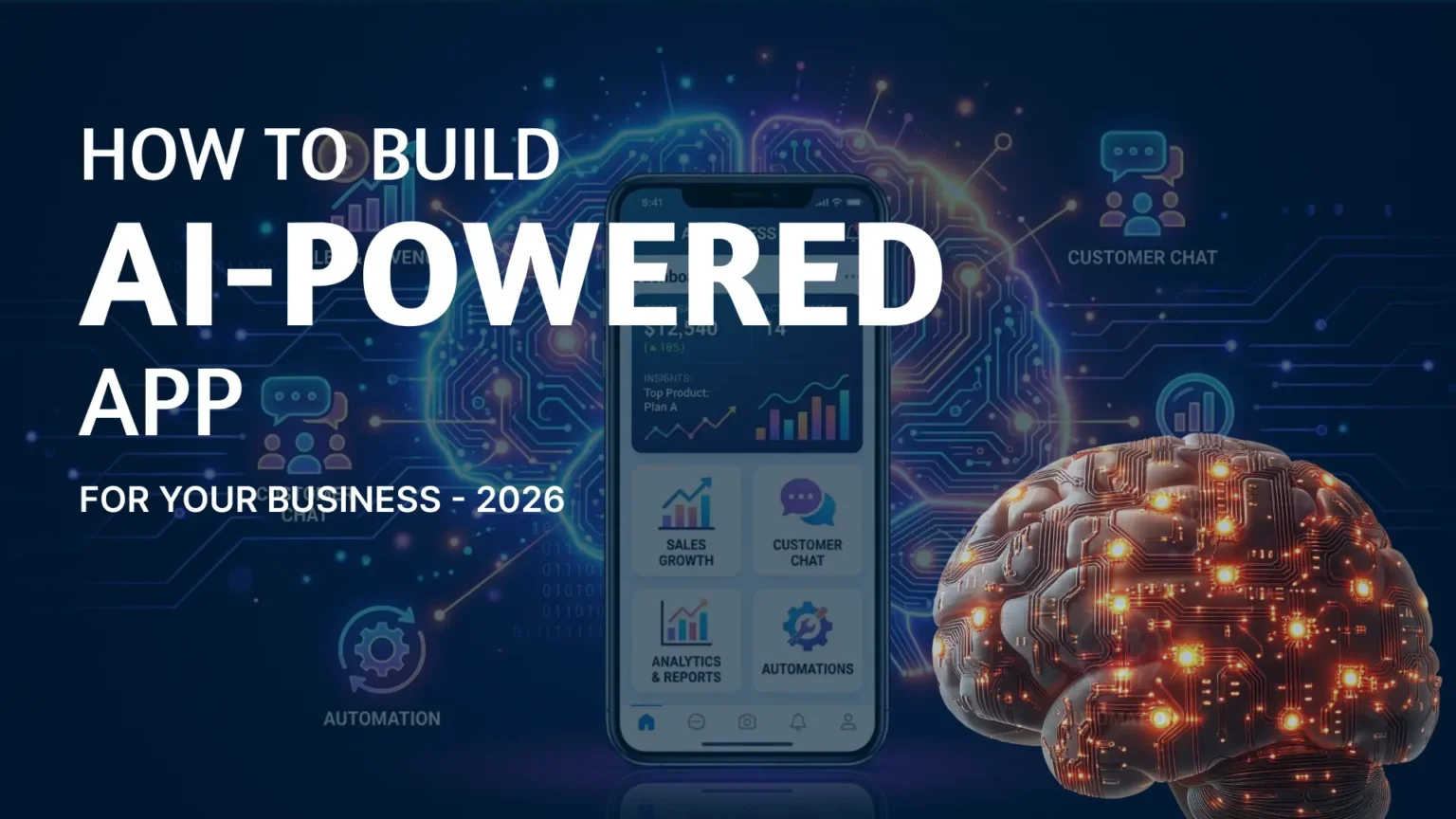
What if you could anticipate customer needs, automate repetitive tasks, and offer custom experiences – all within a single application? This is why AI-driven applications have become a smart investment as opposed to a tech experiment. In 2026, companies of every type and industry are using AI in mobile and web apps to boost efficiency, enrich customer experiences and generate new revenue streams.
The momentum is being supported by real-world use. McKinsey’s 2025 State of AI report shows that 88% of organisations are now using AI in at least one business function and 79% in at least one area, illustrating how quickly AI has gone from a pilot programme to mainstream business operations. Meanwhile, McKinsey’s Global Tech Agenda 2026 survey showed that AI is the preferred business technology investment over cybersecurity and infrastructure modernization, with business leaders voting overwhelmingly for the new priority.
When you’re designing a customer-centric mobile application, an automated workflow, or a smart SaaS solution, it’s important to know how to build the application. In this guide, you’ll discover the steps needed to build an AI-powered application for the year 2026, ranging from idea validation and selecting the right AI technology to estimating the cost of AI app development, determining when to hire an AI app development company to realize your vision, and choosing the best AI application development services.
What Is an AI-Powered App?
An AI-powered app learns from data, is context-aware, and can continually refine its user responses. The basic idea behind using Artificial Intelligence (AI) is to allow applications to make decisions like humans, and with Machine Learning (ML) to gain insight into patterns and improve over time. Apps can utilize features such as chatbots and voice assistants through Natural Language Processing (NLP), which enables them to comprehend and create human speech.
Computer Vision is the ability to use images and videos to carry out a range of functions, including facial recognition and quality control. Personalizing experiences and generating new content, such as text, images, and code, with Generative AI. On the other hand, Predictive Analytics can predict trends, customer behavior, or business outcomes based on previous data. When these technologies are combined, they enable users to make more intelligent applications that automate processes, improve user experience, and provide tangible business value in various sectors.
Why Businesses Are Investing in AI Apps
Gone is the time when AI was a competitive advantage, and now it is a business need. Whether it’s a startup or a multinational company, businesses are turning to AI app development services to optimize their processes, provide an intelligent user experience, and explore fresh revenue streams. IBM’s Global AI Adoption Index confirms that enterprises are becoming more prevalent in their adoption of AI into their core business processes, which generally include boosting productivity, cutting expenses, and driving innovation.
Improve Operational Efficiency
AI-powered apps streamline repetitive and time-consuming tasks like data entry, scheduling, reporting, and document processing. This can help you focus on more valuable tasks, eliminate human error, and boost your overall productivity. Custom AI app development also allows businesses to leverage automation in a way that suits their specific business processes, thereby maximizing operational efficiency.
Deliver Smarter Automation
With the advent of modern applications of AI, this isn’t only about automating tasks; it’s also about making intelligent decisions based on real-time data. From answering customer inquiries to spotting fraud, AI provides businesses with a faster and more efficient way of operation than traditional software. Its capabilities include optimizing inventory, managing workflows, and so much more.
Enhance Customer Experience
Today’s customers expect instant, personalized, and always-available support. These technologies, powered by artificial intelligence, empower businesses to offer round-the-clock support, speed up response times, and deliver smooth digital experiences, boosting customer satisfaction and loyalty.
Personalize Every Interaction
AI can help to understand consumer behavior, preferences, and purchasing patterns to provide relevant recommendations, personalized offers, and content. This customization can enhance customer relationships, boost engagement and conversions, and make the business more successful.
Drive Revenue Growth
AI’s impact extends beyond cost reduction to generating new revenue opportunities. From improving sales forecasting and optimizing pricing strategies to identifying cross-selling opportunities, intelligent applications help businesses make data-driven decisions that directly impact profitability.
Gain a competitive advantage.
Early adoption of AI equips businesses with a competitive edge to innovate, adapt to market shifts, and fulfill customers’ changing needs. By collaborating with a seasoned AI application development firm, businesses can develop scalable AI applications that distinguish themselves in the market, hasten digital transformation, and deliver enduring value.
Benefits of AI App Development
The impact of AI on business transformation is undeniable. Rather than focusing on routine operations, AI-driven applications analyse data, adapt to user behaviour, and continually strive to improve their performance. Today, AI stands out as one of the most impactful business technologies, with organizations adopting it to enhance operational efficiency, customer experience, and drive innovation.
Intelligent Automation
AI can handle repetitive tasks like data entry, document processing, and workflow management, saving time and preventing human error. This enables teams to allocate resources to more value-added work and boost productivity.
Predictive Analytics
AI can forecast customer demands, detect trends, and uncover potential risks by analyzing past and current information. These learnings enable businesses to make informed decisions rather than ones based on guesswork.
AI Chatbots
AI chatbots offer real-time, around-the-clock customer support, answer questions, screen leads, and tackle frequent problems. It reduces response time and customer service costs.
Recommendation Engines
Whether it’s eCommerce or streaming platforms, AI provides tailored product, content, and service recommendations based on user behavior. According to McKinsey, good personalization can result in 5-15% Revenue growth and enhance marketing efficiency.
Fraud Detection
Real-time monitoring of transactions and user activities via AI to identify suspicious activity. Fintech firms, banks, and other industries leverage AI to enhance their security measures and minimize financial damages.AI is being employed to bolster security protocols and limit financial losses in industries like banking and fintech.
Data-Driven Insights
In today’s businesses, there is a lot of data generated on a daily basis. AI transforms this data into actionable insights, enabling leaders to grasp their customers’ behavior, streamline operations, and identify new growth opportunities.
Workflow Optimization
By leveraging custom AI app development, businesses can automate time-consuming internal processes such as approvals, resource allocation, inventory, and other repetitive tasks, leading to quicker and more effective workflows.
Personalized Customer Experiences
AI’s predictive capabilities are used to provide personalized product suggestions, incentives, and engagement based on customer browsing behavior and purchase history. This helps to make their digital journeys more interesting and enhance customer satisfaction and loyalty.
Professional AI app development services can help organizations create intelligent apps that automate processes, enhance decision-making, and provide personalized experiences, thereby positively impacting their business. An AI application development company with experience will help ensure these AI solutions are scalable, secure, and aligned with long-term business goals.
Types of AI-Powered Apps
| AI-Powered App Type | Common AI Features | Business Benefits | Industry Insight |
| AI Chatbots | NLP, Generative AI, Sentiment Analysis | 24/7 customer support, lead qualification, lower support costs | Gartner predicts conversational AI will become a primary customer service channel for many organizations over the next few years. |
| Healthcare Apps | Computer Vision, Predictive Analytics, NLP | Diagnostics, remote monitoring, personalized treatment | AI is increasingly used in medical imaging, patient triage, and clinical decision support. |
| FinTech Apps | Fraud Detection, Risk Scoring, Predictive Analytics | Fraud prevention, credit assessment, and personalized banking | Financial institutions continue expanding AI investment to strengthen security and improve customer experiences. |
| Retail & E-commerce Apps | Recommendation Engines, Demand Forecasting | Higher conversions, personalized shopping, inventory optimization | McKinsey reports that personalization can drive 5–15% revenue growth for retailers. |
| OTT Platforms | Recommendation Systems, Content Intelligence | Improved engagement and viewer retention | Personalized recommendations are a key driver of watch time on streaming platforms. |
| Education Apps | Adaptive Learning, AI Tutors, NLP | Personalized learning and automated assessments | AI is helping create more individualized learning experiences for students. |
| Logistics Apps | Route Optimization, Demand Forecasting | Faster deliveries and reduced operational costs | AI improves fleet utilization and supply chain efficiency. |
| CRM & ERP Solutions | Predictive Analytics, Workflow Automation | Better sales forecasting and process automation | AI-powered CRM tools help businesses identify high-value leads and automate repetitive tasks. |
| HR & Recruitment Apps | Resume Screening, Candidate Matching | Faster hiring and improved talent acquisition | AI can reduce manual screening time while supporting data-driven recruitment. |
| Travel Apps | AI Assistants, Dynamic Pricing, Recommendation Engines | Personalized itineraries and smarter booking experiences | AI enhances customer support, pricing strategies, and travel recommendations. |
Step-by-Step AI App Development Process
Creating an artificial intelligence-enabled application isn’t simply about incorporating AI into the application, but it’s about solving real business problems using the right strategy. With proper development stages, you can minimize risks, optimize AI app development costs, and ensure your AI solution is scalable, secure, and valuable for your business.
Step 1: Define Your Business Goals
All successful AI initiatives have a definitive aim. Define the problem that you want to solve, your target users, and how AI can enhance their experience. From creating measurable KPIs in the initial stage to setting clear goals, having measurable KPIs throughout the project ensures it stays on track.
Pro Tip: Do not tackle all business challenges at the same time; choose one high-impact business challenge to begin.
Step 2: Conduct Market & Competitor Research
Don’t build your app without doing research on your industry, studying your competitors, and knowing what customers are looking for. Identify feature gaps, pain points, and new trends in AI that could set your product apart from the competition rather than blending in as another application available on the market.
Conduct research on the following:
- Market demand
- Customer pain points
- Competitor strengths
- Untapped opportunities
Step 3: Determine the Appropriate AI Applications
Not all features require Artificial Intelligence. Identify the areas in which AI can make the greatest difference in the business and enhance the user experience.
| Business Goal | AI Capability |
| 24/7 Customer Support | AI Chatbots |
| Fraud Prevention | Machine Learning |
| Sales Forecasting | Predictive Analytics |
| Personalized Shopping | Recommendation Engine |
Step 4: Prioritize Features
Do not build all the features at once; build an MVP with the basic features. Having a limited set of features lowers development time, enables faster validation of your idea, and reduces the initial cost for the development of your AI app.
Must-Have Features
- AI-powered core functionality
- Secure user authentication
- Dashboard & analytics
- Notifications
- Data management
Future Enhancements
- Voice AI
- AI Agents
- Workflow automation
- Third-party integrations
Step 5: Design an Intuitive UI/UX
If users aren’t able to interact with the AI, even the cleverest AI will fail. Create a simple and intuitive design that ensures the user will understand the AI capabilities, instills confidence, and provides a smooth experience on both web and mobile.
Best Practice: Great AI should make decisions easier, not harder.
Step 6: Select the Appropriate Tech Stack
Choosing the right technologies is utterly essential for developing a secure, scalable, and efficient application. An experienced AI application development company can ensure that your technology stack can grow with you.
| Component | Recommended Technologies |
| Frontend | Flutter, React Native |
| Backend | Python, Node.js |
| AI Framework | TensorFlow, PyTorch |
| Cloud | AWS, Microsoft Azure, Google Cloud |
Step 7: Create a Minimum Viable Product (MVP)
Start with the basic features, rather than waiting for a “perfect product”. An MVP is a great way to test ideas, gather real-world feedback from users, and make improvements to your application before putting in the effort of building a complex AI application.
Step 8: Integrate AI Models
Select AI models for your business needs: whether using pre-trained models, large language models (LLMs), or custom-created AI solutions. The key is striking a balance between accuracy, scalability, performance, and cost.
Step 9: Test for Performance & Security
Prior to launching, thoroughly test your application to guarantee the right outcomes, quick reaction times, and strong security while shielding delicate client data.
AI Accuracy, Performance, Security, Scalability, and Compliance.
Step 10: Deploy, Monitor & Improve
Once your app is up and running, the hard work isn’t over. Regularly check user feedback, AI performance, and business metrics to help fine-tune your solution over time. Those who commit to continuous improvement of their AI applications reap greater benefits and optimize the use of AI app development services.
Must-Have Features of an AI App
The success of an AI-powered app is not based on the AI; it is based on how the features are being used to solve real user problems. The right set of features is essential for making any application easier to use, more engaging, and providing a better ROI for both the user and the business. When considering AI app development services, it’s important to focus on features that will positively impact the user experience and contribute to long-term scalability.
| Feature | Why It Matters |
| AI Chatbot | Provides 24/7 customer support, answers queries, leads qualification, and resolves common issues with Natural Language Processing (NLP). With this experience, an advanced AI chatbot app development company can create chatbots that learn and evolve over time, recognizing context. |
| Voice Assistant | Supports voice control, making your application more accessible and convenient for various industries such as healthcare, retail, and travel. |
| AI Search | Beyond keyword matching, it recognizes user intent, provides quicker, wiser and more relevant search results and enhances user satisfaction. |
| Recommendation Engine | Analyzes the behaviour and preferences of users and provides them with recommendations for the products, content, or services they are interested in, which boosts engagement and conversions. |
| Personalization | Personalizes content, offers, user journeys according to individual preferences, browsing history and behavior. The personalization that works can drive up revenue by 5% to 15%, and boost customer satisfaction, McKinsey says. |
| Smart Push Notifications | AI selects the appropriate message, target audience, and timing for delivering personalised messages, ensuring they are engaging but not overwhelming to users. |
| Analytics Dashboard | Delivers live customer insights, application performance metrics, business KPIs and allows for data-driven decisions and constant product enhancement. |
| Secure Authentication | Protects sensitive user data with secure login methods such as multi-factor authentication (MFA), biometric authentication, and AI-powered fraud detection. Security is particularly important for enterprise, healthcare, and fintech applications. |
| Payment Integration | Facilitates trusted gateways for secure and seamless digital payments, as well as subscription and one-time purchases and in-app transactions. |
| Admin Dashboard | Enables administrators to get complete control over users, content, analytics, AI performance and system configurations from one single place. |
| Cloud Synchronization | Ensures data is always synchronized in real time across devices, providing a seamless user experience and scalability with reliable backups. |
| Multi-language Support | Increases reach of applications to translate and provide localized experiences with AI, allowing businesses to target more audiences. |
Best Technology Stack for AI App Development
The selection of the right tech stack is one of the most crucial decisions made while developing an AI-powered application. The perfect stack will need to be scalable, secure, performant, and be easily integrated with AI, but also maintainable in the long-term. It is important that businesses consider technologies for their projects based on their requirements, user base, and growth plans rather than on prevailing trends in the industry when choosing the technology for custom AI app development.
| Technology Layer | Recommended Technologies | Why It Matters |
| Frontend | Flutter, React Native | Enables fast, responsive, and cross-platform app development with a consistent user experience across Android and iOS. |
| Backend | Node.js, Java, .NET | Powers business logic, APIs, authentication, and data processing while ensuring high performance and scalability. |
| AI Frameworks | TensorFlow, PyTorch | Industry-leading frameworks for developing, training, and deploying machine learning and deep learning models. |
| LLM Integration | OpenAI, Anthropic, Google Gemini | Adds advanced conversational AI, content generation, summarization, coding assistance, and intelligent automation using large language models (LLMs). |
| AI Orchestration | LangChain, LlamaIndex | Simplifies AI workflows by connecting LLMs with enterprise data, external tools, APIs, and Retrieval-Augmented Generation (RAG) pipelines. |
| Database | PostgreSQL, MongoDB | Stores structured and unstructured application data securely while supporting high-speed queries and reliable performance. |
| Vector Database | Pinecone, Weaviate, Milvus | Enables semantic search, AI memory, document retrieval, and RAG by storing and searching vector embeddings efficiently. |
| Cloud Platform | AWS, Microsoft Azure, Google Cloud | Provides scalable infrastructure, AI services, GPU resources, storage, monitoring, and enterprise-grade security for modern AI applications. |
AI expert tip: No one technology fits all for an AI project. Your business objectives, the complexity of your application, anticipated visitors, compliance regulations, and finances all influence the best choice. By collaborating with a trusted AI app development firm, you can ensure that you’re using the right technology stack for the future, balancing performance, scalability, and AI app development cost to foster
AI App Development Cost in 2026
The most frequent query that businesses ask is, “How much will it cost to create an AI-powered application?” The answer will vary depending on the complexity of your app, its AI features, integrations, security needs, and infrastructure. Although each project is unique, the following table offers realistic estimates for businesses that invest in AI app development services or custom AI app development.
Estimated AI App Development Cost
| App Type | Best For | Timeline | Estimated Cost (USD) |
| AI MVP | Startups & Idea Validation | 2–4 Months | $20,000–$40,000 |
| Mid-Level AI App | SMBs & Growing Businesses | 4–7 Months | $40,000–$90,000 |
| Enterprise AI Platform | Large Enterprises | 8–12+ Months | $100,000–$300,000+ |
What are the drivers of the end cost of the AI app development process?
In addition to the app category, there are a number of factors that can have a huge impact on the cost of artificial intelligence-powered app development:
Features & Functionality
The more features you add, the more work you have to put in; AI chatbots, recommendation engines, voice assistants, analytics dashboards, or payment integration are just a few of them.
AI Complexity
In the real world, the cost of using pre-trained AI APIs tends to be more economical than creating bespoke machine-learning models or optimizing large language models (LLMs).
Third-Party Integrations
If you’re integrating CRM, ERP, payment gateways, cloud storage, or any external API, it’s going to take additional time to develop and test.
Development Team
The more people involved in AI, mobile, UI/UX, QA, and DevOps, the faster the product will get to the market, but also the more it will cost.
Security & Compliance
Compliance with suitable security and testing standards, such as HIPAA, GDPR, PCI DSS, or SOC 2, may be required for certain industries, such as healthcare and fintech, introducing extra security and testing requirements.
Infrastructure & AI Usage
Some of these factors, such as cloud hosting, GPU resources, vector databases, AI model usage, and continuous monitoring, add to the long-term costs.
Expert Insight
While the construction costs are a big part of many businesses, others don’t consider the continuous process of optimizing models, setting up cloud infrastructure, updating security, and monitoring performance. Having an experienced AI app company to work with can help strike a balance between innovation, scalability, and cost-efficiency.
Common Challenges in AI App Development
Creating a successful application with AI is not about picking the right technology; it’s about planning how to navigate through potential pitfalls that can affect not only the performance but also the cost and user confidence in the application.
Data Quality
When the data is poor or incomplete, it can result in incorrect predictions from AI. Good, well-architected data is vital to good results.
Privacy & Security
Security features such as encryption, secure authentication, and compliance with data privacy standards like GDPR and HIPAA are essential for AI applications that manage sensitive data.
AI Hallucinations and Model Bias
Both inaccurate answers from Generative AI and an imbalanced dataset can result in unfair responses. Accurate testing and human checks help ensure accuracy.
Scalability & Infrastructure Costs
Cloud infrastructure, costs of GPUs, and AI model inference all escalate as users grow. The optimized architecture will help to manage the long-term cost of AI app development.
Regulatory Compliance
There are several essential factors for businesses to consider when investing in developing custom AI apps, and compliance, security, and governance are certainly among them. The IBM Cost of a Data Breach Report 2024 indicates that the average cost of a data breach worldwide is $4.88 million, underscoring the need for businesses to collaborate with proven AI application development services to create secure and scalable AI applications.
Best Practices for Successful AI App Development
Developing a successful, scalable, trusted AI application is not simply a matter of selecting appropriate tools; it is a matter of applying best practices in the development of AI applications that will ensure long-term success. You can follow these best practices to help maximize your ROI, whether you’re investing in custom AI app development or collaborating with an experienced AI app development company.
Start with a Clear Business Use Case
Prioritize addressing a specific business challenge before expanding AI capabilities. When you have a clear objective, you can develop the app faster, build it at a lower AI app development cost, and measure the results.
Develop AI capabilities on Quality Data.
The success of any AI application rests on the shoulders of accurate and diverse data and well-structured data. Good data makes good models and minimises error.
Design for Scalability from Day One
Opt for an architecture that allows for scalability with both the number of users and the amount of AI processing required, while still accommodating future feature additions without strain.
Continuously Monitor AI Performance
Monitor progress of high-level metrics like accuracy, response time, user feedback, and model performance. You can catch problems early and maintain consistent performance from your AI with regular monitoring.
Keep Humans in the Loop
In sectors such as healthcare, finance, and legal, leverage AI suggestions to boost precision, transparency, and trust through collaboration with human expertise for critical choices.
Continuously Improve Your AI Models
AI is not a static solution; it’s a process. Periodically retrain models, update data sets, and/or fine-tune algorithms to ensure they match evolving user activity, market trends, and business needs.
AI is not a static initiative but a continuous journey to improvement, a fact that the most successful businesses understand. By leveraging high-quality data, ongoing optimization, and the appropriate AI app development services, intelligent applications can be built that continue to be secure, scalable, and competitive over time.
Industries Using AI Apps
The role of AI in revolutionizing industries, from streamlining operations to enhancing decision-making and providing personalized customer experiences. AI is transforming industries and is a central part of digital transformation, as 78% of companies use it in at least one business process, McKinsey reports.
- Healthcare: Clinical decision support, Medical Imaging, Remote patient monitoring, Virtual Health Assistants.
- Financial: Fraud detection, risk assessment, algorithmic trading, and AI customer service.
- Manufacturing: Predictive maintenance, quality inspection, and smart factory automation.
- Logistics: Route optimization, fleet management, warehouse automation, and supply chain forecasting.
- Education: AI tutors and adaptive learning platforms, automatic assessments.
- Real Estate: Property valuation, virtual tours, and intelligent property recommendations.
- Insurance: Automated claims processing, fraud detection, and risk analysis.
- Media & OTT: AI-assisted content recommendations, audience analysis, and customized streaming.
- Travel: Smart booking assistants, flexible pricing, itinerary planning, and multilingual customer support.
With the growing adoption of AI, companies can now invest in AI app development services and custom AI app development to develop scalable, industry-specific AI applications that promote efficiency, strengthen customer interaction, and provide sustainable competitive advantages. Eager to leverage the power of AI, businesses are increasingly turning to AI app development services and custom AI app development to build scalable, industry-specific AI applications that enhance efficiency, improve customer engagement, and offer long-term competitive benefits.
AI Trends Shaping App Development in 2026
AI is getting so much bigger than just chatbots and automations. AI solutions that are more autonomous, context-aware, and provide genuine business results are attracting businesses’ attention in 2026. In this way, organizations can ensure they are gaining value from their investment in AI app development services and developing future-ready applications by staying ahead of these trends.
Top AI trends to keep an eye on in 2026.
- AI Agents – AI agents can plan, make decisions, and follow through with multi-step tasks with only minimal human involvement, enhancing productivity all across business operations.
- Multimodal AI – Modern AI models can analyze and interpret text, images, audio, and video all at once, providing more engaging and intuitive user experiences.
- On-Device AI – Deploying AI models to smartphones and edge devices shortens the latency, boosts privacy, and decreases reliance on cloud processing.
- Edge AI – Bringing data closer to the point of creation allows for real-time decision-making and is best suited to the IoT, manufacturing, healthcare, and autonomous systems.
- AI Copilots – AI copilots are revolutionizing workplaces, helping employees with coding, content creation, customer support, data analysis, and daily business tasks.
- Voice AI – Next-generation voice assistants can comprehend natural speech, multiple languages, and user intent, making digital experiences more accessible and hands-free.
- Autonomous Workflows – Companies are increasingly leveraging AI to create end-to-end workflows, including approvals, customer onboarding, document processing, and supply chain management.
- Responsible AI – With the increasing adoption of AI, trustworthy AI applications and compliance with regulations are reinforced by factors of fairness, transparency, data privacy, security, and governance.
- Industry-Specific AI Solutions – Companies are investing in AI app development for their industry instead of just generic AI tools, such as healthcare, finance, retail, manufacturing, logistics, etc.
Why Choose Infowind Technologies?
Creating an effective AI-based New Mobile App isn’t only technical; it’s about having a strategic technology partner to create it. Infowind Technologies is an expert in developing tailor-made AI applications, assisting businesses in converting their innovative concepts into secure, scalable, and effective digital solutions. Whether you’re looking for AI-driven mobile apps, cross-platform tools, enterprise-grade software, offshore software development, user-friendly UI/UX, or cloud-seamless integration, our team has got you covered, offering the complete solutions needed for your business objectives. We employ an agile development process to deliver your app faster, with clear collaboration and ongoing enhancements – and backed by robust post-launch support for keeping your app relevant in the future.
Looking to make your AI app concept a reality? Book a free consultation today to share your vision, explore the appropriate AI strategy, and create an intelligent solution to help you achieve long-term business growth.
Conclusion
Creating a successful AI-based app requires having a clear business goal, leveraging the appropriate technology stack, and a clear development plan. From identifying high-impact AI use cases to selecting scalable infrastructure and ensuring continuous optimization, every step plays a crucial role in long-term success. From MVP development to enterprise solutions, collaborating with an AI app development company like Zelos can help mitigate the risks, optimize AI app development costs, and fast-track the time to market. The right expertise translates innovative ideas into intelligent applications that can be measured in terms of business value.