How to Hire Mobile App Developers in 2027
A great idea is the starting point for a great mobile app, but the key to turning that idea into a great product is people. The right developers don’t just code; they also shape your app’s functionality, user experience, security, scalability, and long-term business value. From building a new start-up application to updating an existing business tool, having a clear understanding of how to hire mobile app developers is the key to a successful app development process or a costly failure.
But hiring the right talent isn’t necessarily easy. Choosing technical expertise, examining the differences between hiring models, accounting for budgets, and determining the value of seasoned staff versus developers who make lofty promises can all be a challenge for businesses. The wrong team can result in a missed deadline, unexpected costs, and an app that doesn’t live up to user expectations.
This guide breaks down the hiring process step-by-step and in a practical way. You’ll be able to specify your requirements, understand the difference between freelancers and full-time employees, assess technical abilities, evaluate portfolios and cost to hire mobile app developers, and avoid common hiring pitfalls. Finally, you’ll have a better plan to hire mobile app developers confidently and make informed decisions that align with your business objectives.
Before You Hire Mobile App Developers: What to Define First
It is important to do some planning before you hire mobile app developers for your project to ensure you know what you want to build, why it is important and how many resources you can dedicate to it. Having a clear preparation makes it easy to attract the right candidates, fairly compare offers, and prevent costly miscommunications during development.
1. Define Your App Scope, Business Goals, and Key Features
Identify the problem your app will solve and who will use your app. Developing an e-commerce website, an application for on-demand services, or a SaaS product? Identify your target user, main business goals, and your users’ most important features.
Pick out the key points and the ones that can wait. For instance, the online shopping application can have a user registration form, a product listing system, and payment options and order tracking, and then loyalty programs can be added in a later release.
Pro tip: Make a Minimum Viable Product (MVP) roadmap to prioritise key functionality and test your concept before committing to complex functionality.
2. Choose Between Native and Cross-Platform Development
The type of technology you choose will affect your development, performance and maintenance.
| Approach | Best suited for |
| Native iOS (Swift) | iPhone-specific features and platform-focused experiences |
| Native Android (Kotlin | Android-focused apps and device-specific functionality |
| React Native or Flutter | Apps targeting both platforms with a shared codebase |
Having more control over the platform is powerful with native development, and cross-platform frameworks limit duplicated development work. Depending on the complexity of your app, performance needs, and plans, you will need to choose the right one
3. Make a realistic budget and time plan
Plan your budget according to the complexity of the features, developer experience, design, testing, integrations, and maintenance. Set up goals for discovery, design, development, testing and launch.
Have a contingency plan for when you need additional things, and set up a plan for deliverables before coding. A well-drawn budget and timeline can help you assess proposals and select mobile app developers for hire that can achieve your vision in a timely and cost-effective manner.
Where to Find the Top Mobile App Developers in 2027
Decide how you want to work with the mobile app developers before hiring. The hiring model will impact your development costs, communication, project control and competencies you will have throughout development. The choice of option depends on your budget, complexity of your project, time frame and support needs.
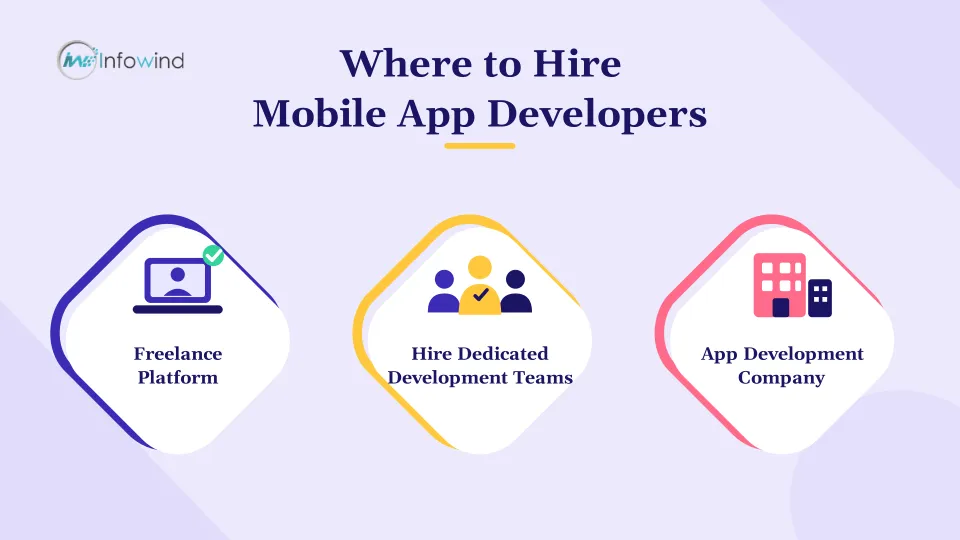
1. In-House Developers: Full Control vs. Higher Overhead Costs
Having in-house developers will allow you to have direct control over the development priorities, workflows, and team collaboration. They get to know your business, product vision and processes, which is ideal for companies that are still developing.
But the formation of an in-house crew isn’t all about paying the bills. The costs of recruitment, employee benefits, equipment, training and retention further contribute to the total cost. In addition to that, it may be necessary to hire individual professionals to work on UI/UX design, quality assurance, and backend development.
Ideal for: Established businesses, companies that rely on technology, and organisations that need constant product development and team supervision.
2. Freelance Developers: Flexibility vs. Management and Quality Risks
Freelancers can be hired on a flexible basis when you require a specific skill that you don’t want to have to hire a permanent employee for. Specialists can be engaged on a project-by-project basis, or for periods of time to assist with additional development when necessary.
The difficulty is that you might have to work with other professionals, track progress and check the code yourself. Availability can also be an issue, and using a single freelancer can cause continuity problems when the freelancer is unavailable. These concerns are minimised by having clear contracts, milestone payments and documented deliverables.
Ideal for: Companies with specific requirements, limited budgets, or specialised expertise for distinct tasks, startups testing an MVP, and businesses with a smaller budget.
3. Mobile App Development Agency: Expertise and Scalability
A mobile application development company can offer access to a dedicated team of developers, designers, testers, and project managers. Rather than having to deal with each specialist individually, you’re able to work with a team that can complete various sections of development, from planning and design to deployment and maintenance.
One advantage that agencies might have is that they can adapt more readily to changing project needs or when they need new skills. But the price is dependent on the team size, engagement model and geographic location. Before signing a contract, assess their portfolios, communication skills, technical expertise and post-launch support.
Ideal for: Companies with no technical staff, businesses developing more complex applications, or organisations looking for end-to-end development support.
Which Hiring Model Should You Choose?
| Your requirement | Recommended model |
| Long-term, in-house product ownership | In-house developers |
| Short-term tasks or specialised expertise | Freelancers |
| End-to-end delivery and flexible team capacity | Development agency |
The final word: select a model that’s appropriate for the quantity of operations you can manage, rather than your first budget. Awareness of these compromises is a crucial part of any mobile application developer recruiting process, and it enables you to assemble a team that is capable of delivering both timely and scalable solutions.
Step-by-Step Process: How to Find, Choose, and Hire Mobile App Developers
Once candidates have been identified, the hiring process is only half over. You must have a process that assesses technical skills, real-world experience, communication and accountability to hire app developers who can deliver a dependable product. Taking these steps will ensure that you can make more objective comparisons among candidates, mitigate hiring risk and hire professionals who are a good fit for your project.
1. Where to Source Top Mobile App Developers
As a first step, seek out developers whose past projects and abilities are easy to track down. The size and scope of your project, technology stack, budget, and hiring model should all play a role in your sourcing strategy.
- Upwork and Toptal are freelance sites that will help you locate independent developers who have varying levels of experience and expertise.
- Professional networks: LinkedIn will give you a way to see work histories, recommendations, and professional contacts.
- Developer communities: Go to GitHub and Stack Overflow to find out how you can contribute to open-source projects, discuss your technical passions, and solve problems.
- Development agencies: If you’re looking for a coordinated team, research agency websites; technology specialisations and published case studies will help you find development agencies.
If you’re a business in the U.S., check to see if candidates have overlapping shifts with your employees. When considering global projects, consider not only location, but also time zone, language and communication proficiency.
2. Evaluate Portfolios, Past Work, and Client Testimonials
Having a polished portfolio is a great place to start, but it does not necessarily mean a developer can complete your project. Review past apps for functionality, usability, performance and relevance to industry.
Have candidates describe what they did specifically in each project. Did they build the whole of the application or many features? What technical problems did they overcome and how did they do it?
When possible, check live apps in the Apple App Store or Google Play, examine relevant sources and ask for references from past clients.
Don’t rely on screenshots alone: The ideal candidate will describe technical decisions and trade-offs, methods of testing, and lessons from the process, rather than just present appealing interfaces.
3. Conduct Technical Interviews and Skill Assessment Tests
After narrowing down the list, you will evaluate the technical skills and determine if they are a good fit for your app. While a résumé may show experience, a practical assessment will tell you how the candidates are tackling real development problems.
Do your evaluation based on skills that align with your selected tech stack:
- Technical fundamentals: Evaluate proficiency in Swift, Kotlin, Flutter, React Native or other technologies as needed.
- Architecture and scalability: Inquire about their approach to structuring the app, handling data, and accommodating future expansion.
- API integration and security: Discuss their experience with integrating back-end services, authentication, and security.
- Testing and debugging: Inquire about how they find bugs, improve performance and make sure the software works on all computers.
- Practical problem-solving: Give a practical problem that needs to be solved, e.g. slow loading or network connection is unreliable.
While lengthy coding tests may be acceptable, a short, project-specific assignment and/or a walkthrough of an existing code sample would also suffice. Appraise the candidate’s reasoning and coding and explain technical trade-offs.
Please refer to Apple’s App Review Guidelines or Google’s Android app quality guidelines for other quality standards.
4. Evaluate Soft Skills, Communication, and Culture Fit
Having the technical expertise is not enough to ensure a successful development partnership. The developers should also be aware of the business goals, should be able to convey the risks involved, and should be able to work with the stakeholders.
In an interview, ask the following questions:
- What would you do if your requirements change partway through development?
- What was a technical issue you had, and how did you solve it?
- How do you provide updates on delays, obstacles, or unforeseen expenses?
- How do you monitor progress? (Tools and processes)
Check for candidates who can clearly communicate difficult matters, have thoughtful questions, accept constructive feedback, and admit limitations rather than making promises that they cannot keep.
Set guidelines for communication (meetings, written communication, documents, response time) in the case of distributed teams. Effective developer communication can prevent miscommunication from becoming a costly issue.
Finalise the Contract Before Development Begins
Before choosing, record the project scope, outcomes, stepping stones, payment conditions, ownership of the source code, confidentiality conditions and post-launch support plans. Explain the changes that can be made to the scope and who will publish the app that is changed.
The lesson learned: It is a combination of verified skills, problem-solving, communication and contract transparency which is the best hiring decision. This systematic approach will help you select app developers who can provide you with a good product and create a productive long-term working relationship.
Common Mistakes to Avoid When Hiring Mobile App Developers
The wrong development team can be a costly learning curve for a brilliant app concept. A lot of missed deadlines, less stable features, security problems, and unforeseen maintenance expenses may be a result of choices made prior to the start of development. If you are aware of these common pitfalls, you’ll be in a better position to hire mobile app developers for your project with complete confidence and prevent a loss of your investment in the long run.
1. Prioritising Low Cost Over Code Quality and Experience
For starters, it might appear to be the cost-effective way to manage costs, particularly for startups. But when prices are lower than usual, it could mean that the company has not had enough experience, has not fully understood the project or hasn’t performed adequate testing.
Badly designed code can make it hard to keep up with future changes, and insufficient testing can mean that bugs end up in the hands of users. Switching developers halfway through development can also add to the recruitment, hiring, and rework expenses.
How to prevent it: Do not only compare prices; compare technical expertise, projects in their portfolios, testing processes, and communication, particularly with regard to the clear project deliverables. Before starting work, solicit candidates’ estimates and ask them to note any risks they see.
2. Neglecting Post-Launch Support, Maintenance, and Scalability
The initial launch of an app is not the end of the development process. Operating systems evolve, dependencies need to be updated, security challenges arise, and user needs shift. A well-functioning app in an initial test could fall apart as traffic and data volumes grow.
Businesses can end up building technical debt, avoidable downtime or otherwise progress without significant improvements if they don’t have a maintenance plan in place.
How to prevent it: Ensure that post-launch support is discussed prior to signing the contract. Explain what is being covered when there is a bug fix, how long it takes to respond to a bug fix, how much a bug fix will cost, what security updates will be provided, how performance will be monitored, and what plans are in place for future feature development. Make sure it is designed to scale realistically without added complexity.
3. Failing to Secure Intellectual Property Rights and NDAs
Your application might have valuable source code, original designs, intellectual property workflows, business information, or proprietary plans for your products. If it is assumed that payment automatically implies transfer of all relevant IP rights, that can lead to ownership problems in the future.
There’s a difference between confidentiality agreements and intellectual property provisions. Typically, an NDA covers confidential information; a development agreement should definitely define the ownership and use of project deliverables.
Steps to prevent it: Get a lawyer to check your contract, especially if you are recruiting abroad. Define ownership/licensing of source code, designs, documentation and deliverables. Discuss third-party libraries, open source licensing, pre-existing developer tools and repository access and credentials transfer.
4. Failure to communicate and missing project milestones
Clear requirements and timely decisions are essential for even best-of-breed developers to produce a successful workforce. If you don’t make updates, minor misunderstandings can escalate to major scope changes, delays and budget bloat.
To prevent it: Develop a communication plan including communication channels, frequency of updates, decision makers, and escalation plans. Break down the project into tangible steps—for instance, design clearance, prototype development, development of the core features, testing, and preparation for launch. Establish criteria for each milestone and track against criteria.
Protect Your Project Before You Sign
A good hiring process is more than technical and first cost. Before development, assess long-term support, define ownership rights and agree upon measurable deliverables. These precautions lessen unnecessary risks and establish a more solid basis for a successful mobile application.
Conclusion
The initial step to hire dedicated mobile app developers is to identify your business objectives, select an engagement model, establish a reasonable budget and filter potential developers based on portfolios, technical skills, and communication. Make sure you understand what milestones are required for the project, who owns the intellectual property rights, who maintains the project and what the needs are for future scalability before signing a contract.
Keep in mind that creating a successful app isn’t just about locating skilled coders; it’s about working together with experts who grasp your vision and can evolve alongside your business. Focus on transparency, technical knowledge and working together to save money in the short term.
Looking to build your mobile app?
For those seeking to employ mobile app developers, Infowind Technologies might be the next option to investigate development options that align with the company’s needs. Talk about your app concept, establish your goals, and assess the impact of the right development team in making your vision a reality.