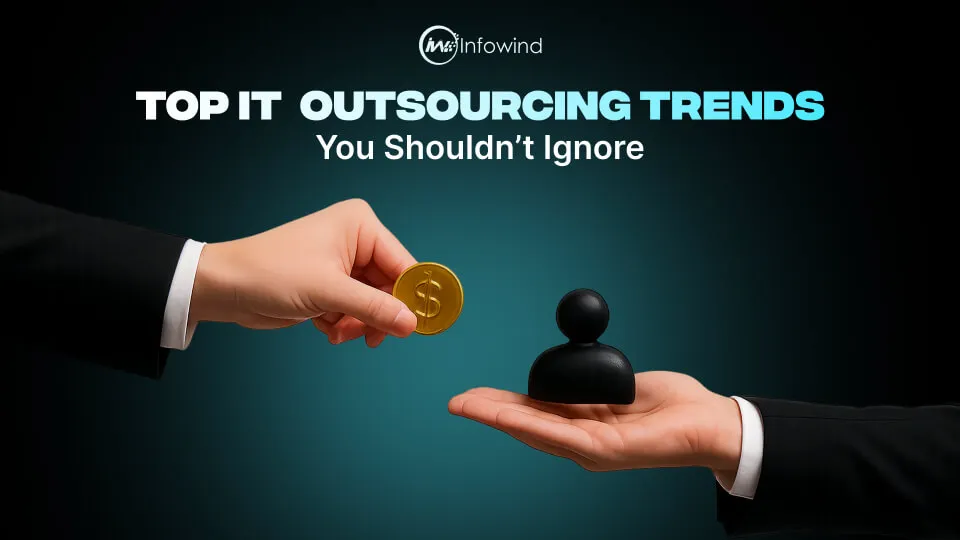
By 2026, IT outsourcing will involve not only contracting external technical agencies but also a clever means to gain access to cutting-edge capabilities, save money, and remain competitive in the rapidly evolving digital environment. Outsourcing is increasing to over 70% of firms today with at least one of their IT functions, and this figure keeps growing with the complexity of technology. It is important to keep abreast of the current IT outsourcing trends since new tools, client demands, and changes in global economies are transforming the manner in which businesses handle technology.
This blog seeks to discuss the best IT outsourcing trends in 2026, according to actual industry developments, changing customer behaviour, and significant macroeconomic dynamics. On coming to know these trends, businesses will be in a better position to make smarter decisions and future-proof themselves.
Generative AI and Automation Will Redefine Development Outsourcing
Generative AI is changing the way companies need to outsource software development and making the whole process a lot faster, smarter, and cost-efficient. Co-pilots, code generators, and auto-documentation tools based on AI are becoming an everyday occurrence in outsourced teams in 2026. Such tools as GitHub Copilot and ChatGPT-4o can assist developers in writing cleaner code, fix bugs in real time, and automatically create documentation. This implies that projects transitioning from idea to implementation are implemented at a faster pace.
Consequently, the functions of developers are changing. With outsourced developers, rather than spending hours on repetitive jobs, it is now possible to do high-value jobs like architecture, problem-solving, and innovation. This also alters the model of outsourcing costs– the companies are capable of producing more at a reduced workforce, and this does not compromise the cost of building the product.
In 2026, selecting vendors with the knowledge and active implementation of Artificial Intelligence solutions workflows is the key to executing business plans, which involve outsourcing. Find partners that code, test, and document AI. These suppliers will provide more timely delivery, enhanced precision, and scalability in the long run, which will provide your business with a legitimate competitive advantage in the rapidly changing IT outsourcing market.
Rise of Nearshoring Over Offshoring
As the companies are changing their offshoring into nearshoring in 2026, there is a shift to technological teams that are closer in terms of culture and time zone as well. This is being changed by the fact that business organisations have come to appreciate quicker communication, less burdensome collaboration, and fewer project delays. Workers with the same working hours and cultural norms work well, and even in a situation where there is a misunderstanding among the team members, the situation flows smoothly.
In 2026, Latin America becomes a popular nearshoring destination to US-based companies, Eastern Europe to Western Europe, and the Tier-2 Indian cities such as Kochi, Jaipur, and Chandigarh grow as popular nearshoring destinations. These areas boast of good technological skills, affordable rates, and good command of the English language, which makes them perfect considerations for the far-off outsourcing centres.
Also Read: 5 Ways To Successfully Outsource Software Projects In India
Risk mitigation is another major cause of this trend. The companies are seeking outsourcing partners who are stable and whose operations can be estimated after years of international conflicts, interruptions in supply chains, and economic uncertainty. Nearshoring can also offer this balance by being cost-effective as well as more secure and closer cooperation.
Nearshoring is an emerging strategic option for businesses looking to plan their outsourcing strategy, giving the company a combination of proximity, talent, and resiliency amid the unpredictable global market.
Cybersecurity-First Outsourcing Partnerships
By 2026, cybersecurity will no longer be an IT issue, but a priority in business. As cyberattacks have increased over the last several years by over 30 per cent every year, businesses are much more careful about who they hand their data and systems over to. Consequently, the new trend is outsourcing partnerships that focus on cybersecurity on a first basis. Companies are no longer basing their assessment of vendors on their technical expertise or pricing system, but on their security practices strength.
The standards of modern outsourcing relations are compliance-first and zero-trust models. This is to say that vendors have to authenticate all users, devices, and access requests, however small. Such certifications as SOC 2, ISO/IEC 27001, GDPR compliance, and strict data-handling policies are no longer a nice-to-have but an absolute must to even secure a spot on the vendor lists.
Enterprises are also doing due diligence to a greater extent before any contract is signed. This involves the review of incident-response strategies, penetration-testing results, staff background verification, and secure coding. There are numerous vendors today offering documented security that is more structured, and clients can risk assess in advance.
The theme of increasing bundled action in SecOps is big in 2026. Businesses would rather pay outsourcing partners to take care of all three development, monitoring, detecting threats, and compliance management rather than employing different teams to handle this. This single platform minimises vulnerabilities, enhances the response time, and maintains the security of the running projects.
The current business that outsources IT should select a vendor with effective cybersecurity; not only is it a wise decision, but it is also a durable survival and reputation.

Outcome-Based Outsourcing Models
More companies in 2026 are abandoning the old forms of billing (hourly or project-based) and opting to rely on outcome-based forms of outsourcing. Companies do not pay for time anymore, but they pay for results, which can be in the form of having reached a certain milestone, performance output, or a well-defined business outcome. This change establishes a closer fit between outsourcing partners and client objectives, particularly in the cases of operating with KPIs, ROI objectives, and agile delivery models.
Outcome-based contracts also make vendors remain lean, innovative, and value-driven, as opposed to working hard. Clients have superior visibility of progress, predictable expenses, and improved faster. It is also advantageous to vendors because they are able to demonstrate skill and develop a long relationship founded on trust and quantifiable success.
One of the biggest facilitators of this trend is the application of smart contracts on blockchain. These computerised deals only payout after the conditions or milestones have been achieved. They improve transparency, decrease conflict, and make both parties adhere to the agreed-upon performance indicators. The technology is gaining popularity in offshore engagements on a large scale, where transparency and responsibility are of utmost importance.
Case Study: A multinational SaaS firm is a recent client that has switched its hourly-based billing model and begun an outcome-based offshore service to maintain its product. Payments pegged on feature releases, bug-fix cycles, and uptime performance enabled the company to cut on unnecessary rework and save 25% of annual outsourcing expenses, but this did not affect quality.
Outcome-based outsourcing is being shaped as the model of choice for scalable, predictable, and value-driven IT collaborations in businesses in 2026 as companies focus on efficiency and business clarity.
Also Read: Staff Augmentation VS Outsourcing: Which Is Better? Unlimited Guide
Talent Cloud Ecosystems Are Going Mainstream
Talent cloud ecosystems are changing the way businesses develop and operate technological teams in the future (2026). Rather than engaging one outsourcing firm, companies are now accessing on-demand, cloud-based talent solutions such as Turing, Upwork Enterprise, and Toptal to acquire talent around the globe. Such platforms provide pre-vetted developers, designers, testers, and data specialists capable of coming into a project within days, which traditional outsourcing models can frequently fail to achieve.
This movement is minimising the risks of dependence on the vendors and providing companies with much greater agility. Multi-vendor setups provide businesses with the ability to rapidly scale teams up and down, import niche skills on demand, and eliminate bottlenecks in the talent shortage process. This ability is particularly useful in rapidly expanding companies that require a quick assist without the need to sign a long-term agreement or have a complicated onboarding process.
One of the key developments in 2026 is the emergence of blended workforce designs, where full-time workers (FTEs) working internally within an organisation co-exist with freelance workers and outsourced expertise as a single work process. This hybrid model enables businesses to have stability and flexibility in one format and develop teams that are quicker, more creative, and adaptable to meet fluctuating priorities.
Such cloud talent ecosystems also enhance the project outcomes through providing transparency, integrated performance tracking, timezone compatibility, and AI-driven skill mapping. Companies acquire the best talent when they need them, and employees access high-quality international opportunities.
With the dynamic nature of IT outsourcing, the idea of talent cloud ecosystems is nowadays becoming a common trend, as they assist businesses in maintaining competitiveness, lowering costs, and creating future-proof teams faster and more flexibly than ever before.
Specialised Tech Outsourcing Is In Demand
By the year 2026, businesses will not be content with any general IT outsourcing, but rather, they will demand domain-specific technology vendors. With the increasingly regulated and data-driven sectors, firms will seek vendors of outsourcing who know their particular industry, be it AI/ML, medtech, fintech compliance, cybersecurity, or industrial automation. This change is necessitated by the desire to have more expertise, an increase in speed, and a reduction in mistakes in highly technical or regulated settings.
Clients desire partners that not only write code but also learn about the specifics of their industry, workflow, and compliance regulations. As an example, healthcare startups developing AI-based diagnostic instruments are not only outsourcing the creation but also AI compliance services, which ensure that their algorithms are compliant with a high standard, such as HIPAA, FDA regulations, and global patient safety standards. Partnering with experts in web development services ensures secure, high-performance digital platforms built for growth. Such a degree of specialisation assists companies in the reduction of risk and time-to-market.
Strategic benefits also come with strategic outsourcing. Such vendors are better placed to provide solutions based on deep vertical knowledge and predict the trends in the industry, and eliminate traps that an otherwise generalist firm may fail to do. They will be able to more easily incorporate innovative technologies due to the knowledge of their usage, the behaviour of customers, and the environment of compliance.
Hint: In selecting an outsourcing partner in 2026, do not only consider broad service providers. Rather, consider niche sellers who specialise in the industry/technology that you need. The partners can be counted on to add genuine value via area savvy, exact execution, and customised advancement, which aids the company to remain competitive in a technology-driven world that keeps evolving at a high rate.
With specialisation becoming inevitable, the outsourcing experience of companies that engage the services of skilled vendors will be smarter, faster, and reliable.
ESG & Ethical Outsourcing Becoming Boardroom Topics
In 2026, ESG (Environmental, Social, and Governance) ceases to be a reporting requirement but becomes a key consideration in the process of companies selecting their outsourcing partners. With corporate responsibility being a new priority in the worldwide context, nowadays, companies demand that their suppliers of technology operate in a way that is ethical, sustainable, and socially responsible. This changes after the customer expectations, investor pressure, regulatory changes, and an increasing need to see a transparent and responsible operation.
Outsourcing Corporate Responsibility
The current outsourcing plans are changing to embrace sustainable operations, data centres that use less energy, and low-carbon footprints. Firms are increasingly aware of the environmental effects of their technology supply chain. Boards now ask:
- What is the consumption of our vendor?
- Is the use of renewable resources?
- Do they embrace waste-reduction measures?
Social Responsibility: Equitable Pay and DEI
Vendors are also being evaluated by businesses on:
- Fair employee wages
- Safe working environments
- Equity, inclusion, and diversity at work.
- Professionalism and fair employment.
This will prevent companies from running the risk of being tarnished and will seem to involve the outsourced employees fairly and professionally.
Buyer Preference with Regard to “Green” Vendors
By 2026, buyers will increasingly choose IT partners that put more emphasis on sustainability and ethics. It has a great impact on the choice of vendors because green IT practices, carbon-neutral operations, and socially responsible policies will make an impact. Ethical outsourcing has ceased to be a choice; it is now a competitive edge.
Rise of ESG Rating Platforms
There are new forums that are coming up to rank vendors of IT according to ESG performance that would provide buyers with a clear picture of sustainability, compliance, and ethical operations. These tools ease the burden of companies when comparing vendors on grounds other than cost and technical talent.
Ethical outsourcing and sustainable outsourcing are defining the future of global IT alliances as ESG is being introduced on a boardroom agenda. Companies that prefer conscientious suppliers do not just build a strong brand, but create stability, confidence, and durable worth.
Integrated Product & DevOps Teams from Vendors
By 2026, businesses will not just outsource developers anymore; they will also engage in vendor partnerships where they hire vendors to offer fully functional product teams. These teams consist of project managers, the UX experts, QA testers, DevOps engineers, and data specialists; however, all of them are also one coordinated squad. This is a holistic approach that provides companies with end-to-end product development without having to create large company teams.
Faster Time to Market
Cross-functional teams facilitate easier co-operation, faster decision-making, and improved product delivery. When data work is done simultaneously with DevOps and engineering, it will reveal:
- Faster deployment cycles
- Higher code quality
- Fewer communication gaps
- Continuous innovation
This arrangement enables businesses to roll out features and products at a significantly quicker pace and still have a high degree of engineering discipline.
5 Questions to Ask when Vetting a Vendor
In gauging a vendor of integrated product teams, one might ask:
- Do you have PMs, QAs, DevOps, and UX talent on your squads?
- What are your interdisciplinary communication strategies?
- Which frameworks of delivery do you adhere to (Agile, Scrum, CI/CD)?
- What do you do to make sure that there is smooth integration with internal teams?
- What are some of the case studies of successful team integration?
When selecting a vendor providing end-to-end, cross-functional groups, companies are able to have pace, innovation, and long-term scalability – mobile app development, integrating product and DevOps teams are among the most effective IT outsourcing trends of 2026.

Also Read: The Role of DevOps in Modern Software Development
Vendor Consolidation & Strategic Partnerships
Corporations are shifting towards fewer, more strategic and deep outsourcing relationships in 2026, abandoning the management of dozens of outsourcing partners. The necessity to have better control, enhanced collaboration, and achieve more efficiency in a rapidly changing digital environment drives this trend. Rather than maintaining a number of relationships, companies are now opting to have one or two partners whom they have confidence in to undertake end-to-end delivery consistently and responsibly.
Reasons Consolidation of Vendors is on the Rise
Larger and more competent service providers are being formed by mergers or acquisitions of many smaller outsourcing companies. This M&A activity is helping vendors strengthen their expertise, enhance infrastructure, and deliver integrated services under one roof.
To the clients, the advantages are obvious:
- Ease of management of costs using simplified contracts.
- Integrated working and tooling to facilitate operations.
- Stability in the quality of all projects.
- Greater conformity to long-term business objectives.
The consolidation of vendors enhances simplicity and makes the model of outsourcing more predictable and scalable.
Real-World Example
Recently, a mid-sized fintech firm has contracted four various vendors, all managing various functions, different activities such as development, QA, support, and DevOps as a single strategic partner. The result? It has resulted in a faster delivery cycle and a 20 per cent decrease in the costs of operation, and enhanced communication among all the teams.
The stronger collaboration with a smaller number of vendors allows the businesses to be reliable, efficient, and have a consistent tech approach. Consolidation of vendors is emerging as a force in 2026 to enhance innovation and value-driven outsourcing partnerships.
AI-Driven Vendor Selection & Management Platforms
By 2026, vendor selection and management of AI-driven vendors will have made the process of selecting the right outsourcing partner smarter and faster. These systems apply machine learning to find a business and a pre-vetted provider a match in terms of skills, expertise in the industry, project size, budget, and previous performance. Companies do not have to take weeks to do a manual search on vendors; today, AI can help shortlist the most suitable partners in a matter of minutes.
Artificial Intelligence to Make Vendor Decisions Better
The modern platforms also track real-time vendors’ performance by analysing:
- Delivery speed
- Developer productivity
- Communication quality
- There are patterns of compliance and violation of the SLA.
- Project risk indicators
This provides businesses with a clear data-driven perspective of the performance of a vendor – way before it goes wrong.
Popular Platforms in 2026
The leading platforms that involve AI and automation in selecting vendors are:
- Clutch – This is an AI-based filtering and recommended client reviews.
- G2 – Intelligence and technology capability mapping.
- Accelerance AI – Matching Automated outsourcing partners.
- Talent Clouds – Skill-based AI matching by on-demand positions.
The sites assist the firms in not gambling and selecting partners whose previous projects have been successful.
Pro Tip for 2026
Introduce AI-based sourcing technology into your outsourcing plan. They eliminate risk, enhance the alignment of the vendor, and make sure that you engage in partnership with the teams that fit your objectives and culture.
With AI reshaping the process of selecting and managing the vendor, businesses are becoming more transparent, have even more precise performance monitoring, and have more viable outsourcing results, which, in turn, places AI-based platforms as an indelible part of the IT world in 2026.
Conclusion
IT outsourcing is evolving rapidly in the future with trends such as AI-led development, nearshoring, integrated teams, ESG focus, and results-based models transforming the way business is conducted. This is the right moment for decision-makers to re-examine their outsourcing strategy and tailor it to these new changes. Assess your suppliers, revamp your models, and make sure that your approach helps you to grow quickly, be innovative, and long-term between Q2 2026.
Infowind Technology can assist you if you are willing to upscale your roadmap of outsourcing. Get in touch with us today to get professional advice or download our free outsourcing checklist to begin with.