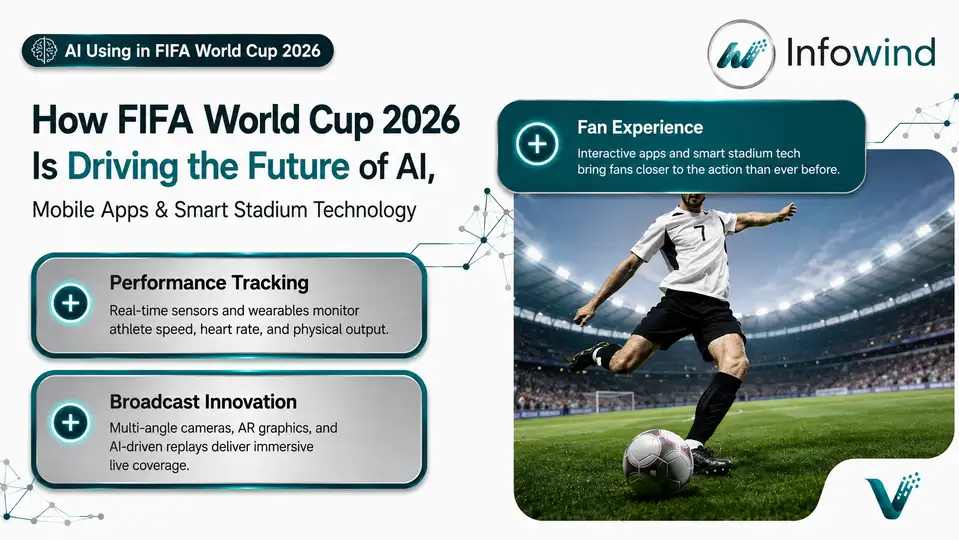
FIFA World Cup 2026 will not just be the largest football tournament in the world, but will also be one of the most technologically advanced sporting events in history. FIFA is using this technology across the USA, Canada, and Mexico to reinvent the way teams play and how fans watch the game, all through the power of AI in football, data analytics, connected infrastructure, and smart stadium technology. The global sports analytics software market is projected to reach more than $4.75 billion by 2030 from $2.29 billion in 2025, indicating how data-driven decision-making plays a growing role in the sports industry.
Technology is transforming all aspects of football, from AI-driven officiating to real-time player insights and immersive fan experiences with the help of cloud computing in sports. The shift opens up fresh avenues for sports app development, bespoke software solutions, and scalable digital solutions offered by a seasoned AI agent development company or mobile app development company. With the tournament just around the corner, knowing about these innovations gives insight into the future of sports technology worldwide.
Why FIFA World Cup 2026 Is More Than Just Football
The FIFA World Cup 2026 is more than a football match; it’s a global stage that showcases the power of technology to shape the future of sports. The tournament, which is the first World Cup to run on an unprecedented scale, with four countries (the United States, Canada and Mexico) and 48 teams, will demand much more advanced digital infrastructure to manage millions of fans, thousands of stakeholders and huge amounts of real-time data.
This tournament stands out for the increasing influence of AI in football, stadium connectivity, cloud-based solutions, and intelligent fan experiences. Technology will be the backbone of every matchday experience, from analysing games with Artificial Intelligence to tracking player performance to intelligent security and fan engagement solutions.
Why FIFA World Cup 2026 Matters Beyond the Pitch
Smarter Fan Experiences
The mobile app will provide real-time updates, content tailored to the user, ticketing, navigation and multilingual support for fans from around the globe.
Data-Driven Team Performance
Advanced sports analytics software will enable the teams to more accurately analyse the players’ fitness, tactical patterns, injury risk and opponent strategies.
Next-Generation Smart Stadiums
New smart stadium technology will improve crowd management, security monitoring, paying without cash and in-stadium connectivity.
Cloud-Powered Global Operations
Cloud computing in sports will allow for scalable, secure, and real-time data processing, making it easier for teams to manage and make decisions with accurate information.
A New Opportunity for Sports Innovation
The tournament underscores the rising need for businesses to develop sports app products and AI-driven platforms, as well as for sports organisations to create customised digital solutions. With technology increasingly playing a crucial role in the competitive landscape of sports, collaborating with an AI development company, mobile app development company, or custom insurance software solutions will be vital for providing the connected experiences that today’s sports fans and organisations anticipate.
FIFA World Cup 2026 is not only the blueprint for the future of football, but it’s also the blueprint for the future of sports technology.
AI in Match Analysis: Turning Football Data Into Winning Decisions
The FIFA World Cup 2026 technology ecosystem will demonstrate the use of AI in football, moving the match analysis process from the poki-game to a real-time decision-making tool.
Coaches and analysts are no longer solely making manual observations today. During a match, AI systems can analyse thousands of data points, such as player positions, passing manoeuvres, player speed, ball movement, defence shapes, and formation changes. This enables teams to pinpoint their strengths, weaknesses, and opportunities a lot quicker than normal analysis techniques.
How AI Is Changing Match Analysis
- Real-Time Tactical Insights
AI can identify trends in gameplay and offer tactical insights during a match.
- Player Performance Monitoring
The advanced tracking systems will monitor movement, workload, and fitness metrics and support coaches in optimising performance and minimising the risk of injury.
- Opponent Strategy Analysis
Historical and live data can be utilised to help teams analyse the attacking play of opponents, their pressing play, and how they change their formation.
- Faster Decision-Making
Analysts will no longer have to spend hours reviewing footage, as AI can provide them with instant reports and actionable insights.
Traditional Analysis vs AI-Powered Analysis
| Match Analysis Factor | Traditional Approach | AI-Powered Approach |
| Data Processing | Manual and time-consuming | Automated and real-time |
| Tactical Insights | Limited by human observation | Pattern-based predictive insights |
| Performance Tracking | Basic statistics | Advanced player and team analytics |
| Injury Risk Detection | Reactive monitoring | Predictive risk assessment |
| Decision Speed | Hours or days | Minutes or live during matches |
Why It Matters for the FIFA World Cup 2026?
The number of teams, matches, and competitions will increase, and AI-based analysis will be a key competitive edge. The advancement of sports analytics software, cloud-based solutions, and smart data systems is a testament to the transformation of modern football through technology. These innovations highlight the power of data to yield tangible results on and off the pitch, for organisations investing in sports app development or collaborating with an AI development company.
Smart Stadiums powered by IoT: The Connected Fan Experience
With the FIFA World Cup 2026 set to host millions of fans in several host countries, smart stadium technology will be vital in bringing safer, quicker, and more personalised experiences. The Internet of Things (IoT) is at the core of this revolution: IoT refers to the network of interconnected devices, sensors, cameras, and systems that gather and transmit data in real-time.
The smart stadiums are designed to react rationally to the movement of the crowd, their operational requirements, and their preferences. This will help event organisers streamline their processes and give a smooth matchday experience to their guests.
How IoT is changing how stadiums function
Smart Crowd Management
These “crowd meters” may help to understand the capacity of the area, identify congestion areas and guide fans to less crowded entrances and exits or concession areas.
Personalised Fan Experiences
Mobile platforms integrate real-time navigation, digital ticketing, seat guidance, live match updates and personalised notifications.
Improved Security and Safety
The technology of AI cameras and IoT devices can help identify unusual behaviour, enhance surveillance, and facilitate rapid response in the event of an emergency.
Efficient Stadium Operations
Smart lighting, energy management solutions, and connected infrastructure contribute to cost savings and sustainability.
Key Benefits of Smart Stadium Technology
| Feature | Fan Benefit | Stadium Benefit |
| Smart Ticketing | Faster entry | Reduced queues |
| Real-Time Navigation | Easier movement | Better crowd flow |
| Connected Security Systems | Safer environment | Improved monitoring |
| Smart Energy Management | Comfortable experience | Lower operating costs |
| Mobile App Integration | Personalized engagement | Higher fan satisfaction |
Why This Transformation Is Essential for FIFA World Cup 2026
The FIFA World Cup 2026 is set to see an unprecedented number of spectators worldwide, requiring all host cities to manage the stadiums with high efficiency and the use of technology. The importance of connected stadium ecosystems is here. With the support of cloud computing, real-time data processing, and IoT technologies, stadiums will be able to manage aspects like crowd flow, security, and operations with increased precision and speed.
The increasing trend of sports app development is also improving the user experience of fans at stadiums and arenas, providing virtual ticketing, navigation, and custom experiences. Meanwhile, businesses that are developing custom software or partnering with a mobile app development companies are creating scalable solutions that bring together fan engagement, business processes and analytics in one digital environment.
These advancements collectively demonstrate the evolution of smart stadiums into a new world of fully connected technology that is changing the way global sporting events are lived and managed.
Mobile Apps Enhancing Fan Engagement: Bringing the World Cup to Every Fan’s Fingertips
The FIFA World Cup 2026 experience will start long before the first match begins, and persist long after the last whistle. Mobile technology is the motivator for this connected trip. With changing fan preferences, mobile apps have emerged as the digital bridge to a more immersive, personal, and interactive football experience.
Today’s fans are not satisfied with just match scores. They desire to have access to content at their fingertips; they want instant updates; they want exclusive insights, and they want experiences that are personalised to their interests. It’s here that modern sports app development is changing the way people around the world enjoy football.
What Modern Football Fans Expect
Fans want to see all of this in one place on one platform, instead of having to visit an assortment of platforms:
- Real-time match stats and live commentary.
- Customise notifications for favourite teams and players
- Digital ticket management and stadium access.
- Interactive polls, predictions and fan challenges
- Automatic translation into all required languages
- Behind-the-scenes content and highlights just for you.
How Mobile Apps Will Elevate FIFA World Cup 2026
| Fan Need | Mobile App Experience |
| Instant Match Updates | Live scores, lineups, and match events |
| Personalized Content | AI-driven recommendations based on user preferences |
| Seamless Stadium Visits | Mobile ticketing, navigation, and venue information |
| Social Interaction | Fan communities, polls, and real-time discussions |
| Enhanced Viewing Experience | Interactive stats, player insights, and match analysis |
The Technology Behind Next-Generation Fan Experiences
AI in football, cloud computing in sports, and scalable digital infrastructure are the three key elements that make these platforms successful. AI enables the delivery of personalised content and recommendations, and cloud technology allows services to be accessed by millions of users without any performance bottlenecks.
This change offers great potential for the development of custom software solutions for sports organisations and stakeholders in the event management sector. When businesses work with a reliable mobile app development company or AI development company, they can create intelligent platforms that not only capture the attention of their fans but also provide valuable insights and create new revenue streams.
Now, with the FIFA World Cup 2026 fast approaching, mobile apps will no longer be a supporting component but will be the main link between the World Cup tournament and the world, bringing every fan closer to the action no matter where in the world they may be.
Cloud Infrastructure Handling Millions of Users: The Digital Backbone of FIFA World Cup 2026
Cloud infrastructure will be a key, unseen power of the FIFA World Cup 2026 technology ecosystem. With millions of fans watching live matches, checking scores, and engaging with digital platforms, the need for seamless matches becomes a huge requirement. That’s where Cloud Computing in sports takes centre stage.
The concept of a modern sports event is no longer confined to stadiums, but is now available on Apps, websites and digital platforms that are accessed by global audiences live. According to industry data, more than 60% of enterprise workloads are now being executed in the cloud, underscoring the critical role of cloud systems in high-traffic settings, where scalability and reliability are paramount.
Cloud Infrastructure is a Game-Changer for FIFA 2026
Cloud systems are created to grow and shrink in an instant as per the demand of the users, whereas traditional servers are fixed and cannot be changed. This flexibility means that during busy times – like a penalty shootout or a final match – no matter what the reason, there is absolutely no lag, crashes or delay of content for the fan.
The seamless integration of AI in football, real-time analytics, and personalised fandom experiences, which demand a massive volume of computing power and constant data flow, is also helped by cloud technology.
Key Advantages of Cloud in Global Sports Events
- High Scalability: Able to scale easily and handle millions of concurrent users at the same time.
- Real-Time Performance: Helps to provide live updates of the match and analytics.Real-Time Performance: Provides instant access to match updates and analytics.
- Global Accessibility: Provides low-latency access from all around the world
- High Reliability: Reduces loss of play in vital moments of the game.
- Secure Data Handling: Ensures that user data, payments, and digital transactions are safeguarded.
Powering the Future of Sports Technology
The cloud is not only about infrastructure, but it’s also about innovation in sports app development, sports analytics software, and immersive fan platforms. It allows AI systems to analyse large data sets, facilitates smart stadium operations, and can power a mobile app that keeps fans connected regardless of their location.
If you’re interested in creating a next-generation sports platform, then working with an AI development company, a mobile app development company, or a custom healthcare software solutions company becomes a necessity. These solutions will not only help scale digital ecosystems but also make them intelligent, secure, and future-proof.
With the FIFA World Cup 2026 here, cloud technology will be well at work, ensuring the world’s biggest sporting event can never become slow, disconnected or interrupted, regardless of the number of millions of fans watching at any given time.
Cybersecurity for Global Sporting Events: Protecting the World’s Biggest Stage
With FIFA World Cup 2026 getting digital, cybersecurity will be equally critical as the technology behind the World Cup. With millions of users who rely on mobile applications, digital tickets, online payments, and live streaming platforms, the security of sensitive data and uninterrupted service is a big priority.
In fact, the cost of a data breach was put at $4.88 million globally, highlighting the financial and reputational threats of cyberattacks, according to the Cost of a Data Breach Report 2024 by IBM. If the system is down for an extended period of time, it could affect millions of people globally.
AI-driven threat detection, encrypted cloud storage, multi-factor authentication, and real-time network monitoring are important tools in the arsenal of modern sports organisations to protect the digital ecosystem. With such security measures, not only is fan data protected, but so is the reliability of sports app development, cloud computing in sports, and connected stadium operations.
In today’s era of businesses investing in custom software development or collaborating with a seasoned AI software development firm, cybersecurity is not just a necessity but an integral part of constructing secure, scalable, and trustworthy sports tech solutions.
Data Analytics for Team Performance: Turning Insights Into Competitive Advantage
Today, it is not only about talent in football; it is about data as well. The technology used at the FIFA World Cup 2026 can only be defined as constantly changing, and sports analytics software is playing a crucial role in turning mountains of data into smarter decisions for teams before, during and after games.
Valuable performance data is created on every sprint, pass, tackle and positional move. This data, coupled with AI in football, can reveal tactical trends, evaluate individual player performance, forecast fatigue, and optimise player development with uncanny accuracy.
How Data Analytics Gives Teams an Edge
- Optimise Player Performance: Monitor physical workload, recovery and fitness to ensure optimal performance throughout the tournament.
- Develop Match Strategies: Understand opponents’ tactics, passing systems, and formation changes to make better plans for the game.
- Lower Risk of Injury: Recognise early signs of tiredness and overexertion to allow timely player management.
- Support Faster Decisions: Convert complex match data into easily understood, actionable information that coaches and staff can use in real time.
The real power of analytics is in converting data into results and strategies. With the aid of cloud computing in sports, teams can analyse and process large amounts of data in real time, ensuring that every team member can access the most relevant information at their fingertips.
With the rising demand for intelligent sports solutions, many organisations are turning to custom software development and collaborating with an AI development partner to create and develop an advanced analytics platform. The innovations are not just transforming the way teams perform but are marking a new era in the future of football beyond the FIFA World Cup 2026.
Business Lessons from FIFA’s Technology: What Enterprises Can Learn from the World’s Biggest Sporting Event
The FIFA World Cup 2026 is not just a football event; it’s a blueprint for the digital transformation. Real-time match updates and a connected stadium are all about a well-integrated technology ecosystem behind the seamless fan experience. Those same innovations that are revolutionising the tournament can be leveraged to increase efficiencies, enrich customer experiences, and make data-driven decisions across business lines.
From startups to enterprise to sports organisations, the message is loud and clear:
The following points should be kept in mind in this regard:
Put AI at the Centre of Decision-Making
While AI can assist teams in understanding player performance and strategy in football, its applications in business extend to streamlining processes, tailoring customer interactions, and making informed decisions.
Convert Data to Actionable Insight
Real-time analytics is no longer an option. By purchasing sports analytics software and intelligent reporting tools, you can make informed decisions that are made faster.
Build on Scalable Cloud Infrastructure
Cloud computing has proven to be a success in the sports industry, and it has become clear that scalable and secure platforms are essential for meeting the increasing demands of users.
Focus on Digital Customer Experiences
The World Cup demonstrates the power of digital platforms to enhance engagement through various features, including mobile ticketing and personalised content. In the same way, companies can get the same effects with sports app development and customer-focused mobile solutions.
The Bigger Opportunity
Innovation for organisations today is key for the digital economy of tomorrow. Engaging with an established AI software development firm, employing custom software development, or collaborating with a trusted mobile app development agency ensures that businesses can develop solutions that are intelligent, scalable, and customer-centric, geared for the future. With an established AI software development firm, custom software development, or a trusted mobile app development agency, businesses can create intelligent, scalable, and customer-centric solutions that are prepared for the future.
In conclusion, FIFA World Cup 2026 demonstrates that technology is more than a facilitator of global events; it is a catalyst for innovation that forward-thinking businesses, if they can, can leverage to maintain their competitive edge.
How Companies Can Adopt Similar AI Solutions: Turning FIFA-Inspired Innovation into Business Growth
The technologies behind FIFA World Cup 2026 aren’t exclusively for football; they provide a realistic blueprint for companies aiming to speed up the digital transformation process. The use of AI-driven insights, cloud-based platforms, and intelligent mobile experiences can be applied across industries to enhance efficiency, engagement, and sustainable growth.
The secret to investing in technology is not only in the investment, but in the solution that meets business needs.
A Business Roadmap to the Practical Way
Start with Data, Not Assumptions
All AI solutions start with quality data. Secure useful information from your business, like interactions with customers, your operational processes, or user activity, and analyse it to find actionable insights.
Embed AI in everyday tasks.
Similarly, the application of AI in football has enabled teams to make more informed decisions. AI can assist businesses in automating repetitive tasks, predicting demand, customising customer experiences, and making better-informed decisions within various departments.
Build on Scalable Cloud Infrastructure
The best performance of AI in sports-style architecture is with the help of cloud computing. Cloud platforms offer flexibility, security, and processing power to handle increasing workloads and real-time analytics.
Create Connected Digital Experiences
From a customer portal to an enterprise platform to an app for sports, optimising your mobile presence and experience is a great way to boost engagement and customer relationships.
Collaborate with Right Technology Experts
The use of AI is not just about selecting the appropriate tools; it’s about implementing AI in the right way. By collaborating with a seasoned AI development company, businesses can leverage its expertise to create intelligent solutions that suit their objectives, and by adopting custom software development, they can ensure that every platform is optimised to meet specific operational requirements. A trusted mobile app development company can further unify AI, analytics, and cloud capabilities into seamless digital experiences.
The simple takeaway from FIFA World Cup 2026 technology is that the organisations that can leverage AI, cloud technology, and data-driven thinking now will be able to lead the way in the future. Businesses that embrace technology but don’t do so in a random fashion will create measurable value in the future.
Why Choose Infowind Technologies?
Intelligent technology is the engine of the future of sports and business – and Infowind Technologies is the organisation to help them stay ahead of the curve. From sports app development and AI-driven platforms to modernising legacy systems and scaling with custom software solutions, we provide options that are optimised for performance, security, and future growth.
We are a trusted AI development company and mobile app development company, with technical expertise and a business-first approach to develop scalable digital products that address real-world challenges. Whether you’re looking for AI integration, cloud-native solutions, advanced analytics, or enterprise-grade software, each option is designed to meet your specific needs and requirements.
If you are eager to explore the innovations of FIFA World Cup 2026, then you should look into Infowind Technologies to help with your business with similar technology. Let’s create digital solutions that are smarter, faster, and future-proof, so that they deliver tangible results and a sustainable competitive edge.
Conclusion
The FIFA World Cup 2026 is not just a football tournament; it’s a transitional moment in the history of how technology is shaping global sporting events. Whether it’s AI in football or sports analytics software, smart stadium technology, mobile platforms, or cloud computing in sports, these innovations are all focused on making better decisions, smoother operations, and more memorable fan experiences.
However, the benefits of such technologies are much wider-reaching than the football pitch. It’s these artificial intelligence-driven insights, scalable cloud capabilities, and connected digital ecosystems that are helping businesses in all industries become more efficient, more engaging, and more growth-oriented. The world of digital transformation is moving at a rapid pace, and companies that are taking the time and steps to implement intelligent technologies now will be positioned for success in the future.
Regardless of whether you are developing a sports app, investing in custom software development, or considering having your business partner develop an app with an AI development company or mobile app development company, you want to make sure that the solutions are scalable, secure, and designed to meet your business objectives.
At Infowind Technologies, we enable businesses to transform groundbreaking concepts into successful digital solutions, leveraging AI, cloud computing, and data. When you’re looking to build smarter applications, streamline operations, or build the next-gen digital experience inspired by the technologies behind the FIFA World Cup 2026, our team is ready to help you take the next step towards sustainable digital growth.