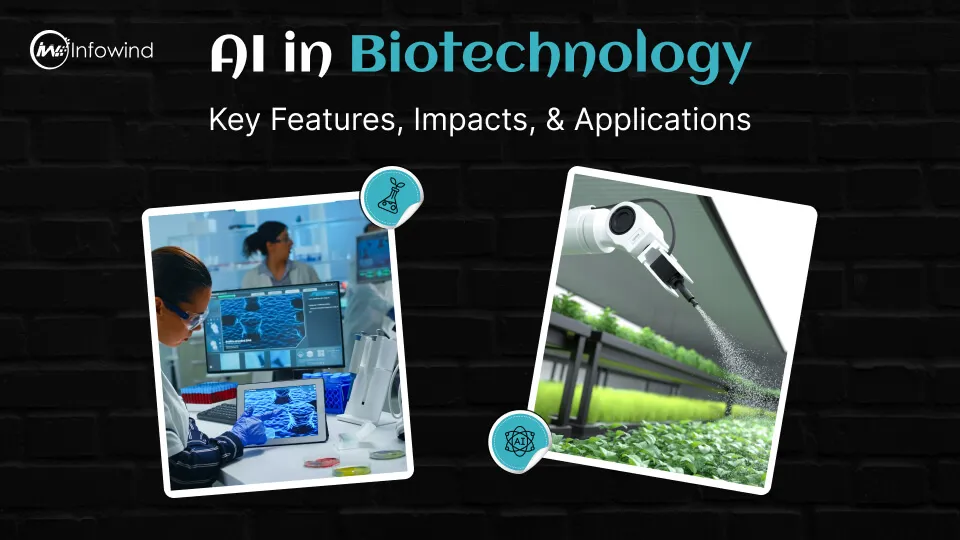
Biotechnology has never been left behind in innovation and has made it possible to break through in fields of healthcare, agriculture, and life sciences. Artificial intelligence in biotechnology is transforming the way more research is done, the process of drug discovery, and the stage of disease diagnostics. With artificial intelligence, scientists can analyse large volumes of biological data more quickly and efficiently than they could previously.
The global market of AI in biotech is forecasted to expand at a compound annual growth rate exceeding 30% according to research in the industry due to improved machine learning in biotech, genomics, and predictive analytics. It emphasises the emergence of artificial intelligence as an important aspect of biotech in order to accelerate drug discovery, refine clinical trials, and enhance individual medicine.
Bioinformatics AI through AI-based diagnostics is becoming a medium to alter the conventional mechanism of biotech into a speedier, data-intensive, and more exact answer- a healthcare and life sciences innovation that will transform how biotech is conducted in the future.
Key Features of AI in Biotechnology
The uptake of AI in biotechnology is quite fast due to a number of potent features that allow for discovering the truth quickly, more precisely, and based on data. The capacities are changing the way scientists are solving intricate biological problems.
Machine Analytics and forecasting
Biotech Machine learning can be used to analyse large volumes and complicated biological data, extract latent features, and make correct predictions. Predictive analytics is highly efficient in saving time and money on research and enhancing outcomes, proven by the possibility to predict the development of a disease, as well as drug-target interactions.
Natural Language Processing (NLP)
NLP assists AI systems in processing and examining great volumes of biomedical text, clinical notes, and study articles. Artificial intelligence in biotech hastens the process of knowledge discovery by deriving meaningful information from unstructured text and can contribute to informed decision-making in research and medical practice.
Computer Vision
In medical imaging and microscopy, computer vision is an important field. Abnormalities in X-rays, MRIs, and pathology slides can be detected with a great degree of precision using AI models, helping to diagnose early and enhance accurate clinical diagnosis.
Automation & Robotics
Through automated laboratory procedures that involve repetitive and high-throughput experiments, as well as eliminating human errors, AI-powered automation and robotics automate labour-intensive laboratory tasks. This enhances efficiency as well as providing uniformity of experiments.
Genomics Analysis: Bioinformatics
To facilitate the analysis of genomic information to an advanced level, bioinformatics AI can be used to aid in DNA sequencing, gene editing, and the prediction of protein structure. These functions support the precise medication and bespoke medicine, and the development of novel medicines.
The combination of these characteristics shows that AI is transforming contemporary biotechnology by making it faster, more precise, and smarter through automation.
Also Read: Best Online Medical Apps to Simplify Healthcare
Applications of AI in Biotechnology
Artificial intelligence is no longer an imaginary projection of the future, but a reality and transformational tool in the sphere of AI in biotechnology. With AI-based tools where breakthroughs can be made in less time, and what is possible in life sciences is increasing, the field of drug discovery to personalised medicine brings forth AI-based tools.
Drug Discovery & Development
Drug discovery and development is one of the applications of AI that has had the largest effect. The conventional approaches of discovering new compounds may require years and billions of dollars. Through machine learning in biotech, biology determines the statistics of success of the compounds by quick analysis of biological and chemical data. Not only does it cut back time and cost, but it will also enhance the quality of candidate molecules, accelerating the preclinical research and clinical trials.
Genetic Research and Personalised Medicine
The field of genomics is being transformed by AI, as it allows one to learn more about the DNA sequences and the expression of genes. Bioinformatics artificial intelligence software assists scientists in comprehending the intricate data on various genomes, and this results in highly specific treatments that are patient-centred. It is the cornerstone of personalised medicine, whereby treatment is tailored to a genetic profile and the projected responses of a person.
Medical Diagnostics and Imaging
AI is more accurate and efficient in diagnostics. Computer vision models can identify delicate patterns in medical images that cannot be seen by the human eye. As an example, AI-based imaging devices are proposed by the activity of Infowind Technologies’ medical imaging AI software development, which triggers the detection of diseases at the earliest and most reliable stage for radiologists, who positively affect the outcomes of patients.
Agricultural Biotechnology
The use of AI is not limited to the human health field, but also goes into agricultural biotechnology. There are more sustainable practices in farming and healthier food security as predictive models are used to examine environmental data in order to create a better crop, predict disease outbreaks, and resource utilisation.
Synthetic Biology and Bioengineering
In synthetic biology, AI drives the decoration of new biological molecules, enzymes, and biological systems. Using AI to simulate results and develop sequences faster, engineers obtain more elaborate engineering processes in organism shape, which can be probed to accomplish progress in materials fields, biofuels, and medicines.
In these applications, therefore, artificial intelligence in biotech is transforming research and innovation. A collaboration with professionals in the field of advanced AI technologies, such as a team that can create a personal AI assistant using open source software, is priceless in achieving the edge in a competitive environment as the organisation adopts AI.
To experiment with the AI-based biotech application to transform your projects, have a look at how Infowind Technologies can use AI to deliver faster intelligent results.

Impacts of AI in Biotechnology
The increased use of AI in biotechnology is producing quantifiable effects in the healthcare sector, research, and the bioeconomy worldwide. Organisations are using improved processing speed, better results, and more effective work when highly developed algorithms are applied to biological data.
Healthcare Improvements
Healthcare is one of the areas that is experiencing one of the greatest effects of artificial intelligence in biotech. AI is created to be quicker and more precise in the process of diagnostics through the art of medical images, patient histories, and genomic data. The insights serve personalised treatment plans that entail individual genetic profiles with better results and fewer trial-and-error practices. Machine learning in biotech is transforming the way of patient care, since its early detection of diseases through machine learning data, to precise medicine.
Research Efficiency
AI is a serious boost to research performance, as it automates data analysis and speeds up the process of conducting experiments. What used to take months can be done in days using bioinformatics AI tools, which will handle and process complex data sets with high accuracy. The patterns may be easily discovered, the hypothesis is tested, and the results may be predicted at a faster pace, so that the researcher can concentrate on the innovation instead of the manual data operations. This change has greatly reduced the development time of biotech research.
Economic Implications
The economic contribution of biotechnology in terms of AI is huge. AI allows allocation of resources to organisations through the reduction of operational costs and minimisation of failed experiments, and enhanced productivity. This not only provides startups with shorter go-to-market strategies, but it also enhances innovation by businesses. Consequently, AI has been embarking on biotechnology as a central area of competitiveness and long-term expansion in the life sciences field.
Ethical & Regulatory Strengths
Even though it has very important advantages, the application of AI in biotech evokes significant ethical and regulatory concerns. Privacy of data, sensitive genetic information safety, and algorithm prejudice are to be handled carefully. Clear models, accountable data governance, and regulation are necessary to help build proper trust and fairness. These issues will be significant to solve to promote the sustainable use of AI technologies in life sciences.
In general, the effects of AI keep on redefining biotechnology with smarter, faster, and more responsible innovation.
Case Studies & Real-World Examples
The potential of AI in biotechnology is truly evident by looking at the tangible projects that have produced an actual outcome. The following are some registered hitches of how artificial intelligence in biotech is spurring forth innovation, bettering results, and changing sectors.
1. DeepMind’s AlphaFold – Protein Structure Prediction
AlphaFold was created by DeepMind and was built on deep learning to be able to predict protein structures extremely well. The breakthrough is greatly used in research in drug design, genomics, and molecular biology since it offers insights that would have taken years to discover. AlphaFold has become highly known as a breakthrough in bioinformatics AI, making it possible to discover and understand biological systems more quickly and comprehensively.
2. IBM Watson to Drug Discovery
The AI platform of IBM Watson examines large volumes of biomedical literature, clinical data, and chemical databases to find potential drug candidates. Machine learning applications in biotech have allowed Watson to assist investigators in eliminating potential compounds and save time and money at the early stages of drug development. Several pharmaceutical firms have cited accelerated pipeline development on the insight of Watson.
3. PathAI-Pathology Diagnostics with AI Enhancement
PathAI uses the best machine learning and computer vision to enhance the study of pathology images. Their algorithms help the pathologists to see the tissues with accurate and efficient detection compared to traditional methods. There is a direct clinical use of AI-coding language codes in medical imaging devices that directly influences patient outcomes and aids accuracy in diagnosis.
4. Insilico Medicine – Generative AI for Molecule Design
The use of generative AI models in Insilico Medicine is to generate new drug molecules whose biological activity is based on optimization. Insilico can save experimental cycles and speed up discoveries because it uses artificial intelligence in the business of biotech and medicinal chemistry. The development of their AI-based methodology has become the way to develop the next generation of drug development.
These case studies show that AI technologies are transforming biotechnology in all areas – protein prediction and drug discovery, diagnostic accuracy, and molecular design. They point out the practical efficacy of AI in biotechnology to stimulate effectiveness, sophisticated understanding, and quicker creativity in research laboratories and business organisations.
Challenges and Limitations
Although AI in biotechnology has a transformative potential, it has various challenges that the organisations need to deal with in order to be sustainable and responsible in innovation. These limitations are critical factors that need to be understood to put artificial intelligence in biotech.
Data Availability and Quality Problems
Large and high-quality datasets play essential roles in the provision of quality results by the AI systems. In biotechnology, biological as well as clinical data are usually disjointed, random, or scarce owing to privacy constraints. The quality of data used in machine learning can significantly affect the results in biotech models and thus give wrong predictions. Furthermore, the labelled genomic or clinical data may be costly and time-intensive to obtain and use in bioinformatics AI.
Ethical Concerns and AI Bias
As a significant issue in AI-based biotech solutions, there are ethical challenges. Training data bias could lead to unjust or incorrect results, especially in the field of healthcare and genetic research. In such a situation, biased algorithms can be used against some of the people when AI in biotechnology is utilised in sensitive fields like diagnostics or personalised medicine. It is highly important to build trust by ensuring a high level of transparency, fairness, and explainability of AI models.
Coexistence with Current Biotech Processes
It is complicated to incorporate AI solutions into the conventional biotech processes. Most companies use old systems, which do not have the capability to support advanced AI tools. Integrating artificial intelligence in biotech with the prevailing laboratory operations, data architectures, and regulatory guidelines will entail technical skills, time, and considerable investments.
Invigilatory and Legal Barriers
Biotechnology is a very sensitive business, and the use of AI will be subject to strict regulations in relation to legal and ethical standards. Rules regarding data security, patient permission, and accountability of algorithms can slow down the adoption of AI. With the continuing evolution of machine learning in biotech, the regulatory structures should keep changing as well so that they can promote innovation while maintaining safety and quality of compliance.
Wise resolution of these challenges will be a significant key to the widespread potential of the AI-oriented biotechnological solutions.
Future Trends of AI in Biotechnology
The future of AI in biotechnology is set to develop fast as technologies evolve and more life sciences are transforming into the realm of integration. Further artificial intelligence development in biotech will serve as the accelerant in research, deliver better healthcare results, and reinvent the process of biologically unearthing knowledge and implementing it in practice.
Artificial Intelligence in Drug Discovery Pipelines
The conventional method of drug discovery is time-consuming and resource-heavy, whereas the use of machine learning in the biotech industry is altering this situation. The next generation AI models will be automated to screen compounds, have smarter predictions of molecular interactions, and will be able to design clinical trials better. With the improvement of predictive analytics, AI-based pipelines will save time and cost by a large margin, allowing researchers to introduce new therapeutics in the market at unprecedented speed.
Use of AI in Gene editing and CRISPR
The technologies of gene editing, like CRISPR, produce enormous amounts of genetic data. The AI-based bioinformatics is becoming crucial to the interpretation of this complexity, target sequences, and off-target effects predictions. The future trends would be characterised by more in-depth AI engagement in making safer, more efficient gene edits, which will allow synthetic biology breakthroughs in customised treatment, research on rare diseases, and drawbacks.
Growth of AI-Supported Diagnostics in New Markets
AI-driven diagnostics is also leaving the high-resource contexts and going to the new markets. Mobile and cloud-based technologies are opening better avenues for providing better models of medical imaging, pathology analysis, and early detection of diseases. The democratisation of biotech artificial intelligence will ensure that healthcare gaps are bridged, to enhance preventive care and provide clinicians with smarter tools.
Humans and Artificial Intelligence in Biotechnology
The future AI systems will not be the human experts and will work together, instead, in the research activities. State-of-the-art AI assistants and decision support systems will enable scientists to test and research frontiers of simulations of biological systems. Such human creativity and AI effectiveness will foster innovation in the field of systems biology, vaccines, and environmental biotech.
With these trends expanding and diversifying, AI in biotechnology is going to be at the heart of the future of life sciences, offering quicker discoveries, more accurate interventions, and expanded access to advanced healthcare solutions.

Conclusion
AI has become a formidable force disrupting the biotechnology field, including hastening drug discovery and developing further genomics, diagnostics, and precision medicine. The recent developments in AI and biotechnology underscore the effectiveness of data-intensive intelligence to develop new endeavours and smarten life sciences in promoting quality health, transform healthcare systems, and expand the possibilities of life sciences. With artificial intelligence in biotech still developing, responsible adoption will be necessary, which includes the quality of data, ethics, and transparency to guarantee a successful and reliable outcome in the long term.
To biotech and bioinformatics researchers, practitioners, and biotech firms, the adoption of unceasing innovation using machine learning in biotech and bioinformatics AI presents empirical worth, competitive edge, and acceleration. This can be facilitated by collaborating with well-established technology providers that will help ease the transition.
If you want to use AI to interact with the real world, biotech, reach out to Infowind Technologies and discuss how our AI-based solutions will be used in your research, healthcare, and biotechnology projects.